Science-backed healthcare is the deliberate use of the best available research evidence, combined with clinical expertise and individual patient values, to guide every medical decision. The formal industry term for this practice is Evidence-Based Medicine (EBM), first systematized at McMaster University in the early 1990s. A related and more rigorous framework, Science-Based Medicine (SBM), adds a filter for scientific plausibility before a treatment even reaches clinical testing. Together, these approaches define what it means to receive care grounded in reality rather than habit, tradition, or marketing. Understanding the difference matters more now than ever, because the volume of health information competing for your attention has never been higher.
What is science-backed healthcare and why does it matter?
Science-backed healthcare is defined as the conscientious integration of three distinct inputs: the best current research evidence, the clinician's accumulated expertise, and the patient's own goals, values, and risk tolerance. No single input overrides the others. A physician who ignores your preferences in favor of a textbook protocol is not practicing EBM. Neither is one who follows your preferences while ignoring the research.
The practical consequence of this definition is significant. It means your doctor should be able to tell you not just what treatment they recommend, but why the evidence supports it and how it fits your specific situation. When that conversation happens, you are receiving science-backed care. When it does not, you are receiving something else, regardless of the credentials on the wall.

This framework also protects against a real and persistent problem: treatments that persist in clinical practice long after the evidence has moved on. Bloodletting survived for centuries on anecdote and authority. Science-backed healthcare replaces both with data. The importance of evidence in medicine is not abstract. It is the mechanism by which medicine improves over time rather than cycling through fashionable theories.
How does the evidence hierarchy work in science-backed healthcare?
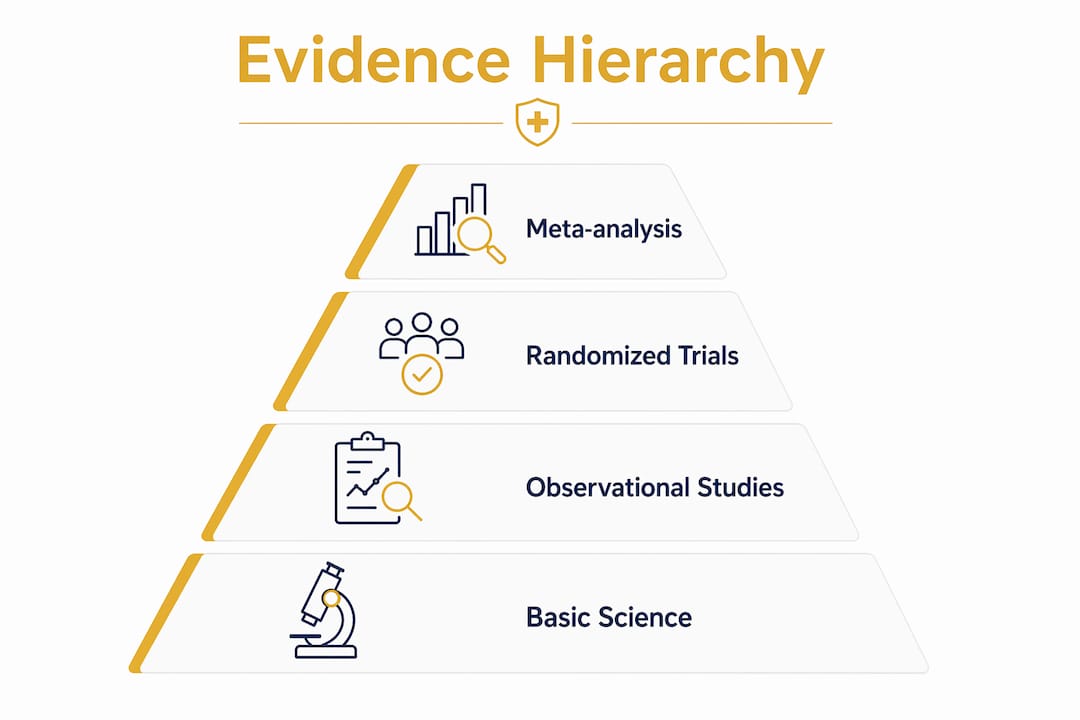
Not all research is created equal. The evidence pyramid ranks study types by their reliability, with meta-analyses and systematic reviews at the top and expert opinion or anecdotal case reports at the bottom. Understanding this hierarchy lets you evaluate health claims with the same tools a trained clinician uses.
| Research type | Reliability level | What it tells you |
|---|---|---|
| Meta-analysis and systematic review | Highest | Synthesizes all available studies on a question |
| Randomized controlled trial (RCT) | High | Tests one intervention against a control group |
| Cohort and case-control study | Moderate | Observes outcomes in defined populations |
| Expert opinion and case reports | Lowest | Reflects individual experience, not population data |
The pyramid matters because a single study, even a well-designed one, is rarely definitive. Clinicians assess the full body of evidence to determine whether a treatment effect is real, not just statistically significant in one trial. This is why a headline announcing a "breakthrough" based on one small study should always prompt skepticism rather than action.
Basic science, meaning laboratory and animal research, sits at the foundation of the pyramid. It generates hypotheses and biological plausibility, but it does not confirm that a treatment works in humans at a therapeutic dose. Many compounds that perform brilliantly in a petri dish fail in human trials. Science-backed healthcare requires moving up the pyramid before drawing clinical conclusions.
Pro Tip: When evaluating any health claim, ask which level of the evidence pyramid it comes from. A treatment backed only by lab studies or expert opinion deserves far more scrutiny than one supported by multiple RCTs or a systematic review.
What process do clinicians follow to apply evidence-based care?
Applying science-backed healthcare in practice follows a structured sequence. The MSD Manual describes this multi-step process as the mechanism that ensures care is adapted to individual needs rather than applied as a generic protocol.
- Formulate a precise clinical question. Vague questions produce vague answers. Clinicians use the PICO framework: Patient, Intervention, Comparison, and Outcome. "Does semaglutide reduce cardiovascular events in adults with type 2 diabetes compared to placebo?" is a PICO question. "Is this drug good?" is not.
- Search the literature systematically. Tools like PubMed, the Cochrane Library, and UpToDate aggregate peer-reviewed research. A clinician who relies on memory or a single textbook is working with an incomplete picture.
- Critically appraise the evidence. Not every published study is valid. Clinicians evaluate sample size, blinding, follow-up duration, and conflict of interest. A pharmaceutical-funded trial with no independent replication carries less weight than an independent meta-analysis.
- Integrate evidence with patient context. The research tells you what works on average across a population. Your clinician's job is to determine whether you resemble that population and whether the treatment aligns with your goals, lifestyle, and risk profile.
- Evaluate outcomes and adjust. Science-backed care does not end at the prescription pad. Tracking results and adjusting the plan based on your response is part of the process. You can learn how to track health progress systematically to support this step.
AI tools like IBM Watson Health and newer large-language-model assistants are increasingly used to summarize evidence and flag relevant studies, but they supplement rather than replace clinical judgment. The integration step, where evidence meets your specific values and circumstances, remains irreducibly human.
Pro Tip: Before any significant medical appointment, write down your specific outcome goals. Clinicians practicing EBM need to know what matters to you in order to integrate evidence with your context correctly.
How does science-backed healthcare differ from evidence-based practice and science-based medicine?
These three terms overlap but are not identical, and the distinctions carry real consequences for the quality of care you receive.
Evidence-Based Medicine (EBM) is the original framework. It asks: what does the clinical trial evidence show? EBM is powerful but has a known vulnerability. A treatment can accumulate positive trial data even when the underlying mechanism contradicts established biology. Homeopathy, for example, has produced occasional positive trial results despite the physical impossibility of its proposed mechanism.
Science-Based Medicine (SBM) addresses this gap directly. SBM weighs prior plausibility alongside clinical trial data, meaning a treatment that contradicts well-established physics or biochemistry requires far stronger evidence before acceptance. This additional filter screens out pseudoscience that might otherwise slip through EBM's trial-focused lens.
Evidence-Based Practice (EBP) is the broader application of EBM principles across healthcare disciplines including nursing, physical therapy, and psychology, not just physician-led medicine.
Key distinctions at a glance:
- EBM prioritizes clinical trial evidence and patient values in a structured process
- SBM adds scientific plausibility as a prerequisite, filtering pseudoscience before it reaches clinical testing
- EBP extends the EBM framework to all healthcare professions, not just physicians
- All three reject anecdote and authority as sufficient justification for treatment
- None of the three are static. All evolve as new evidence accumulates
The practical takeaway is that not all clinical studies carry equal weight, and a treatment backed by a handful of low-quality trials while contradicting basic biology deserves skepticism regardless of how it is marketed.
What are the real benefits of science-backed healthcare for patients?
The benefits of science-backed health extend well beyond receiving the "right" treatment. They reshape the entire patient experience.
"Evidence-based science is a shared decision process, guiding patients to the best care aligned with their goals and risks." — HealthCentral
Improved safety and outcomes. Treatments that have cleared the evidence hierarchy are less likely to cause harm and more likely to produce the intended result. This is not a guarantee, but it is a meaningful probability shift compared to treatments selected by habit or marketing.
Shared decision-making. Science-backed care is explicitly collaborative. Your clinician brings the evidence. You bring your goals, values, and constraints. The treatment plan emerges from that conversation, not from a one-size-fits-all protocol. This model produces better adherence because patients who understand and agree with their treatment plan are more likely to follow it.
Personalized treatment. Science-backed care requires individual risk and context integration, meaning your age, comorbidities, lifestyle, and preferences all shape the recommendation. Fields like metabolic health, hormone optimization, and peptide therapy are applying this framework to deliver genuinely individualized protocols.
Greater transparency and trust. When a clinician can explain the evidence behind a recommendation, you can evaluate it. That transparency builds trust in a way that authority alone never can. It also empowers you to ask better questions and recognize when a recommendation lacks adequate support.
Protection from unproven therapies. Patient education is the front line of defense against treatments that sound compelling but lack scientific backing. Understanding the evidence hierarchy gives you a practical tool for evaluating every health claim you encounter, from supplements to novel therapies.
Key takeaways
Science-backed healthcare works because it combines the highest-quality research evidence with clinical expertise and your personal values, producing decisions that are both scientifically sound and individually appropriate.
| Point | Details |
|---|---|
| Core definition | EBM integrates research evidence, clinical expertise, and patient values in every decision. |
| Evidence hierarchy | Meta-analyses and systematic reviews carry the most weight; single studies and expert opinion the least. |
| EBM vs. SBM | SBM adds a prior plausibility filter that EBM lacks, providing stronger protection against pseudoscience. |
| Patient role | Shared decision-making requires you to articulate your goals and risk tolerance for the process to work. |
| Practical benefit | Personalized, evidence-grounded care improves safety, adherence, and outcomes compared to protocol-only medicine. |
Why I think most people misunderstand what "science-backed" actually means
After years of working at the intersection of health communication and clinical practice, the most common misconception I encounter is this: people assume "science-backed" means "proven beyond all doubt." It does not. It means "supported by the best available evidence at this time." That distinction is not a weakness. It is the mechanism by which medicine self-corrects.
The second misconception is that science-backed care is cold and algorithmic. The opposite is true. The EBM framework explicitly requires integrating your values and preferences. A clinician who ignores what you want in favor of a guideline is not practicing EBM correctly. The physician-guided approach is fundamentally a human process that uses science as its compass, not its script.
What concerns me most in 2026 is the gap between evidence and practice. Research from the Centre for Evidence-Based Medicine at Oxford confirms that many clinicians do not consistently apply best evidence in routine care. That gap is where patient education becomes your most powerful tool. When you understand how evidence works, you can ask the questions that close it.
The future belongs to patients who treat their own health with the same rigor they would apply to any important decision: gather the best information, evaluate its quality, and act in alignment with their own goals. Technology and AI will accelerate evidence synthesis, but the judgment call at the end of that process will always be yours.
— Roosevelt
How Grownupmeds puts science-backed health optimization into practice
Grownupmeds is built on the same principles this article describes. Every protocol on the platform is physician-supervised, grounded in peer-reviewed research, and personalized to your individual health profile and goals. The platform connects you with licensed physicians who follow a structured evidence-integration process, not a one-size-fits-all menu of treatments.
If you are ready to explore what science-backed health optimization looks like in practice, Grownupmeds offers peptide therapy protocols designed around current clinical evidence, as well as NAD therapy for cellular support and longevity. Start with a personalized health assessment to identify where evidence-based interventions can make the most meaningful difference for you specifically.
FAQ
What is science-backed healthcare in simple terms?
Science-backed healthcare is the practice of making medical decisions based on the best available research evidence, combined with a clinician's expertise and your personal values. The formal term is Evidence-Based Medicine (EBM).
How is science-based medicine different from evidence-based medicine?
Science-Based Medicine (SBM) adds a prior plausibility requirement to EBM, meaning treatments that contradict established biology or physics face a higher evidentiary bar before acceptance. EBM focuses primarily on clinical trial data without this additional filter.
Why does the evidence hierarchy matter to patients?
The evidence hierarchy tells you how much confidence to place in any health claim. A recommendation backed by a systematic review of multiple RCTs is far more reliable than one based on a single study or expert opinion alone.
Can science-backed healthcare be personalized?
Yes. Science-backed care explicitly requires integrating individual risk, preferences, and context into every treatment plan. The research defines what works on average; the clinician's job is to determine whether and how that applies to you specifically.
How do I know if my doctor is practicing evidence-based care?
Ask your clinician to explain the evidence behind their recommendation and how it accounts for your specific goals and risk profile. A clinician practicing EBM should be able to answer both questions clearly and without relying solely on authority or tradition.