
Physician-guided therapy is a medically supervised treatment approach where licensed physicians design, monitor, and adjust individualized treatment plans based on each patient's health history, lab results, and clinical goals. Unlike generic wellness programs or app-based plans, this model places a qualified physician at the center of every decision. Medical weight loss programs, peptide therapy, and Medication-Assisted Treatment (MAT) for opioid use disorder all operate under this framework. The core distinction is physician oversight at every stage, not just at intake. If you are exploring options for weight management, hormone health, or cellular support therapies, understanding what physician-guided therapy actually means is the first step toward choosing care that works.
What is physician-guided therapy and how does it work?
Physician-guided therapy is defined as a treatment plan designed and supervised by a licensed physician who conducts individualized evaluation and provides continuous clinical monitoring throughout the program. This is the standard industry term for what many telehealth platforms now offer under labels like "physician-supervised therapy" or "physician-assisted therapy." Both phrases describe the same clinical model, and recognizing the terminology helps you evaluate providers accurately.
The process begins with a comprehensive intake. A physician reviews your medical history, orders relevant lab work, and identifies contraindications before recommending any intervention. This is not a questionnaire that routes you to a product. It is a clinical evaluation that shapes every element of your protocol.

From there, the physician establishes a treatment plan that may include FDA-approved medications, supplementation, lifestyle modifications, or specialized therapies like peptides or NAD+. Monitoring continues throughout. Dosing adjustments, follow-up labs, and protocol changes happen in response to how your body actually responds, not according to a fixed schedule designed for the average patient.
The physician role also extends to safety. Formal medical supervision includes defined escalation paths and immediate access to qualified personnel, which is a legal and practical standard that underpins the safety of any physician-guided treatment. That standard separates genuine physician oversight from programs that simply use the word "medical" in their marketing.
What are the main benefits of choosing physician-guided therapy?
The primary benefit of physician-guided treatment is personalization grounded in clinical data. A physician who has reviewed your labs, your history, and your current health status can prescribe interventions that a generic program cannot. This matters most when you have underlying conditions, hormonal imbalances, or a history of treatments that did not work.
Here is what distinguishes physician-led therapy from every other option:
- Individualized protocols. Medical weight loss programs include FDA-approved medications, diet plans, supplementation, behavior modification, and ongoing medical monitoring, all tailored to the individual rather than a population average.
- Real-time adjustments. Physicians track your response and modify the plan. If a peptide dose is not producing the expected result, or a medication is causing side effects, the protocol changes. App-based programs cannot do this.
- Multidisciplinary support. Physician-guided programs often include dietitians, lifestyle coaches, and psychotherapists working alongside the physician. This team-based structure addresses the behavioral and nutritional dimensions that medication alone cannot resolve.
- Integrated care for co-occurring conditions. Physician involvement facilitates management of conditions like depression, anxiety, and chronic pain alongside the primary therapy, which improves long-term outcomes significantly.
- Regulatory and safety compliance. Physician oversight means your treatment uses clinically validated interventions, not unregulated supplements or protocols sourced from online forums.
Pro Tip: Ask any program you are evaluating whether your treatment plan will be reviewed and adjusted by a licensed physician after your first 30 days. If the answer is no, the program is not truly physician-guided.
How does physician-guided therapy compare to self-directed and online programs?
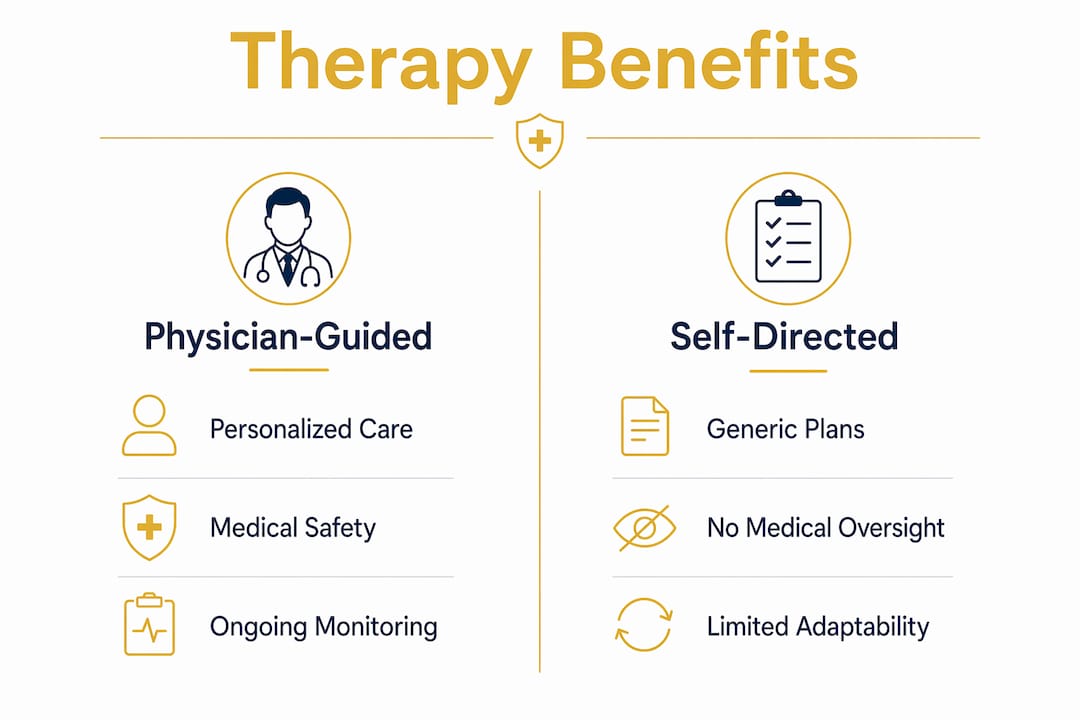
Self-directed programs, including app-based fitness plans, over-the-counter supplement stacks, and generic online protocols, operate without physician input. You receive a standardized plan based on demographic data and self-reported goals. The plan does not change based on your labs, your history, or your response to treatment. That is the fundamental limitation.
Online peptide programs lack comprehensive evaluation and ongoing physician oversight, which increases risks compared to physician-guided protocols. Peptides affect hormone signaling, cellular repair, and metabolic function. Dosing errors or contraindications that a physician would catch during an intake evaluation can cause real harm when the program skips that step.
The table below summarizes the key differences across three program types:
| Feature | Physician-guided therapy | Online/app-based program | Self-directed plan |
|---|---|---|---|
| Medical evaluation | Full intake, labs, history review | Questionnaire only | None |
| Treatment personalization | Individualized by physician | Algorithm-based | Self-selected |
| Ongoing monitoring | Regular follow-ups and lab reviews | Automated check-ins | None |
| Protocol adjustments | Physician-driven, response-based | Limited or none | Self-managed |
| FDA-approved medications | Available when clinically appropriate | Rarely available | Not available |
| Safety oversight | Defined escalation paths | Minimal | None |
The gap is widest in safety and adaptability. A physician-guided program catches problems early. A self-directed plan does not catch them at all.
Pro Tip: Before enrolling in any program that claims medical supervision, verify that a licensed physician, not just a nurse practitioner or health coach, reviews your case and signs off on your treatment plan. Check the provider's credentials on your state medical board's public database.
In what medical contexts is physician-guided therapy commonly applied?
Physician-led therapy spans a wider range of health domains than most people realize. The following are the most established and emerging applications:
- Medical weight loss. This is the most common application. Programs combine FDA-approved medications such as GLP-1 receptor agonists with dietary coaching, behavioral support, and regular physician monitoring. The physician role is not limited to prescribing. It includes evaluating cardiovascular risk, adjusting dosing based on metabolic response, and coordinating with dietitians.
- Peptide therapy. Physician-guided peptide therapy integrates full medical assessment, lab testing, personalized dosing, and monitoring for complications. Peptides like BPC-157, Sermorelin, and CJC-1295 are used for hormone optimization, recovery, and healthy aging. The physician determines which peptides are appropriate, at what dose, and for how long.
- Medication-Assisted Treatment (MAT). Physician-led MAT programs include comprehensive assessments, medication selection based on health history, close early monitoring, and coordinated counseling for opioid use disorder. The physician's role extends beyond the prescription to managing the full recovery protocol.
- Contrast procedure supervision. In imaging and procedural medicine, CMS mandates immediate availability of qualified on-site personnel for contrast injections. This regulatory standard reflects how seriously physician presence is taken in high-risk clinical procedures.
- Psychedelic-assisted therapy. Physician-guided psychedelic therapy models involve structured screening, consultation-intervention-return to care frameworks, and longitudinal provider involvement. This emerging field requires specialized protocols and ongoing physician engagement to manage safety and patient eligibility.
Each of these contexts shares the same structural requirement: a physician who knows your case, monitors your progress, and holds clinical responsibility for your outcomes.
What should patients consider when choosing a physician-guided therapy program?
Choosing the right program requires more than reading a website. The term "medically supervised" is not federally regulated, which means providers use it with widely varying levels of actual physician involvement. Here is how to evaluate a program before you commit:
- Verify physician credentials. Confirm that the physician overseeing your care is licensed in your state and holds relevant board certifications. Use your state medical board's public lookup tool. A telehealth platform should disclose which physicians are on staff.
- Assess the intake process. A legitimate physician-guided program requires a comprehensive initial evaluation, including lab work and a full medical history review, before recommending any treatment. If a program skips labs and moves straight to a product recommendation, that is a warning sign.
- Confirm ongoing monitoring. Ask specifically how often a physician reviews your case after the initial intake. Monthly check-ins with lab reviews are a reasonable minimum for programs involving medications or peptides.
- Look for protocol transparency. The program should explain which interventions it uses, why they are appropriate for your profile, and what the evidence base is. Vague references to "proprietary protocols" without clinical explanation are a red flag.
- Ask about co-occurring condition management. A quality program will have a plan for what happens if your labs reveal an issue the primary therapy does not address. Integrated care, as described in physician-led MAT treatment, is the standard to measure against.
- Check for team-based support. Programs that include dietitians, behavioral counselors, or health coaches alongside physician oversight produce better adherence and outcomes than single-provider models.
For a deeper look at how to evaluate safe weight management programs with genuine physician oversight, Grownupmeds has published a practical guide covering the key questions to ask any provider.
Key takeaways
Physician-guided therapy delivers better outcomes than self-directed or app-based programs because it combines individualized clinical evaluation, ongoing physician monitoring, and protocol adjustments based on your actual response to treatment.
| Point | Details |
|---|---|
| Core definition | A licensed physician designs, monitors, and adjusts your treatment plan based on labs and health history. |
| Safety advantage | Physician oversight includes defined escalation paths and regulatory compliance that generic programs cannot provide. |
| Broad applications | Medical weight loss, peptide therapy, MAT, and psychedelic-assisted therapy all rely on physician-guided frameworks. |
| Choosing a program | Verify physician credentials, require lab-based intake, and confirm ongoing monitoring before enrolling. |
| Terminology caution | "Medically supervised" is unregulated. Confirm actual physician involvement rather than accepting marketing language at face value. |
Why physician-guided therapy is worth the higher bar
I have spent years reviewing health optimization programs, and the single most consistent finding is this: the quality of physician involvement predicts outcomes more reliably than the specific intervention used. Two patients on the same peptide protocol can have completely different results depending on whether a physician reviewed their labs, adjusted their dose at week six, and caught the thyroid irregularity that the generic program would have missed entirely.
The telehealth expansion has made physician-guided care more accessible than it has ever been. That is genuinely good news. But it has also made it easier for loosely supervised programs to present themselves as clinically rigorous. The screening question is not whether a physician is listed on the website. It is whether that physician is actively involved in your specific case, reviewing your specific data, and making decisions that affect your specific protocol.
Patient responsibility matters here too. The best physician-guided programs work because patients show up to follow-up appointments, report side effects honestly, and engage with the behavioral and lifestyle components alongside the medical interventions. Physician guidance is not a passive service. It is a clinical partnership.
If you are evaluating options for weight management, hormone health, or cellular support, look for providers who offer telehealth-supervised protocols with transparent physician involvement and team-based support. That combination is what separates genuine physician-guided therapy from programs that simply use the label.
— Roosevelt
Start your physician-guided health optimization with Grownupmeds
Grownupmeds offers physician-supervised health optimization through a telehealth platform built around genuine clinical oversight. Every program begins with a comprehensive health assessment and physician evaluation before any treatment is recommended.

Grownupmeds connects you with licensed physicians who review your labs, design your protocol, and stay involved throughout your treatment. Services include peptide therapy for hormone optimization and recovery, NAD+ cellular support, and weight management programs using clinically validated interventions. Medications are dispensed from US-based pharmacies, and your physician remains accessible for follow-up and adjustments. If you are ready to move beyond generic wellness programs and into a plan built around your actual health data, start with a personalized health assessment at Grownupmeds today.
FAQ
What is physician-guided therapy in simple terms?
Physician-guided therapy is a treatment plan designed and supervised by a licensed physician who evaluates your health, prescribes appropriate interventions, and monitors your progress with ongoing adjustments. It differs from self-directed programs because a qualified physician holds clinical responsibility for your care throughout the process.
How does physician-supervised therapy differ from regular online programs?
Physician-supervised therapy requires a full medical intake including lab work, uses FDA-approved medications when appropriate, and includes regular physician-reviewed follow-ups. Standard online programs use questionnaires and algorithms to generate generic plans without clinical evaluation or real-time monitoring.
What types of conditions benefit most from physician-guided treatment?
Medical weight loss, hormone imbalances, opioid use disorder treated with MAT, and cellular health concerns addressed through peptide or NAD+ therapy all benefit significantly from physician-guided frameworks. These conditions require individualized dosing, lab monitoring, and protocol adjustments that only a physician can provide.
Is telehealth physician-guided therapy as safe as in-person care?
Telehealth physician-guided therapy is safe for most health optimization and weight management protocols when the platform requires comprehensive lab-based intake, maintains licensed physician oversight, and provides clear escalation paths for adverse events. Procedures requiring on-site intervention, such as contrast imaging, still require in-person physician presence under CMS regulations.
How do I know if a program is truly physician-guided?
Verify that a licensed physician, not just a health coach or automated system, reviews your labs and medical history before treatment begins. Confirm that the physician is reachable for follow-up, that your protocol can be adjusted based on your response, and that the provider's credentials are verifiable through your state medical board.