
Peptide therapy has moved from research labs into mainstream health conversations, and with that shift has come a flood of claims that range from genuinely promising to wildly overblown. Understanding what is peptide therapy actually means, biologically and clinically, separates the adults making smart health decisions from those chasing expensive placebos. This article gives you a clear-eyed look at how peptide therapy works, where the science holds up, where it does not, and what a responsible, medically supervised approach actually looks like in practice.
Table of Contents
- Key takeaways
- What is peptide therapy and how it works biologically
- Benefits and applications worth knowing about
- Limitations, risks, and what you actually need to know
- How to start peptide therapy the right way
- My honest take on peptide therapy
- Start your peptide therapy with physician guidance
- FAQ
Key takeaways
| Point | Details |
|---|---|
| Peptides are cell messengers | Short amino acid chains trigger targeted biological responses, making them precise therapeutic tools. |
| FDA approval matters | Peptides like insulin and GLP-1 agonists are well-validated; most wellness peptides are not. |
| Delivery method affects results | Subcutaneous injection offers far better absorption than oral or topical routes. |
| Medical supervision is non-negotiable | Labs, personalized protocols, and ongoing monitoring separate effective therapy from guesswork. |
| Peptides work best in context | Lifestyle factors and root-cause health work determine how well any peptide protocol performs. |
What is peptide therapy and how it works biologically
To understand peptide therapy, you first need to understand what peptides are. Peptides are short chains of amino acids, typically between 2 and 50 amino acids long, that act as signaling molecules inside the body. Proteins are structurally similar but consist of 50 or more amino acids and serve different roles. Think of peptides as the body's text messages: short, targeted, and designed to trigger a specific response from the receiving cell.
When you introduce a therapeutic peptide, it binds to a specific receptor on a cell surface and activates a biological pathway. This specificity is actually one of peptide therapy's most compelling features. Unlike traditional small-molecule drugs that can affect multiple systems at once, peptides modulate targeted pathways with fewer off-target effects. That precision is why researchers have been interested in peptides for decades.

How FDA-approved peptides compare to experimental ones
Not all therapeutic peptides occupy the same territory. Here is how the major categories stack up:
| Category | Examples | Evidence Level | Regulatory Status |
|---|---|---|---|
| Metabolic/hormonal | Insulin, GLP-1 agonists (Ozempic, Wegovy) | Extensive clinical trials | FDA-approved |
| Growth hormone-related | Sermorelin, CJC-1295, Ipamorelin | Limited human data | Experimental/compounded |
| Tissue repair/recovery | BPC-157, TB-500 | Mostly preclinical | Unregulated/grey market |
| Anti-aging | Epithalon, Thymosin Alpha-1 | Anecdotal or early-phase | Investigational |
GLP-1 agonists like Ozempic and Wegovy represent the gold standard in peptide pharmacology today. They are rigorously studied, physician-prescribed, and backed by large clinical trial data. Growth hormone-releasing peptides sit in a grayer zone, with some promising but limited human research. Tissue repair peptides like BPC-157 are largely studied in animals, with human evidence still thin.
Delivery method matters more than most people realize. Subcutaneous injection provides 90 to 100% bioavailability, meaning nearly all of the peptide reaches the bloodstream. Oral and topical routes are far less predictable because the digestive system breaks peptides down before they can act. This is why legitimate peptide protocols almost always involve injections.
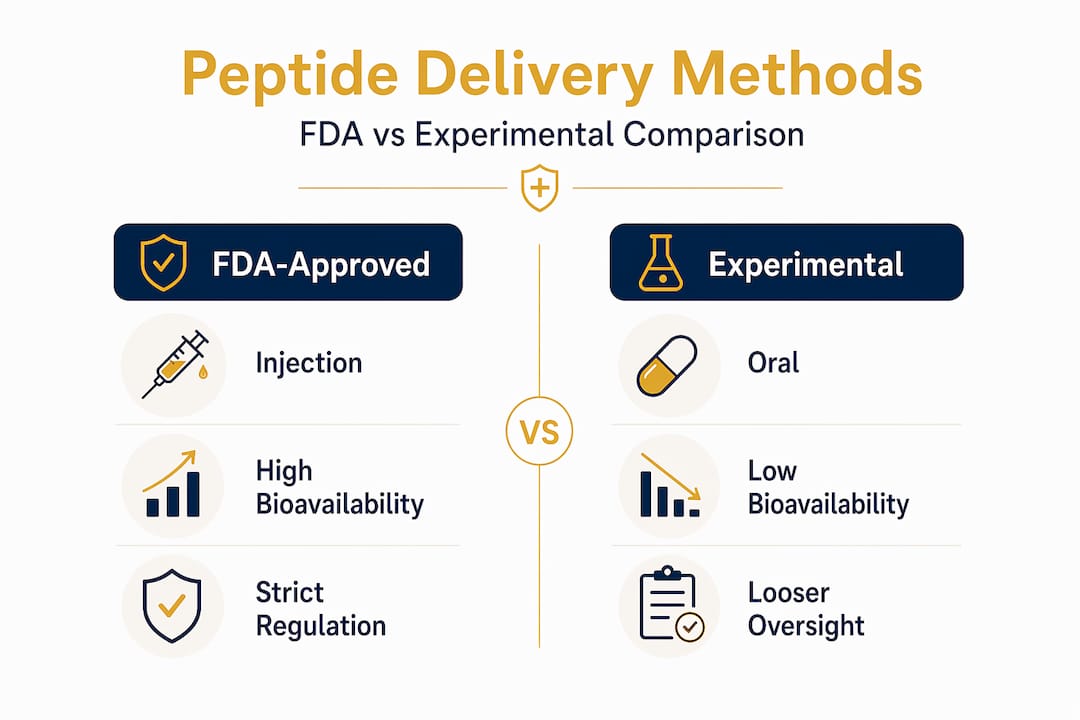
Pro Tip: If a peptide product is sold as an oral supplement claiming the same effects as an injectable version, the absorption science simply does not support that claim. Proceed with skepticism.
Benefits and applications worth knowing about
When you look at the validated and promising applications of peptide therapy, a few categories stand out as genuinely worth understanding.
-
Metabolic health and weight management. GLP-1 agonists are the clearest example. These FDA-approved peptide therapies are not experimental. They reduce appetite, improve insulin sensitivity, and support significant weight loss in clinical populations. If you are researching peptide therapy for weight management, this is where the strongest evidence lives.
-
Muscle recovery and tissue repair. Peptides like BPC-157 have generated real excitement in the recovery space. Animal studies show accelerated healing of tendons, ligaments, and gut tissue. Human evidence is limited, but this is one of the more active areas of investigation. You can read more about how peptides aid tissue repair from a science-focused perspective.
-
Growth hormone support. Peptides such as sermorelin and ipamorelin work by stimulating the pituitary gland to release more growth hormone naturally, rather than injecting synthetic growth hormone directly. This approach is considered lower risk than exogenous growth hormone but still requires medical supervision.
-
Immune modulation. Peptides like thymosin alpha-1 are used in some clinical settings for immune system support, including in chronic infection management and as an adjunct in cancer care in certain countries.
-
Longevity-oriented applications. This is the area with the most hype and the least evidence. Peptides marketed for anti-aging and cellular rejuvenation are compelling in theory. The biology is real. The human data, at scale, simply is not there yet.
The role of peptide therapy for adults in health optimization continues to expand as research catches up with clinical interest. For now, applying it thoughtfully means starting where the evidence is strongest.
Limitations, risks, and what you actually need to know
Here is where the conversation gets serious. The benefits of peptide therapy are real in specific contexts. But the risks and limitations are equally real and far less discussed in the wellness media space.
-
Limited human clinical data. Many peptides marketed for wellness lack large-scale human clinical trials. What exists is often preclinical research from animal models or small human studies. That is not nothing, but it is not the same as the evidence base behind insulin or GLP-1 agonists.
-
Grey market sourcing. Many wellness peptides are sold online without regulation. Products may be mislabeled, contaminated, or incorrectly dosed. Some carry theoretical cancer risks because growth-promoting peptides used irresponsibly could theoretically stimulate unwanted cell growth.
-
Side effects. Even in medical settings, injectable peptides can cause side effects including injection site irritation, nausea, headaches, and gastrointestinal issues. Long-term safety profiles for many experimental peptides are simply unknown.
-
Stacking risks. Combining multiple peptides simultaneously, often called stacking, is common in biohacking communities but has no formal clinical protocols behind it. The interaction effects are not well studied.
-
No substitute for root causes. Peptides do not fix poor sleep, chronic stress, a poor diet, or underlying hormonal dysfunction on their own. Using them without addressing foundational health factors is expensive and likely ineffective.
"Medical experts emphasize caution with peptides marketed online, highlighting regulatory gaps and safety risks of unverified products." — American Medical Association
The regulatory landscape matters too. The difference between getting a physician-prescribed, pharmacy-compounded peptide and ordering something online is enormous in terms of safety, purity, and legal standing. That distinction should guide every decision you make in this space.
How to start peptide therapy the right way
If you have read this far and are seriously considering peptide therapy, the process for doing it correctly is more involved than most wellness content suggests. That is a feature, not a bug.
A legitimate consultation for starting peptide therapy typically runs 30 to 60 minutes and should include a thorough review of your medical history, current medications, and health goals. Labs are part of the process. Blood panels help establish your baseline and identify whether peptide therapy is appropriate, safe, and likely to be effective for your specific situation. You can learn more about what physician-supervised telehealth protocols look like in practice.
Here is what a well-structured peptide therapy program should include:
- Baseline labs covering relevant biomarkers before starting any protocol
- Personalized peptide selection matched to your health goals and medical history, not a generic stack from a forum
- Dosing protocol developed by a licensed physician with experience in peptide pharmacology
- Follow-up monitoring at defined intervals to track efficacy and catch side effects early
- Integration with lifestyle including nutrition, sleep, and exercise optimization
Pro Tip: Ask any provider offering peptide therapy exactly which pharmacy compounds your medication and whether that pharmacy is FDA-registered. Legitimate programs use licensed, US-based compounding pharmacies with verifiable quality standards.
Therapeutic success depends on combining peptide administration with lifestyle changes, ongoing lab monitoring, and addressing underlying health factors. That is not a disclaimer. That is the actual mechanism by which results happen. Adults who approach this as one component of a broader health strategy consistently get better outcomes than those treating it as a standalone solution.
Before committing to any experimental peptide, clarify your goals and consider safer, FDA-approved options first. For many adults, GLP-1 therapy or other approved interventions may achieve their primary goals with a much clearer safety profile. The experimental peptides may have a place later, once the foundation is solid.
My honest take on peptide therapy
I have spent years watching the peptide therapy space evolve, and the pattern I keep seeing is the same: adults who get results are the ones who went in with realistic expectations and medical guidance. The ones who are disappointed, or worse, the ones who had adverse effects, usually bought something online and self-administered based on forum advice.
What strikes me most is how the framing around peptides shifts depending on who is selling them. In a clinical context, a physician will tell you that GLP-1 agonists are a meaningful advance in metabolic medicine. In wellness influencer circles, the same class of molecule gets bundled with unproven tissue-repair peptides and sold as a longevity stack. The biology does not change. The evidence base does.
My honest position is this: peptide therapy is not hype, but it is also not what most of the internet makes it out to be. For certain conditions and goals, particularly metabolic health and hormone optimization, the options are real and meaningful. For anti-aging and recovery applications, the science is genuinely interesting but still developing. The adults who will benefit most are the ones willing to work within a medically supervised framework and resist the urge to stack six experimental peptides because someone on social media said it worked for them.
The role of peptides in aging and health optimization is worth following closely. But follow it with a physician, not a shopping cart.
— Roosevelt
Start your peptide therapy with physician guidance
If this article has you thinking seriously about peptide therapy, the next step matters as much as the decision itself. Grownupmeds offers physician-supervised peptide therapy programs built around science-backed protocols, personalized to your labs and health history, and fulfilled through licensed US-based pharmacies.

Whether you are looking into GLP-1 therapy for metabolic health or exploring broader health optimization through peptide therapy, Grownupmeds connects you with licensed physicians who specialize in this space. You get a real consultation, real lab work, and a protocol that is actually yours. No guesswork, no grey-market sourcing. Just medically supervised care designed to work.
FAQ
What is peptide therapy in simple terms?
Peptide therapy uses short chains of amino acids as signaling molecules to trigger specific biological responses, such as hormone regulation, tissue repair, or metabolic support, under medical supervision.
What are the main benefits of peptide therapy?
Validated benefits include weight management and metabolic improvement through GLP-1 agonists, while investigational benefits include muscle recovery, immune support, and growth hormone stimulation, depending on the specific peptide used.
Is peptide therapy the same as hormone therapy?
Not exactly. Peptide hormone therapy overlaps with hormone therapy when the peptide in question affects hormone pathways, such as growth hormone-releasing peptides, but peptide therapy as a category covers a broader range of biological targets.
What peptide therapy options are FDA-approved?
Insulin and GLP-1 agonists like Ozempic and Wegovy are among the most well-known FDA-approved peptide therapies, with extensive clinical evidence supporting their use for diabetes and obesity management.
How do I know if peptide therapy is right for me?
A licensed physician who reviews your labs, medical history, and goals is the only qualified person to answer that question. Self-diagnosing and self-administering peptides without that evaluation carries real safety risks.