
Navigating a guide to physician-supervised protocols can feel overwhelming, especially when you're trying to sort through telehealth options for weight management, hormone therapy, or anti-aging treatments. The rules around remote supervision have changed significantly, the lab requirements are specific, and the stakes are real. Done right, these protocols deliver measurable results with clinical safety built in. Done wrong, they leave you guessing, under-monitored, or worse, on a therapy your body isn't ready for. This guide cuts through the noise and gives you exactly what you need to participate safely and effectively.
Table of Contents
- Understanding physician-supervised protocols and telehealth regulations
- What you need before starting: prerequisites and baseline assessments
- Step-by-step execution of physician-supervised telehealth protocols
- Monitoring, troubleshooting, and optimizing outcomes remotely
- Why physician-led telehealth protocols are the safest path for complex health optimization
- Explore safe physician-supervised telehealth protocols with Grown Up Meds
- Frequently asked questions
Key Takeaways
| Point | Details |
|---|---|
| Virtual supervision allowed | Since 2026, physicians can supervise telehealth services remotely via real-time video, increasing access and flexibility. |
| Baseline labs essential | Accurate baseline lab testing, including fasting morning testosterone, ensures safe initiation of hormone therapies. |
| FDA-approved devices required | Remote physiologic monitoring must use FDA-approved devices with automatic data upload for compliance. |
| Physician-led care safest | Physician supervision maximizes safety and efficacy in complex telehealth health optimization protocols. |
| Regular monitoring necessary | Ongoing lab tests every 6-12 months and data review optimize treatment and prevent complications. |
Understanding physician-supervised protocols and telehealth regulations
A physician-supervised protocol is a structured treatment plan where a licensed physician holds clinical responsibility for your care, even when that care happens entirely online. This is different from simply chatting with a provider on an app. True supervision means the physician reviews your labs, monitors your progress, adjusts your treatment, and remains accountable for your outcomes.

The distinction between physical presence and virtual supervision used to be a regulatory gray area. That changed when CMS permanently allows virtual direct supervision via real-time two-way audio-visual technology for diagnostic tests under Medicare Part B starting January 1, 2026. This is a major shift. It means your physician can now supervise diagnostic services and auxiliary staff remotely, using live video, without being in the same building.
For adults pursuing physician-supervised protocols for weight loss, testosterone replacement, or cellular therapies, this regulatory update matters because it legitimizes and standardizes how telehealth platforms can operate under physician oversight.
Here is what this framework covers in practice:
- Virtual direct supervision: Physician is immediately available via real-time video and audio during the service
- General supervision: Physician approves the overall protocol but does not need to be present in real time
- Remote physiologic monitoring (RPM): Ongoing data collection from FDA-approved devices used to track chronic conditions like metabolic health and hormone balance
- Incident-to billing: Non-physician staff can provide services under physician supervision and bill accordingly
Pro Tip: Before committing to any telehealth platform, ask directly whether their physician supervision model meets CMS real-time audio-visual requirements. A platform that cannot answer this question clearly is not operating at the standard you deserve.
With a clear understanding of current telehealth supervision rules and regulations, let's explore what requirements and preparations you need to get started in physician-supervised protocols.
What you need before starting: prerequisites and baseline assessments
Starting a physician-supervised telehealth protocol is not a same-day process, and that is actually a good sign. Any platform that skips the preparation phase is cutting corners on your safety. Here is what legitimate protocols require before your first prescription is written.
Patient consent and the physician relationship
Establishing a valid patient-physician relationship remotely requires documented informed consent. This is not a checkbox. It means you understand the therapy, its risks, its monitoring requirements, and your responsibilities as a patient. This documentation must be on file before any treatment begins.
FDA-approved monitoring devices
Remote physiologic monitoring requires patient consent documented and FDA-approved devices that auto-upload data for at least 16 days per 30 days in chronic conditions under physician supervision. For weight management protocols, this typically means a connected smart scale. For cardiovascular monitoring, a Bluetooth-enabled blood pressure cuff. These are not optional add-ons. They are compliance requirements.
Baseline lab testing
Before starting hormone therapy or anti-aging protocols, your physician needs a complete biochemical picture. Here is what that looks like:
| Lab Test | Why It Matters | Protocol Relevance |
|---|---|---|
| Total testosterone (AM fasting) | Establishes true baseline | TRT, hormone optimization |
| Hematocrit and hemoglobin | Screens for polycythemia risk | TRT |
| PSA (men 40+) | Prostate cancer screening | TRT |
| Lipid panel | Cardiovascular baseline | TRT, GLP-1, anti-aging |
| Liver function (ALT, AST) | Metabolic safety screen | All protocols |
| IGF-1 | Growth hormone axis marker | Peptide therapy, anti-aging |
| Fasting glucose and HbA1c | Metabolic health baseline | GLP-1, weight management |
| Thyroid panel (TSH, free T3, T4) | Hormonal interplay | Anti-aging, hormone optimization |
The diagnosis of hypogonadism requires two morning fasting total testosterone measurements below 300 ng/dL with confirmatory baseline labs including hematocrit, PSA for men 40+, and lipids before starting TRT. Two measurements matter because testosterone follows a diurnal rhythm, peaking in the early morning and dropping significantly by afternoon. A single afternoon draw can produce a falsely low result and lead to unnecessary treatment.
Pro Tip: Schedule your initial assessment labs before 9 AM after an overnight fast. If you are already on any supplements containing DHEA or pregnenolone, disclose them. They can skew hormone panels and muddy your baseline. If you are combining TRT with a GLP-1 like semaglutide, your physician needs a comprehensive metabolic panel from day one, not just hormone markers.
Now that you know the prerequisites and baseline assessments needed, let's walk through executing these protocols properly under physician supervision via telehealth.
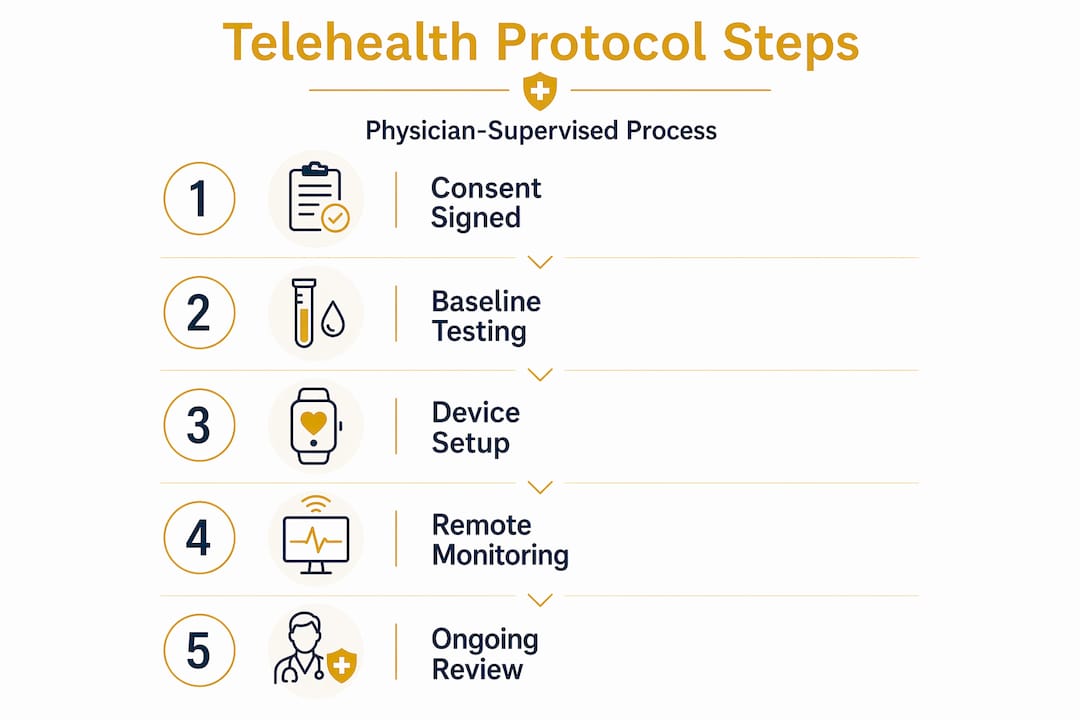
Step-by-step execution of physician-supervised telehealth protocols
This is where the process becomes concrete. Whether you are starting a GLP-1 weight management program, testosterone replacement therapy, or an NAD+ anti-aging protocol, the execution follows a defined sequence.
- Confirm eligibility and document informed consent. Your physician reviews your health history, identifies contraindications, and documents your consent for telehealth services. This step cannot be delegated to a chatbot or intake form alone.
- Set up your remote monitoring devices. You receive or purchase FDA-approved devices, connect them to the platform, and confirm data is uploading correctly. Your care team walks you through this setup.
- Complete your initial physician consultation. This is a real-time video visit where the physician reviews your baseline labs, medical history, and goals. Your protocol is customized here, not templated.
- Receive your prescription and initiate therapy. Medications are prescribed with specific dosing schedules and lab testing timelines. For TRT, this includes follow-up labs at 6 to 8 weeks. For GLP-1 therapy, weekly dose titration is standard.
- Begin continuous remote monitoring. Your device data uploads automatically. The physician or qualified staff reviews it under virtual direct supervision, flagging anything outside normal ranges.
- Attend follow-up telehealth visits and adjust as needed. Therapy is never static. Dosing, timing, and adjunct therapies are adjusted based on your monitored data and how you feel.
The care team behind these protocols includes more than just your physician. Here is how team-based health optimization typically works:
- Physician: Holds clinical responsibility, reviews labs, prescribes, and supervises
- Nurse practitioner or PA: Conducts follow-up visits, manages routine adjustments under physician oversight
- Medical assistant or care coordinator: Handles device setup, appointment scheduling, and patient communication
- Pharmacist (US-based compounding or retail): Verifies prescriptions and flags drug interactions
Physician-led team-based care maximizes safety and outcomes by assigning responsibility to the physician while leveraging complementary skills for complex health optimization.
"Telehealth makes care more accessible, but it does not make complex hormone and metabolic therapies simpler. Physician oversight is not a formality. It is the clinical infrastructure that makes these protocols safe."
Pro Tip: Upload your device data daily, not just when you remember. Gaps in data are not just compliance issues. They are missed signals. A sudden weight spike on day 14 of a GLP-1 protocol could indicate fluid retention worth investigating.
Following these execution steps properly ensures therapeutic safety and effectiveness, but monitoring and managing progress is equally important.
Monitoring, troubleshooting, and optimizing outcomes remotely
Execution gets you started. Monitoring keeps you safe and moving forward. This phase is where most patients either see strong results or plateau due to inconsistent follow-through.
Signs that require immediate physician contact:
- Hematocrit rising above 54% during TRT (polycythemia risk)
- Unexplained weight gain greater than 5 lbs in 72 hours
- Persistent nausea, vomiting, or GI distress on GLP-1 therapy beyond week 3
- Mood changes, sleep disruption, or libido shifts during hormone protocols
- Injection site reactions that worsen rather than improve
Lab testing frequency by protocol:
| Protocol | Initial Labs | Follow-up Frequency | Key Parameters |
|---|---|---|---|
| Testosterone replacement | Pre-treatment | 6 to 8 weeks, then every 6 months | Testosterone, hematocrit, PSA, lipids, liver function |
| GLP-1 weight management | Pre-treatment | 3 months, then every 6 months | HbA1c, fasting glucose, lipids, kidney function |
| Peptide therapy (e.g., BPC-157, CJC-1295) | Pre-treatment | Every 3 to 6 months | IGF-1, glucose, thyroid |
| NAD+ / anti-aging protocols | Pre-treatment | Every 6 months | Comprehensive metabolic, inflammatory markers |
The American Urological Association recommends monitoring serum testosterone, PSA, hemoglobin, lipids, and liver function every 6 to 12 months during testosterone replacement therapy with special PSA screening for men 40+.
On the billing side, only one practitioner can bill remote physiologic monitoring per patient in a 30-day period, and monitoring must be digitized and meet CMS compliance requirements. This protects you from being double-billed and ensures your data is being reviewed in a structured, accountable way.
Common troubleshooting scenarios:
- Device not syncing: Restart the app, check Bluetooth permissions, and re-pair the device. Contact your care coordinator if the issue persists beyond 48 hours.
- Lab scheduling conflict: Most labs require fasting. Schedule for early morning, avoid post-workout draws, and confirm medication timing with your physician the day before.
- Dose not feeling effective: Do not self-adjust. Document your symptoms with timestamps and bring them to your next telehealth visit with your monitoring data.
Pro Tip: Avoid intense exercise within 24 hours of a testosterone lab draw. Post-workout interference can transiently elevate hematocrit and skew your results, potentially triggering unnecessary dose reductions.
"Consistent monitoring is not bureaucratic overhead. It is the feedback loop that turns a protocol into a result. Patients who engage with their data consistently outperform those who treat monitoring as optional."
Why physician-led telehealth protocols are the safest path for complex health optimization
Here is the uncomfortable truth most telehealth marketing glosses over: convenience does not equal safety, and not all supervision is equal.
Hormone therapy, GLP-1 weight management, and anti-aging peptide protocols are not simple interventions. They interact with your cardiovascular system, your liver, your endocrine axis, and in some cases your mental health. The clinical decision-making required to manage these therapies well is not something an algorithm or a non-physician practitioner can replicate independently. Physician-led team-based care ensures ultimate responsibility and safer outcomes by leveraging complementary skills and avoiding risks of independent non-physician practice in hormone and metabolic optimization.
What we have seen in telehealth health optimization is a spectrum. On one end, platforms with genuine physician oversight, regular lab review, and responsive care teams. On the other, subscription services that auto-renew your prescription without anyone actually reviewing your data. The difference is not always obvious from the outside.
Here is how to tell the difference before you sign up. Ask whether a physician personally reviews your labs before each prescription renewal. Ask whether your monitoring data is reviewed by a credentialed clinician, not just flagged by software. Ask whether the physician supervising your care is licensed in your state. If these questions are met with vague answers or redirects to FAQ pages, that is your signal.
"Telehealth convenience should never come at the cost of physician accountability. The access is the benefit. The physician is the safeguard. You need both."
The advantages of physician-supervised protocols are not just clinical. They are practical. You get faster course corrections, fewer adverse events, and a documented medical record that your primary care physician can actually use. That is the difference between health optimization and health gambling.
Explore safe physician-supervised telehealth protocols with Grown Up Meds
Ready to take control of your health with trusted physician supervision? Grown Up Meds offers the expertise and telehealth convenience to help you achieve your optimization goals.

Grown Up Meds is built around physician-led, team-based care where a licensed physician reviews your labs, customizes your protocol, and stays accountable for your outcomes. Every service, from GLP-1 weight management to testosterone replacement to NAD+ cellular support, is delivered with documented supervision and regular monitoring built in.
Here is what you get as a patient:
- Convenient remote monitoring with FDA-approved connected devices
- Regular lab testing with physician review at every key interval
- Data-driven protocol adjustments based on your actual results
- Expert guidance from a credentialed care team, not a chatbot
Pro Tip: Book your initial consultation with your full health history ready, including any current supplements, prior lab results, and your top three health goals. The more your physician knows upfront, the more personalized your protocol will be from day one.
Frequently asked questions
What is virtual direct supervision in telehealth protocols?
Virtual direct supervision allows physicians to oversee diagnostic tests and treatments remotely via real-time two-way audio and video technology instead of being physically onsite, enhancing access while maintaining safety. CMS permanently allows virtual direct supervision via real-time two-way audio-visual technology for diagnostic tests starting January 1, 2026.
How often should lab tests be done during testosterone replacement therapy?
Guidelines recommend monitoring serum testosterone, PSA, hemoglobin, lipids, and liver functions every 6 to 12 months during therapy, with PSA screening especially important for men aged 40 and above. The American Urological Association guidelines on TRT monitoring make this schedule a clinical standard, not a suggestion.
What devices are needed for remote physiologic monitoring in telehealth?
FDA-approved connected medical devices that automatically upload physiological data such as weight, blood pressure, or glucose levels to a secure platform are required for monitoring chronic conditions remotely. Remote physiologic monitoring requires FDA-approved devices with automatic data upload for at least 16 days per 30-day period.
Can non-physician practitioners bill for telehealth services under physician supervision?
Yes, non-physician practitioners can provide services incident to a physician's care and bill accordingly, but they must be directly supervised virtually or physically by the physician as per CMS guidelines. Virtual direct supervision is now allowed for incident-to Medicare billing, making compliant telehealth team-based care more practical than ever.