Most adults chasing better recovery are still relying on the same playbook: sleep more, ice the sore spots, maybe take some protein powder. That approach works, but it leaves real performance on the table. Peptides, short chains of amino acids that your body already uses as biological messengers, are reshaping how physicians think about recovery, tissue repair, and long-term vitality. The science behind them involves GH/IGF-1 axis stimulation, angiogenesis, inflammation modulation, and mTOR signaling, which is exactly why they deserve more than a passing glance from any health-conscious adult serious about performance.
Table of Contents
- What are peptides and how do they affect recovery?
- Key peptides for recovery: Evidence and limitations
- How peptide therapy works under physician supervision
- Peptides versus traditional recovery methods: What's the advantage?
- A physician's perspective: What most wellness seekers get wrong about peptide recovery
- Next steps: Explore safe, science-backed recovery solutions
- Frequently asked questions
Key Takeaways
| Point | Details |
|---|---|
| Peptides target key recovery pathways | Modern peptides can accelerate muscle and tissue repair by boosting protein synthesis, angiogenesis, and reducing inflammation. |
| Evidence varies by peptide | Collagen peptides are supported by human trials while BPC-157 and TB-500 show promise mainly in animal studies. |
| Supervised therapy is essential | Medical oversight ensures peptide therapy is both safe and individually optimized, avoiding unnecessary risks. |
| Combine with proven methods | Peptides work best alongside, not in place of, traditional recovery strategies like physical therapy and nutrition. |
What are peptides and how do they affect recovery?
Peptides are short chains of amino acids, typically between 2 and 50 residues long, that act as signaling molecules in the body. They are not exotic lab creations. Your body already produces hundreds of them naturally, and they regulate everything from hormone release to immune response to tissue repair. The difference between a peptide and a protein is mostly size: proteins are longer chains, while peptides are compact enough to cross cell membranes and bind directly to receptors.
When it comes to recovery, the biological pathways peptides influence are remarkably specific. Here is what makes them stand apart from a standard supplement:
- GH/IGF-1 axis stimulation: Certain peptides trigger the release of growth hormone, which then stimulates insulin-like growth factor 1 (IGF-1). IGF-1 drives protein synthesis in muscle tissue, meaning damaged fibers rebuild faster.
- Angiogenesis via VEGF: Vascular endothelial growth factor (VEGF) promotes the formation of new blood vessels. Better blood supply to injured tissue means faster delivery of oxygen and nutrients.
- Inflammation modulation: Chronic inflammation is one of the biggest obstacles to recovery. Some peptides actively downregulate pro-inflammatory cytokines, shortening the inflammatory phase without completely suppressing the healing response.
- mTOR and PI3K/Akt signaling: These intracellular pathways are the molecular switches for muscle growth and repair. Peptides that activate them can accelerate the anabolic response after exercise or injury.
"Peptides target core recovery mechanisms at the cellular level, influencing pathways that ordinary supplements simply cannot reach with the same precision or efficiency." This is what separates science-backed health optimization from generic wellness trends.
Understanding these mechanisms matters because it explains why peptides are not just "stronger protein shakes." They work upstream, at the signaling level, before your body even begins the repair process. For adults over 35, when natural GH secretion starts declining, this upstream support becomes increasingly relevant.
Key peptides for recovery: Evidence and limitations
Not all peptides carry the same weight of evidence. Some have robust human trial data. Others show exciting results in animal models but have never been tested rigorously in people. Knowing the difference is not just academic. It directly affects what you should consider, and under what conditions.
Collagen peptides are the most evidence-supported option available right now. A well-designed human trial found that collagen peptides at 15g daily improved muscle strength recovery and explosive power after damaging exercise compared to free amino acids. The mechanism is straightforward: collagen provides the specific amino acids (glycine, proline, hydroxyproline) that tendons, ligaments, and connective tissue need to rebuild. This is not hype. It is replicated, peer-reviewed human data.

BPC-157 (Body Protection Compound 157) is a synthetic peptide derived from a protein found in gastric juice. In preclinical models, it promotes tissue repair through angiogenesis, collagen synthesis, and cell migration. Rodent studies show impressive results for tendon healing, muscle repair, and even gut health. The problem is that high-quality randomized controlled trials in humans simply do not exist yet for musculoskeletal recovery.
TB-500 (Thymosin Beta-4) follows a similar pattern. Strong preclinical signals, promising mechanisms, but no rigorous human RCT data to confirm efficacy or establish safe dosing ranges. Expert sources caution that without proper trials, using these peptides means accepting meaningful uncertainty about both effectiveness and long-term safety.
Here is a direct comparison of the three most commonly discussed recovery peptides:
| Peptide | Evidence level | Typical use | Safety notes | Regulatory status |
|---|---|---|---|---|
| Collagen peptides | Strong (human RCTs) | Oral, 10-15g daily | Well-tolerated, minimal risk | Legal, not banned |
| BPC-157 | Preclinical only | Injectable or oral, under supervision | Limited human safety data | WADA banned |
| TB-500 | Preclinical only | Injectable, under supervision | Unknown long-term risks | WADA banned |
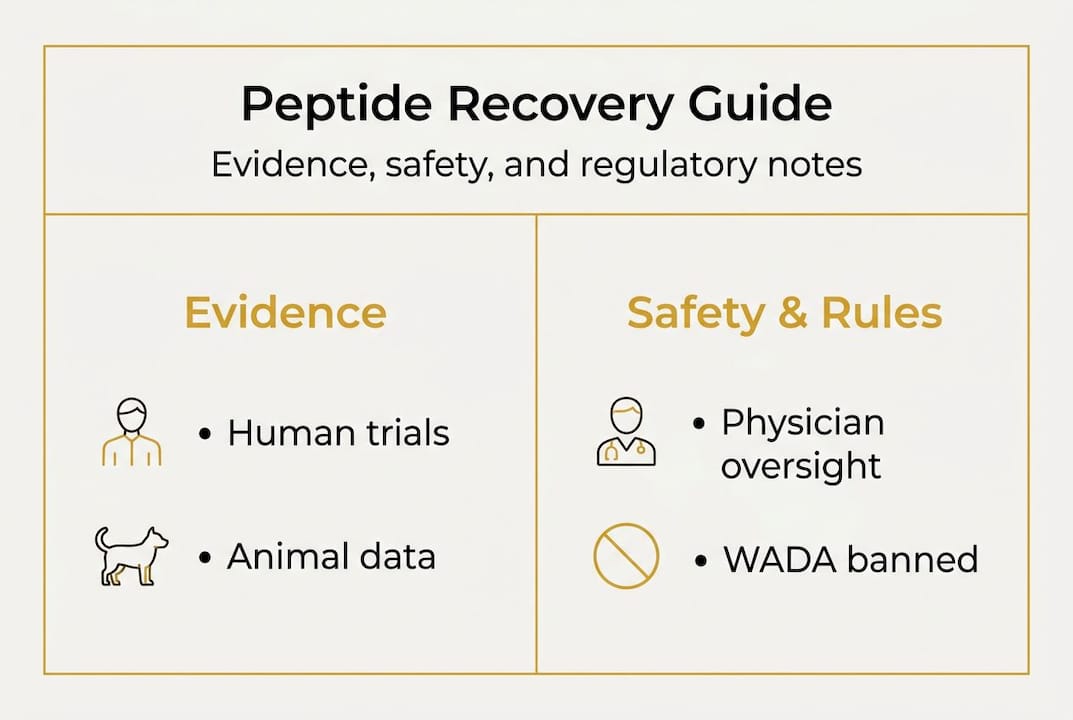
The regulatory picture is important. WADA (World Anti-Doping Agency) bans most performance-related peptides, including BPC-157 and TB-500, for competitive athletes. Collagen peptides are the notable exception: widely available, legal, and backed by actual human data.
Pro Tip: If you compete in any sanctioned sport, collagen peptides are your only safe option from a regulatory standpoint. For non-competitive adults exploring experimental peptides, physician supervision is not optional. It is the baseline requirement for responsible use.
The gap between animal data and human application is worth sitting with for a moment. Rodents heal differently than humans. Their immune systems respond differently. A peptide that dramatically accelerates tendon healing in a rat may do something entirely different in a 45-year-old human with a history of metabolic issues. This is not a reason to dismiss the research. It is a reason to demand proper oversight.
How peptide therapy works under physician supervision
Understanding which peptides to use is only half the battle. Safe and effective therapy requires careful, medically-backed protocols that go well beyond ordering something online and hoping for the best.
Here is what a responsible, physician-supervised peptide therapy process actually looks like:
- Initial consultation: A licensed physician reviews your health history, current medications, fitness goals, and any prior injuries. This is where contraindications get identified before anything else happens.
- Baseline lab work: Blood panels assess hormone levels, inflammatory markers, metabolic function, and organ health. These numbers establish your starting point and flag any issues that would make certain peptides inappropriate.
- Prescription and informed consent: If a peptide protocol is appropriate, the physician writes a prescription and walks you through the risks, benefits, and alternatives. You sign off with full knowledge of what you are taking and why.
- Compounding pharmacy sourcing: Physician-supervised protocols use compounding pharmacies that are licensed and regulated, not gray-market suppliers. This matters enormously for purity, dosing accuracy, and safety.
- Cycle duration and protocol: Depending on the peptide, cycles typically run 4 to 12 weeks with clearly defined dosing schedules. Collagen protocols may run longer. Injectable experimental peptides are used in shorter, monitored cycles.
- Ongoing monitoring: Follow-up labs and check-ins track your response, catch any adverse signals early, and allow the physician to adjust the protocol as needed.
One specific safety consideration that often gets overlooked is cancer risk. Angiogenic peptides, those that promote new blood vessel formation, can theoretically accelerate tumor growth in someone with undetected cancer. This is why cancer screening and a thorough health history review are non-negotiable before starting any angiogenesis-promoting peptide. It is not a theoretical concern. It is a real clinical edge case that responsible physicians account for upfront.
The physician oversight of peptide therapy is not bureaucratic red tape. It is the mechanism that separates a protocol with a real chance of helping you from one that could cause harm you would never see coming.
Pro Tip: Never self-administer experimental peptides sourced outside a licensed pharmacy. The purity of unregulated products is genuinely unknown, and dosing errors with injectables can have serious consequences. The supervision step protects you in ways you may not fully appreciate until something goes wrong.
Peptides versus traditional recovery methods: What's the advantage?
But how do peptides actually stack up against time-tested recovery methods you already use? Here is the direct comparison.
The conventional recovery toolkit is solid and well-established. It includes:
- Rest and sleep: Non-negotiable for tissue repair and hormonal recovery. No peptide replaces quality sleep.
- Physical therapy: Targeted rehabilitation rebuilds functional strength and movement patterns. It addresses the root cause of many injuries.
- Nutrition: Adequate protein, micronutrients, and caloric intake fuel every repair process in the body.
- Ice and compression: Useful for acute injury management, though the evidence for long-term icing is more nuanced than most people realize.
Peptides do not replace any of these. What they potentially do is accelerate and augment the processes these methods support. Think of it this way: rest gives your body the time to repair. Peptides may help the repair happen more efficiently during that time.
"Proven strategies like physical therapy and rest remain the foundation of recovery. Peptides, where evidence supports them, are best understood as adjuncts rather than replacements for these established methods." This framing, drawn from expert performance medicine sources, is the one responsible clinicians consistently return to.
Here is where peptides may add genuine value beyond traditional methods:
- Connective tissue recovery: Collagen peptides specifically support tendon and ligament repair, an area where traditional methods have limited direct impact at the tissue level.
- Hormonal decline: Adults over 40 experience natural GH decline. Peptides that support the GH/IGF-1 axis may partially offset this, improving the anabolic environment for recovery.
- Chronic injury patterns: For adults dealing with recurring soft tissue issues that have not fully resolved with PT alone, targeted peptide support under medical supervision may provide a meaningful additional signal.
Where traditional methods remain clearly superior is in acute injury management, neurological rehabilitation, and any situation where the evidence base for peptides is thin. A torn ACL still needs surgery and structured PT. A stress fracture still needs rest and load management. Peptides are not a workaround for these realities.
The smart approach treats peptides as one tool in a well-designed recovery system, not the whole system.
A physician's perspective: What most wellness seekers get wrong about peptide recovery
Here is the uncomfortable truth about how most health-conscious adults approach peptide therapy: they either dismiss it entirely as unproven, or they treat it like a magic recovery switch that bypasses the hard work. Both positions miss the point by a wide margin.
The dismissal camp is understandable. The hype around BPC-157 and TB-500 online is genuinely overblown. People claiming these peptides healed decade-old injuries in weeks, without any physician involvement or verified sourcing, are not credible sources of medical information. The absence of human RCT data for these compounds is a real limitation that should not be glossed over.
But the overcautious rejection of peptide science entirely ignores what we actually know. Collagen peptides have solid human trial data. The GH/IGF-1 axis is well-understood and clinically relevant. The mechanisms through which peptides influence recovery are not speculative. They are documented at the molecular level.
What most wellness seekers miss is the nuance in between. A responsible peptide protocol is not about chasing the most exotic compound available. It is about identifying where your specific recovery limitations are, what the evidence supports for your situation, and then building a supervised protocol around that. For many adults, that means starting with collagen peptides and optimizing the basics before ever considering anything experimental.
The future of peptide therapy is genuinely exciting. More human trials are underway. Personalization through genetic and biomarker profiling will eventually allow physicians to match specific peptides to specific patients with much greater precision. The clinician-patient relationship will be central to that future, not optional. Adults who build that relationship now, through platforms offering expert health optimization guidance, are positioning themselves well for what comes next.
The right process matters more than the right peptide. That is the insight most people never reach.
Next steps: Explore safe, science-backed recovery solutions
Recovery science is moving fast, and the gap between what is possible under physician supervision and what most people are actually doing is significant.

At Grown Up Meds, physician-supervised physician-led peptide recovery programs are built around exactly the kind of evidence-based, personalized protocols described in this article. The platform connects you with licensed physicians who review your labs, design your protocol, and source your medications from US-based compounding pharmacies. There are no guesswork orders from unverified suppliers, no unsupervised dosing, and no shortcuts around the safety steps that actually matter. If you are serious about optimizing your recovery and you want the medical infrastructure to do it right, this is where that process begins.
Frequently asked questions
Are peptides legal for recovery purposes?
Most peptides are not FDA-approved and are banned by WADA in competitive sports, with collagen peptides being the primary exception that is widely considered safe and legal for general use.
How quickly do peptides work for muscle recovery?
Human studies show collagen peptides improved recovery of maximal strength and explosive power over a 12-week period, while experimental peptides like BPC-157 lack established human timelines entirely.
Can I use peptides for recovery without a prescription?
It is strongly discouraged, as physician-supervised protocols require compounding pharmacy sourcing, lab monitoring, and informed consent to ensure safety and appropriate dosing for your individual health profile.
What are the risks of peptide therapy?
Risks include allergic reactions, contaminated products from unregulated sources, and the potential for angiogenic peptides to raise cancer risk in individuals with undetected malignancies, which is why cancer screening is part of any responsible intake process.