
Most people think anti-aging peptides start and end with a jar of face cream. That framing misses almost everything important. The role of peptides in aging extends far beyond the dermis, touching muscle maintenance, mitochondrial energy production, and even measurable biological age. A 2026 meta-analysis of 19 randomized controlled trials confirmed that oral peptides meaningfully improve skin hydration, brightness, and texture. But the science goes deeper than that, and understanding it changes how you think about every supplement, protocol, and therapy in this space.
Table of Contents
- How peptides affect aging skin and biological age
- Peptides and muscle health: combating sarcopenia effectively
- Targeting mitochondrial health with peptides: SS-31 and MOTS-c
- Navigating peptide therapies: safety, formulation, and evidence nuances
- Rethinking peptides in aging: practical wisdom beyond hype
- Explore science-backed peptide therapies at Grown Up Meds
- Frequently asked questions
Key Takeaways
| Point | Details |
|---|---|
| Peptides target aging biology | Peptides influence skin, muscle, and mitochondrial health by stimulating collagen, reducing degradation, and improving cell function. |
| Oral peptides show clinical benefits | Clinical trials demonstrate oral collagen peptides improve skin hydration, elasticity, reduce wrinkles, and lower biological age. |
| Muscle peptides support strength | Myoki peptide enhances muscle mass and function, offering promise against age-related sarcopenia. |
| Mitochondrial peptides differ | SS-31 is clinically advanced for mitochondrial disease, while MOTS-c shows preclinical metabolic benefits. |
| Safety and evidence matter | Injectable peptides have limited human data and safety concerns; oral peptides and regulated sources are safer choices. |
How peptides affect aging skin and biological age
Peptides are short chains of amino acids, typically 2 to 50 units long, that act as biological signals. When your skin ages, fibroblast activity slows, collagen production drops, and the extracellular matrix that gives skin its structure begins to break down. Certain peptides directly stimulate fibroblasts to rebuild that matrix, which is why they show up in both topical formulations and oral supplements.
The evidence for oral peptides is now considerably stronger than for topical ones. Skin has a formidable absorption barrier. Most topically applied peptides never reach the fibroblasts they need to activate. Oral delivery bypasses that barrier entirely, though it introduces its own challenge: peptides must survive digestion and reach target tissues in a bioavailable form.
A 2025 to 2026 clinical trial found that oral collagen amino acid supplementation using a specific 3:1:1 ratio of glycine to proline to hydroxyproline reduced biological age by 1.4 years in human participants. That ratio matters because it mirrors the amino acid composition of human collagen itself, making it easier for the body to use as raw material for synthesis.
The 2026 meta-analysis covering 19 randomized controlled trials confirmed that oral peptides significantly improved:
- Skin hydration across all age groups studied
- Skin brightness and tone evenness
- Elasticity measured by cutometry
- Wrinkle depth, though reductions were modest rather than dramatic
| Outcome | Oral peptides | Topical peptides |
|---|---|---|
| Skin hydration | Strong evidence | Moderate evidence |
| Collagen synthesis | Confirmed in trials | Limited absorption |
| Wrinkle reduction | Modest, consistent | Variable |
| Biological age reduction | 1.4 years (trial data) | Not measured |
| Systemic benefits | Yes | No |
Pro Tip: When evaluating a collagen supplement, look for products that specify the glycine:proline:hydroxyproline ratio rather than simply listing "collagen peptides." The ratio is what drives efficacy, not the total gram count.
Peptides and muscle health: combating sarcopenia effectively
Skin is visible. Muscle loss is not, which is why sarcopenia gets far less attention despite being one of the most consequential age-related changes you will face. After age 40, adults lose roughly 1 to 2 percent of muscle mass per year without intervention. By 70, that adds up to a significant reduction in strength, mobility, and metabolic rate.

Sarcopenia is not simply a matter of not exercising enough. It involves dysregulated protein synthesis, elevated muscle protein degradation, and elevated myostatin, a protein that actively inhibits muscle growth. This is where targeted peptides become genuinely interesting.
A peptide called Myoki works through three distinct mechanisms:
- Stimulates muscle protein synthesis via anabolic signaling pathways
- Inhibits protein degradation pathways that accelerate in aging muscle
- Binds myostatin directly, reducing its suppressive effect on muscle growth
A 2026 randomized controlled trial tested 200 mg per day of oral Myoki over 12 weeks in patients with muscle atrophy. The results were notable: significant improvements in muscle mass, grip strength, and walking speed compared to placebo. This is not a preclinical mouse study. It is a human trial with functional outcomes that matter to daily life.
What makes Myoki particularly relevant for adults in their 40s and 50s is that it works orally. No injections, no complicated protocols. The 12-week timeline also aligns with what most people can commit to in a supervised health program.
Pro Tip: Pair any muscle-targeted peptide protocol with resistance training, even light resistance. Peptides amplify the anabolic signal, but the signal needs a stimulus. Training and peptides together produce outcomes that neither achieves alone.
Targeting mitochondrial health with peptides: SS-31 and MOTS-c
Mitochondria are the energy factories of every cell in your body. As you age, mitochondrial function declines: membranes destabilize, reactive oxygen species accumulate, and ATP production drops. This is not a peripheral concern. Mitochondrial dysfunction is now recognized as a core hallmark of aging, contributing to fatigue, muscle weakness, metabolic slowdown, and cardiovascular decline.
Two peptides have emerged as serious candidates for targeting this problem, and they work in fundamentally different ways.
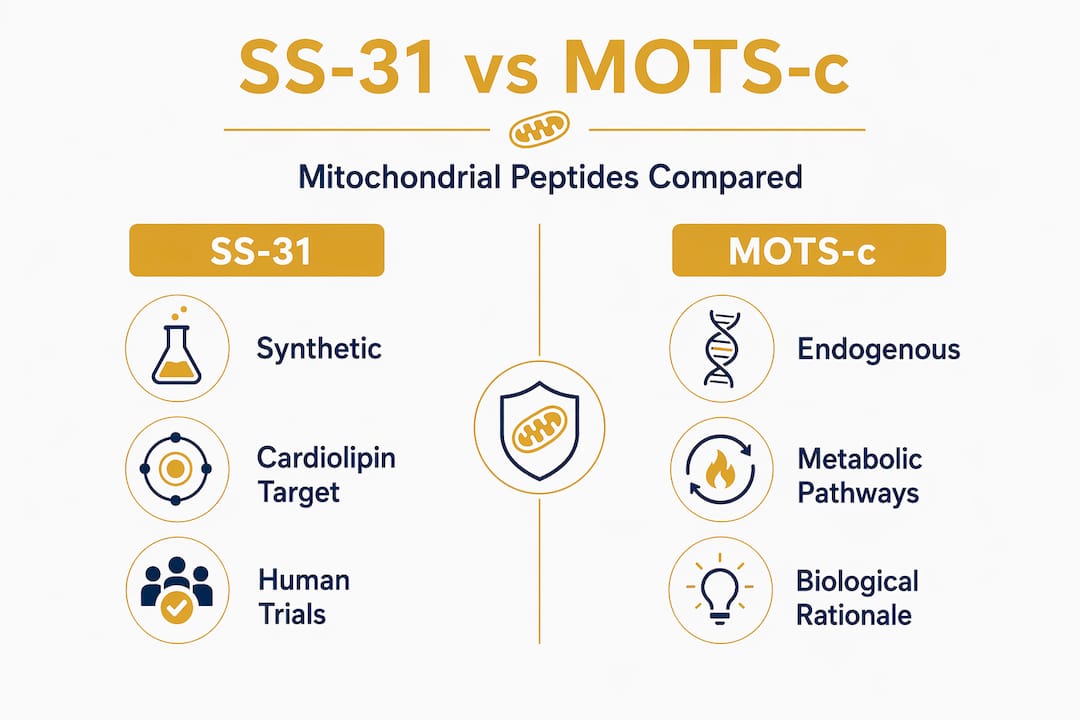
SS-31 is a synthetic peptide that binds directly to cardiolipin, a lipid in the inner mitochondrial membrane. By stabilizing that membrane, SS-31 reduces oxidative damage and restores efficient ATP production. It is the more clinically advanced of the two. SS-31 has reached Phase 3 trials with demonstrated improvements in cardiac and muscular function, and it holds FDA Fast Track designation, meaning regulators recognize its potential for serious conditions.
MOTS-c is different in origin. It is a naturally occurring peptide encoded in mitochondrial DNA, which makes it unique among the peptides discussed here. Preclinical studies show it improves insulin sensitivity, activates AMPK (a cellular energy sensor), and extends lifespan in animal models. However, no completed human trials exist yet.
| Feature | SS-31 | MOTS-c |
|---|---|---|
| Origin | Synthetic | Endogenous (mitochondrial DNA) |
| Mechanism | Cardiolipin stabilization | AMPK activation, insulin sensitivity |
| Clinical stage | Phase 3 human trials | Preclinical only |
| Primary focus | Cardiac and muscle function | Metabolic health |
| FDA status | Fast Track designation | Not yet regulated |
The key takeaway is that these peptides are not interchangeable. SS-31 has the human data. MOTS-c has the biological rationale and animal evidence. For anyone considering mitochondrial peptide therapy today, SS-31 is the one with a verifiable clinical track record.
Navigating peptide therapies: safety, formulation, and evidence nuances
Here is where honest conversation becomes essential. The science of peptides in aging is genuinely exciting, but the commercial landscape around it is not uniformly trustworthy. Understanding the difference between evidence-backed options and gray-market products is not optional. It is the difference between benefit and harm.
What the evidence actually supports:
- Oral collagen peptides with defined amino acid ratios have solid safety profiles and clinical backing for skin and biological age outcomes.
- Oral muscle peptides like Myoki have human trial data supporting their use in supervised protocols.
- Mitochondrial peptides like SS-31 are advancing through legitimate clinical channels with regulatory oversight.
Where caution is warranted:
Injectable peptides like GHK-Cu and BPC-157 are widely promoted online, but high-quality human evidence is limited and safety concerns include potential cancer risk and immune reactions. Enthusiasm on social media is not a substitute for clinical data.
The regulatory picture reinforces this caution. FDA Category 2 restrictions now limit the compounding of certain injectable peptides due to documented risks including impurities and immune reactions. This affects what licensed pharmacies can legally prepare, and it exists for good reason.
Practical steps for safe peptide use:
- Choose peptides with published human trial data, not just animal studies or anecdotal reports.
- Prefer oral formulations when available. They have better-characterized safety profiles.
- Source only from US-licensed compounding pharmacies operating under physician supervision.
- Avoid any product sold without a clear ingredient list, dosing rationale, or third-party testing.
- Treat peptide therapy as one component of a broader health protocol, not a standalone fix.
Pro Tip: If a peptide product is being sold without a prescription or medical consultation for an injectable formulation, that is a red flag, not a convenience. Regulatory restrictions exist because the risks are real.
Rethinking peptides in aging: practical wisdom beyond hype
Here is the uncomfortable truth that most peptide content avoids: no single peptide addresses all of aging. Aging involves at least 12 recognized hallmarks, including genomic instability, telomere shortening, epigenetic changes, cellular senescence, and more. Current peptide research, even the best of it, addresses a handful of these mechanisms. Expecting a peptide to reverse aging comprehensively is like expecting a single vitamin to cure malnutrition.
What peptides can do, used correctly, is meaningfully move specific markers. Skin structure improves. Muscle loss slows. Mitochondrial efficiency increases. Biological age, as measured by specific biomarkers, can shift in the right direction. These are real, valuable outcomes. They just require honest framing.
We have seen patients come in having spent significant money on injectable peptide cocktails sourced from unvetted suppliers, expecting dramatic transformation. What they often got instead was inconsistent results, anxiety about safety, and frustration. The patients who see the most durable benefit are those who treat peptides as a precision tool within a broader strategy: quality sleep, resistance training, protein-sufficient nutrition, stress management, and regular lab monitoring.
The SS-31 clinical trial data is instructive here. Even in Phase 3 trials with a well-characterized peptide, outcomes vary by disease context. What works for mitochondrial myopathy does not automatically translate to general longevity for a healthy 45-year-old. Context always matters.
Cycling peptide protocols, monitoring biomarkers before and after, and working with a physician who understands the current evidence landscape are not optional extras. They are what separates therapeutic benefit from expensive experimentation.
Explore science-backed peptide therapies at Grown Up Meds
If you have read this far, you understand that effective peptide therapy is not about picking a product off a shelf. It requires clinical context, proper formulation, and ongoing monitoring.
Grown Up Meds offers physician-supervised peptide therapy programs designed around exactly this kind of evidence-based approach. Their licensed physicians review your health history, recommend protocols supported by clinical data, and connect you with US-based pharmacies that meet regulatory standards. Whether your goals involve skin health, muscle preservation, metabolic support, or cellular longevity, their team integrates peptide therapy into a personalized plan that accounts for your full health picture. This is what responsible peptide use actually looks like.
Frequently asked questions
What are peptides and how do they help with aging?
Peptides are short amino acid chains that act as biological signals, stimulating collagen synthesis and supporting mitochondrial health to improve skin, muscle, and metabolic function as you age.
Are oral peptides effective for reducing wrinkles and improving skin?
Yes. Oral collagen peptides with specific amino acid ratios have been shown to reduce biological age and improve skin hydration, elasticity, and texture over 8 to 24 weeks in clinical trials.
Are injectable anti-aging peptides safe and well-supported by evidence?
Human evidence is limited for most injectable anti-aging peptides, and safety concerns including immune reactions and potential cancer risk make medical supervision non-negotiable for this route.
What is the difference between SS-31 and MOTS-c peptides?
SS-31 is a synthetic peptide with Phase 3 human trial data focused on cardiac and muscle function, while MOTS-c is an endogenous mitochondrial peptide with promising preclinical metabolic data but no completed human trials yet.
How should I approach using peptide therapies safely?
Choose peptides with published human trial evidence, source from FDA-compliant pharmacies under physician supervision, and integrate them with lifestyle habits rather than treating them as a standalone solution.