Hormone imbalance assessment is the structured clinical process of combining symptom tracking with targeted laboratory testing to identify disruptions in the body's endocrine system. Adults experiencing fatigue, unexplained weight changes, mood swings, or reproductive irregularities often struggle to connect these symptoms to a root cause because symptoms are nonspecific and can overlap with dozens of other conditions. Knowing how to assess hormone imbalances means understanding which tests to request, when to take them, and how to interpret results alongside your clinical picture. This guide gives you that roadmap, from the first symptom you notice to the follow-up conversation with your physician.
What symptoms and signs suggest a hormone imbalance?
Recognizing the right symptoms is the starting point for any hormonal assessment. The challenge is that no single symptom points exclusively to a hormone problem. Your job is to notice patterns, not isolated incidents.
The most clinically significant hormone balance symptoms include:
- Sudden or unexplained weight changes (gain or loss without dietary shifts)
- Persistent fatigue that does not improve with rest
- Mood instability, including anxiety, depression, or irritability without clear cause
- Hair thinning or loss, or new hair growth in unexpected areas
- Reproductive irregularities such as missed periods, heavy bleeding, or low libido
- Sleep disruption and night sweats
- Brain fog or difficulty concentrating
What matters most is change from your baseline. A woman who has always had irregular cycles is in a different clinical position than one whose cycles became irregular at 38. Tracking symptoms before testing helps clinicians avoid unnecessary tests and focus on what is actually shifting. Individual hormone patterns vary with age, menstrual cycle phase, and lifestyle factors, so a two-to-four week symptom log gives your physician far more useful data than a verbal summary.
Pro Tip: Use a free app like Clue or a simple paper journal to log daily energy levels, mood, sleep quality, and any physical changes. Bring this log to your first appointment. Clinicians at platforms like Grownupmeds use this kind of structured symptom data to guide which hormone panels to order.

Learning to recognize hormone balance and its disruptions is the foundation before any lab work begins.
Which hormone tests are used to assess imbalances and how do they work?
Once you have documented symptoms, the next step is understanding which tests actually measure what. Hormone testing is not one-size-fits-all. The right panel depends on your symptoms, sex, age, and the time of day or cycle phase when blood is drawn.
Common hormone panels and what they measure
Blood tests are the most reliable method for measuring most hormones. A standard panel for suspected imbalance typically includes thyroid-stimulating hormone (TSH), free T3 and T4, estrogen, progesterone, testosterone, cortisol, prolactin, and DHEA-S. For thyroid concerns specifically, TSH is the first-line test, with abnormal results triggering follow-up T4, T3, and antibody testing to determine whether the issue is hypothyroidism, hyperthyroidism, or an autoimmune condition like Hashimoto's.
Blood, saliva, and urine: which sample type is right?
| Sample Type | Best Used For | Key Limitation |
|---|---|---|
| Blood | Thyroid, sex hormones, cortisol, prolactin | Snapshot only; timing-sensitive |
| Saliva | Adrenal and sex hormones (free fraction) | Variable accuracy; not preferred clinically |
| Urine (24-hour) | Broader metabolic hormone profiles | Inconvenient; not needed for most cases |
Blood testing is the clinical standard. Saliva and urine tests have niche applications but commercial free hormone assays often lack the accuracy of equilibrium dialysis methods, which are more complex and costly. Many at-home saliva kits fall into this category. They can generate numbers that look meaningful but do not hold up to clinical scrutiny.
Dynamic testing for complex cases
When standard blood panels do not explain your symptoms, stimulation or suppression tests provide a deeper look at glandular function. The ACTH stimulation test evaluates adrenal insufficiency. The dexamethasone suppression test identifies cortisol overproduction linked to Cushing's syndrome. These are not first-line tests, but they are the right tool when static hormone levels do not match your clinical picture.
Pro Tip: Cortisol should be drawn between 7 and 9 a.m. because it peaks at that time. Testosterone in men is also highest in the morning. Scheduling your blood draw at the right time is not a minor detail. It is the difference between an accurate result and a misleading one.
How to interpret hormone test results and why retesting matters
Getting results back is not the end of the process. It is often the beginning of a more nuanced conversation. Hormones fluctuate daily, and a single test captures one moment in a constantly shifting system.
Here is what to keep in mind when reviewing your results:
- Normal ranges are population averages. A result within the reference range does not automatically mean your levels are optimal for you. A testosterone level at the bottom of the normal range may still explain fatigue and low libido in a 45-year-old man.
- Timing affects everything. Progesterone tested on day 5 of a menstrual cycle tells you almost nothing. It needs to be measured around day 21 to reflect the luteal phase accurately.
- One test is rarely enough. Retesting confirms whether an abnormal result is a consistent pattern or an isolated outlier caused by stress, illness, or poor sleep the night before.
- Symptom correlation is mandatory. A physician who interprets labs without your symptom history is working with half the picture. Clinicians order tests at specific times or request multiple draws precisely because circadian and cyclical variation can mask or mimic imbalances.
- Watch for the mismatch signal. If your labs look normal but your symptoms are worsening, push for a second opinion or a more targeted panel. This mismatch is one of the most common reasons hormone conditions go undiagnosed for years.
The goal of interpretation is not to find a number outside a range. It is to build a coherent clinical story where your symptoms, your history, and your lab values all point in the same direction.
What additional examinations support hormone imbalance diagnosis?
Lab work alone does not always close the diagnostic loop. Several complementary tools help clinicians rule out structural causes and related conditions before attributing everything to a hormonal source.
| Examination | Purpose | When It Is Used |
|---|---|---|
| Pelvic or thyroid ultrasound | Identify structural abnormalities | Abnormal bleeding, thyroid nodules |
| Complete blood count (CBC) | Rule out anemia and infection | Fatigue, heavy menstrual bleeding |
| Ferritin and iron studies | Assess iron deficiency | Hair loss, fatigue |
| Endometrial assessment | Exclude uterine pathology | Abnormal uterine bleeding in women over 45 |
For women with abnormal uterine bleeding, a multi-modal approach that includes CBC, ferritin, prolactin, TSH, progesterone, and pelvic ultrasound is standard. This prevents misattributing structural problems like fibroids or polyps solely to hormone shifts. Excluding pregnancy and imaging are both required steps before a hormonal diagnosis is confirmed.
Specialist referrals to an endocrinologist become appropriate when dynamic testing is needed, when multiple endocrine axes appear affected, or when initial treatment does not produce the expected response. An integrated approach that combines lab data, imaging, and clinical examination consistently produces more accurate diagnoses and better treatment outcomes than any single test in isolation.
Step-by-step guide to getting assessed for hormone imbalance
This is the practical sequence that takes you from noticing symptoms to having a clear clinical picture.
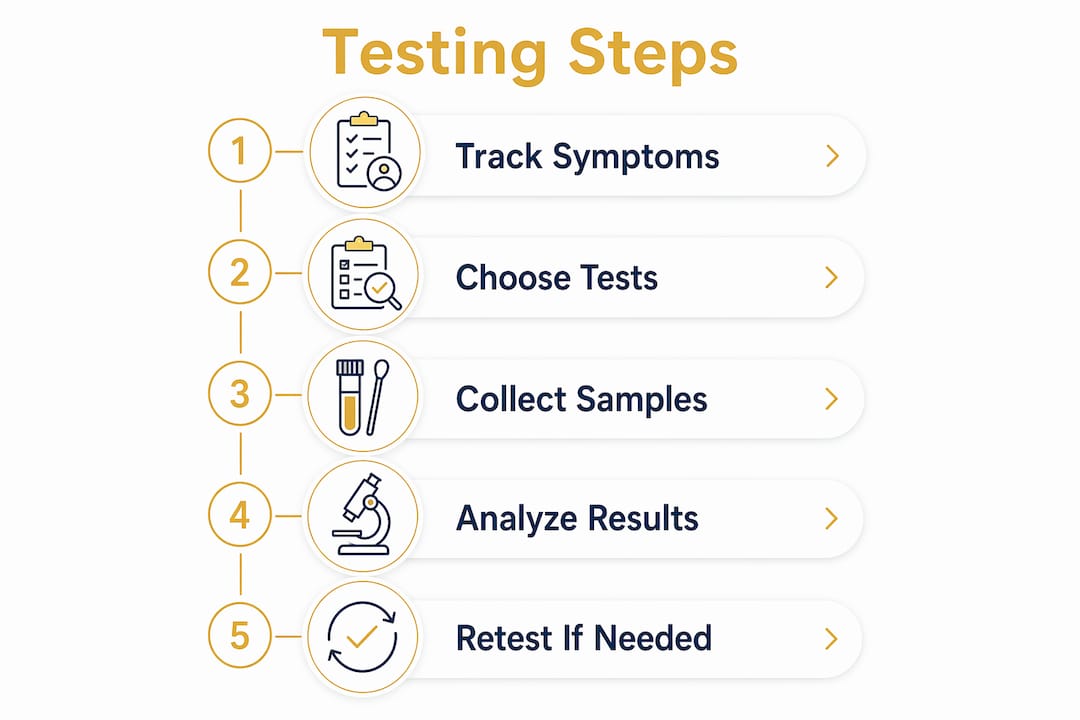
- Start a symptom log. Record energy, mood, sleep, weight, and any physical changes daily for two to four weeks. Note the timing of symptoms relative to meals, sleep, and your menstrual cycle if applicable. Use a tool like health progress tracking to structure this process.
- Schedule a clinical consultation. Book with a physician who specializes in hormone health or endocrinology. Bring your symptom log. Telehealth platforms like Grownupmeds connect you with licensed physicians who review your history before ordering any labs.
- Discuss which tests fit your symptoms. Not every panel is appropriate for every person. A 32-year-old woman with irregular periods needs different tests than a 55-year-old man with fatigue and low libido. Let your symptom pattern guide the panel.
- Prepare for your blood draw correctly. Fast if instructed. Schedule morning appointments for cortisol and testosterone. Women should note where they are in their cycle. These details directly affect result accuracy.
- Review results with your physician, not alone. Numbers without clinical context are misleading. Ask your doctor to explain what each result means relative to your symptoms, not just whether it falls within the reference range.
- Plan for follow-up. If results are borderline or do not match your symptoms, schedule a retest. Ask whether a referral to an endocrinologist or a physician-supervised protocol is the right next step.
Pro Tip: Before your appointment, write down your three most disruptive symptoms and when they started. Physicians make better diagnostic decisions when you lead with specific, time-stamped information rather than a general complaint of "not feeling right."
Key takeaways
Accurate hormone imbalance assessment requires combining timed laboratory testing with documented symptom patterns and clinical interpretation, not a single blood draw.
| Point | Details |
|---|---|
| Symptoms guide testing | Track symptoms for two to four weeks before testing to help clinicians choose the right panels. |
| Timing determines accuracy | Draw cortisol and testosterone in the morning; test progesterone around day 21 of the cycle. |
| Single tests can mislead | Retesting confirms whether an abnormal result reflects a true pattern or a temporary fluctuation. |
| Imaging adds diagnostic clarity | Ultrasound, CBC, and ferritin studies rule out structural causes before attributing symptoms to hormones. |
| Clinical correlation is non-negotiable | Lab values must be interpreted alongside your symptom history, not in isolation. |
Why I think most people get their hormone assessment backward
After years of working in health optimization content and watching how adults navigate this process, the most common mistake I see is starting with the test instead of the symptom. Someone reads about low testosterone or estrogen dominance online, orders a direct-to-consumer panel, gets a number, and then tries to interpret it without any clinical context. That approach almost always leads to either unnecessary anxiety or false reassurance.
The second mistake is accepting a single normal result as a final answer when symptoms persist. Hormones are not static. A cortisol level drawn at 2 p.m. after a stressful commute tells you almost nothing useful. A TSH drawn without follow-up T3 and antibody testing misses the full thyroid picture. The patients who get the best outcomes are the ones who push for repeat testing, ask for dynamic tests when warranted, and treat their symptom log as clinical evidence, not a personal complaint.
At-home saliva kits and direct-to-consumer panels have a role in raising awareness, but they are not a substitute for physician-supervised assessment. The interpretation gap between a number on a report and a clinical decision is where most people get stuck. Closing that gap requires a clinician who understands both the data and your individual history. That partnership is the most underrated part of the entire process.
— Roosevelt
Start your hormone assessment with Grownupmeds
If your symptoms have been dismissed, your labs have come back "normal" but you still feel off, or you simply want a structured starting point, Grownupmeds offers physician-supervised hormone health assessments designed to go beyond a basic panel. Licensed physicians review your symptom history, order clinically appropriate tests, and build a personalized protocol around your results.

Grownupmeds also offers peptide therapy and NAD therapy for adults whose assessment reveals metabolic or hormonal deficits that benefit from targeted support. Everything is delivered through a telehealth model that prioritizes your privacy and connects you with US-based pharmacies. If you are ready to move from symptoms to answers, the assessment is the right place to start.
FAQ
What is the first step to assess a hormone imbalance?
The first step is tracking your symptoms for two to four weeks before any lab work. Documenting patterns in energy, mood, sleep, and physical changes gives your physician the context needed to order the right tests.
Which blood tests check hormone levels most accurately?
A clinically meaningful panel typically includes TSH, free T3, free T4, estrogen, progesterone, testosterone, cortisol, prolactin, and DHEA-S. The right combination depends on your specific symptoms and the time of day or cycle phase when samples are collected.
Can hormone levels be normal and still cause symptoms?
Yes. Reference ranges reflect population averages, not individual optimal levels. A result at the low end of normal can still produce significant symptoms, which is why clinical correlation with your symptom history is required alongside lab interpretation.
How often should hormone levels be retested?
Retesting is recommended when initial results do not match your symptoms, when results are borderline, or after starting treatment to confirm the protocol is working. There is no universal interval. Your physician determines timing based on your specific clinical picture.
Are at-home hormone tests reliable?
Most commercial at-home saliva and urine kits lack the accuracy of clinical blood testing methods like equilibrium dialysis. They can be useful for general awareness but should not replace physician-ordered lab work for diagnosis or treatment decisions.