
Hormone therapy used to feel like something reserved for people with serious medical conditions or those lucky enough to have a specialist nearby. That perception is changing fast. Millions of adults between 30 and 60 are now discovering that evidence-based hormone therapy is accessible, convenient, and medically supervised through telehealth platforms. Whether you're dealing with fatigue, sleep issues, or mood changes from shifting hormones, or you simply want to optimize how you feel and function, online hormone therapy has become a legitimate and increasingly popular option worth understanding clearly.
Table of Contents
- What is online hormone therapy?
- Main types of online hormone therapy and how they work
- Potential benefits and expected outcomes
- Risks, side effects, and who should and shouldn't get online therapy
- A practical perspective on online hormone therapy: What most guides don't tell you
- How to get started with trustworthy online hormone therapy
- Frequently asked questions
Key Takeaways
| Point | Details |
|---|---|
| Personalized approach | Online hormone therapy works best when tailored to your symptoms and health goals, not just lab results. |
| Evidence-backed benefits | Symptom relief—such as better sleep, mood, and energy—is well-documented, but weight loss is not guaranteed. |
| Safety first | Proper screening and monitoring are essential to lower risks and avoid complications with hormone therapy. |
| Convenience advantages | Telehealth platforms offer streamlined care, specialist access, and treatment from the comfort of your home. |
What is online hormone therapy?
Online hormone therapy is the process of receiving a medically supervised hormone treatment plan through a virtual care platform rather than a traditional clinic. You complete an intake assessment, consult with a licensed physician via video or secure messaging, and receive a personalized prescription delivered from a US-based pharmacy. The entire process happens without you needing to sit in a waiting room.
The conditions it addresses are real and common. For women in perimenopause or menopause, online therapy typically involves estrogen or progesterone to ease hot flashes, improve sleep quality, stabilize mood, and protect bone density. For men experiencing andropause or low testosterone, testosterone replacement therapy (TRT) targets declining energy, reduced muscle mass, and diminished libido. Both groups can also pursue hormone therapy for broader health optimization goals, not just acute symptom management.
The reason people are turning to online platforms now is straightforward: access and convenience. Many adults in their 40s and 50s have busy schedules, live in areas with limited specialist availability, or simply prefer the privacy of managing their health digitally. Telehealth prescribing protocols have matured significantly, and licensed providers working through reputable platforms follow the same clinical standards as in-person physicians.
Here's what the typical online hormone therapy process looks like:
- Intake assessment: You complete a detailed health questionnaire covering symptoms, medical history, medications, and goals.
- Lab work: Many platforms arrange at-home hormone testing or direct you to a local lab for baseline bloodwork.
- Physician consultation: A licensed provider reviews your results and symptoms, then discusses therapy options with you.
- Personalized prescription: Your treatment plan is tailored to your specific hormone profile and symptom burden, not a one-size-fits-all protocol.
- Ongoing monitoring: Regular follow-ups and lab checks ensure your dosing stays optimized and safe over time.
"Hormone therapy is not a shortcut or a luxury. It's a clinically recognized approach to restoring physiological balance when the body's natural production declines or becomes dysregulated."
The key advantage of online hormone therapy is that it brings specialist-level care to people who might otherwise go untreated or wait months for an in-person appointment. When the platform is reputable and the providers are licensed, the clinical quality is genuinely comparable to traditional care.
Main types of online hormone therapy and how they work
With a definition in hand, it's helpful to compare what kinds of hormone therapies are actually available online and how they differ in delivery, effectiveness, and tolerability.
The three primary hormone categories prescribed online are estrogen, progesterone, and testosterone. Within each category, the method of delivery matters significantly. Your route of administration affects how the hormone is absorbed, how stable your levels remain, and what side effect profile you're working with.
Here are the typical steps in an online hormone therapy program:
- Telehealth consultation with a licensed physician who reviews your symptoms and health history.
- Baseline labs to measure current hormone levels, metabolic markers, and any contraindications.
- Prescription issued and sent directly to a US-based compounding or retail pharmacy.
- Delivery to your door with clear dosing instructions and a follow-up schedule.
- Monitoring and adjustment at 4 to 12 week intervals based on symptom response and updated labs.
When it comes to delivery methods, the evidence is clear. Transdermal HRT (patches, gels, or creams applied to the skin) consistently outperforms oral forms for vasomotor symptoms like hot flashes and night sweats, and it carries a lower risk of blood clots compared to oral estrogen. Injectable testosterone offers more stable blood levels for men on TRT but requires more precise dosing management.
| Delivery method | Efficacy | Key risks | Convenience |
|---|---|---|---|
| Oral (pill) | Moderate for some symptoms | Higher clot risk, liver metabolism | Very easy |
| Transdermal (patch/gel) | High for vasomotor/mood symptoms | Skin irritation, transfer risk | Easy, daily or twice-weekly |
| Injectable | High, stable levels | Injection site reactions, level peaks | Moderate, requires technique |
For men, testosterone replacement via injection or transdermal gel improves energy levels, sexual function, lean muscle mass, and cognitive sharpness. For women, transdermal estrogen combined with progesterone (for those with a uterus) is the most widely recommended approach by clinical guidelines.

Pro Tip: Don't let your provider treat you based solely on lab numbers. If your testosterone is "technically normal" but you feel exhausted, foggy, and flat, symptom-driven dosing through evidence-based hormone protocols is what actually moves the needle on quality of life.
The most important thing to understand about online hormone therapy is that the science behind it is not new. What's new is the delivery mechanism. The hormones themselves have decades of clinical research behind them.
Potential benefits and expected outcomes
After understanding the available options, let's look at what real-world benefits online hormone therapy offers, according to the latest research.
The most consistently documented benefits fall into a few clear categories. Symptom relief is the most immediate and measurable. Hot flashes, night sweats, disrupted sleep, mood instability, and low libido all respond well to appropriately dosed hormone therapy. These aren't minor inconveniences for many people. They're daily disruptions that affect work performance, relationships, and overall wellbeing.
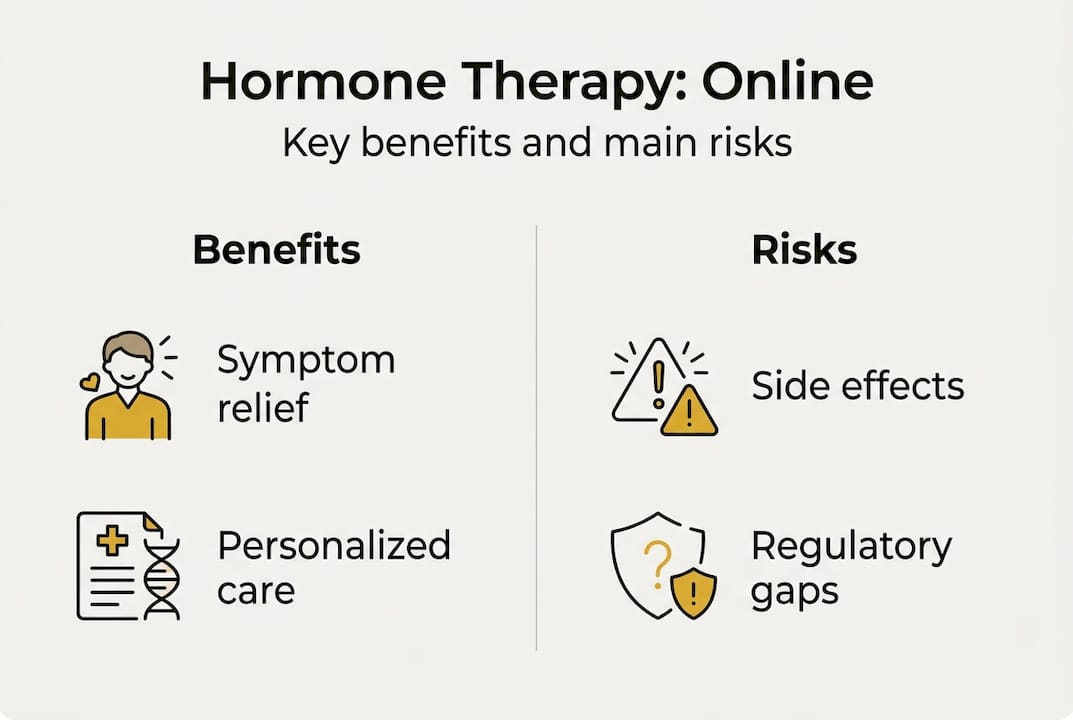
Here's a realistic breakdown of what you can expect and when:
| Benefit area | Typical timeline | What the evidence shows |
|---|---|---|
| Hot flashes and night sweats | 2 to 8 weeks | Significant reduction with transdermal estrogen |
| Sleep quality | 4 to 8 weeks | Improved sleep onset and duration |
| Mood and anxiety | 6 to 12 weeks | Measurable reduction in depression and anxiety scores |
| Energy and cognitive clarity | 4 to 10 weeks | Reported improvement in fatigue and mental sharpness |
| Lean muscle and body composition | 3 to 6 months | Modest gains, not dramatic transformation |
| Bone density | 6 to 12 months | Protective effect documented with long-term use |
One of the more striking data points from recent research: 40 to 42% remission in elevated depression and anxiety scores was documented after just three months of telehealth-administered hormone therapy. That's a meaningful clinical outcome, not just a subjective feeling.
Here's where realistic expectations matter. What hormone therapy can do:
- Reduce or eliminate hot flashes and night sweats in most women
- Restore energy and libido in men with clinically low testosterone
- Improve sleep architecture and reduce nighttime waking
- Support bone density and reduce fracture risk over time
- Stabilize mood and reduce anxiety related to hormonal fluctuation
What hormone therapy is unlikely to do on its own:
- Produce dramatic weight loss without dietary and exercise changes
- Replace the need for mental health treatment in clinical depression
- Reverse all aging-related changes in body composition
- Work optimally without adequate sleep, nutrition, and activity
For health optimization and body composition, hormone therapy is a meaningful support tool. It helps you build and preserve lean mass, recover faster, and maintain metabolic efficiency. But it works best as part of a broader lifestyle strategy, not as a standalone fix.
The benefit also varies based on timing. Women who begin hormone therapy within 10 years of menopause onset or before age 60 tend to see the strongest results with the lowest risk profile. Men who start TRT when testosterone is genuinely low (not just at the lower end of "normal") see the clearest improvements.
Risks, side effects, and who should and shouldn't get online therapy
Benefit is only half the story. Let's turn to safety, risks, and when you should avoid or get extra medical review before starting online therapy.
The major risks associated with hormone therapy are real but also context-dependent. For women, the most significant concerns include increased risk of blood clots (venous thromboembolism), stroke, and cardiovascular events. However, the 2022 NAMS position statement is clear: for women under 60 or within 10 years of menopause onset, the benefits of hormone therapy for vasomotor symptoms and bone protection outweigh the risks when using the lowest effective dose for the shortest appropriate duration.
The risk profile changes significantly with age. Women who begin hormone therapy after 60 or more than 10 years past menopause face a meaningfully higher risk of cardiovascular and thromboembolic events. This is not a reason to avoid therapy entirely, but it is a reason to have a thorough medical conversation before starting.
Side effects to watch for include:
- Breast tenderness or swelling in the first weeks of therapy
- Spotting or irregular bleeding (for women on combined therapy)
- Fluid retention and mild bloating
- Mood fluctuations during dose adjustment periods
- Skin irritation at transdermal application sites
- In men on TRT: acne, elevated red blood cell count, and testicular atrophy with long-term use
People who should avoid online hormone therapy or seek additional in-person evaluation first:
- Anyone with a history of hormone-sensitive cancers (breast, uterine, prostate)
- Those with a personal history of blood clots or stroke
- People with uncontrolled cardiovascular disease
- Individuals in states where telehealth prescribing laws require an in-person visit first
The regulatory landscape for online hormone therapy is genuinely complex. State laws vary considerably. Some states require at least one in-person visit before a telehealth provider can prescribe hormones. Testosterone is a controlled substance, which adds another layer of regulatory oversight. And the debate between bioidentical and synthetic hormones, while ongoing, generally resolves in favor of FDA-approved formulations for most people.
Pro Tip: Before you sign up for any online hormone therapy platform, verify that the prescribing physicians are licensed in your state, that the platform uses legitimate US-based pharmacies, and that telehealth safety protocols include baseline labs and follow-up monitoring. A platform that skips these steps is cutting corners on your safety.
A practical perspective on online hormone therapy: What most guides don't tell you
Most articles about online hormone therapy either oversell the benefits or catastrophize the risks. Neither approach helps you make a good decision. Here's what we've learned from working with adults who are navigating this space seriously.
The single biggest mistake people make is chasing a lab number instead of tracking how they actually feel. A testosterone level of 450 ng/dL means something very different for a 45-year-old man who feels energetic and strong versus one who is exhausted and losing muscle. Symptom-driven dosing, combined with regular lab monitoring, is how good providers actually practice. It's also what expert clinical reviewers recommend when they evaluate the quality of online hormone therapy platforms.
The second thing most guides skip is the lifestyle multiplier effect. Hormone therapy works significantly better when you're also sleeping 7 to 8 hours, eating enough protein, and doing resistance training at least twice a week. These aren't optional extras. They're the conditions under which hormone therapy delivers its best outcomes. Therapy alone without lifestyle support produces modest results. Therapy combined with smart habits produces real transformation.
Finally, be skeptical of platforms making dramatic promises. If a website guarantees you'll lose 30 pounds or reverse 20 years of aging, that's a commercial pitch, not medicine. Choose platforms that discuss best practices for hormone therapy transparently, acknowledge limitations, and connect you with real licensed physicians who will tell you when therapy isn't the right fit.
How to get started with trustworthy online hormone therapy
If you're ready to move forward, here's how to take the next steps safely and effectively.
The most important filter when choosing a telehealth platform is medical transparency. Look for platforms that clearly explain what labs they require, what monitoring they provide, and how they handle dose adjustments over time. Therapy tailored to your symptoms and your biology, not a generic protocol, is what produces real results.

Grown Up Meds offers exactly that: evidence-based, physician-supervised hormone therapy with personalized treatment plans, US-pharmacy-sourced medications, and ongoing clinical support. The intake process is straightforward, the providers are licensed, and the protocols are grounded in current medical evidence. Whether you're addressing menopause symptoms, low testosterone, or broader health optimization goals, Grown Up Meds gives you a medically credible starting point without the hassle of traditional clinic scheduling.
Frequently asked questions
How safe is online hormone therapy compared to in-person care?
When overseen by licensed providers, online hormone therapy can be as safe as in-person care if proper screening and monitoring protocols are followed. The key is choosing a platform that requires baseline labs and provides ongoing physician oversight.
Who should avoid starting online hormone therapy?
People with a history of hormone-sensitive cancers or blood clots and those in states with in-person requirements should avoid or seek special review before starting. Contraindications are real and a thorough intake process should screen for them.
Does insurance cover online hormone therapy?
Insurance coverage varies widely depending on your plan, your state, and the specific medications prescribed. Check with your chosen telehealth platform and your insurer before committing to a treatment plan.
How fast will I feel benefits from online hormone therapy?
Many people notice some improvement within the first few weeks, with most seeing meaningful results within 1 to 6 months depending on the therapy type and individual response. Mood and sleep often improve before physical changes become noticeable.
Is bioidentical hormone therapy better than synthetic forms?
FDA-approved hormones are preferred for most people because they have the strongest safety and efficacy data behind them. The evidence on compounded bioidentical formulations is mixed, and regulatory oversight is less consistent than with approved products.