
Hormone balance gets talked about constantly, yet most people misunderstand what it actually means. It is not about keeping every hormone at a fixed number forever. Your hormones shift by the hour, day, and decade, and that is entirely by design. Understanding what is hormone balance means grasping this dynamic reality, not chasing some ideal lab value. This guide breaks down how your endocrine system actually works, what throws it off, how to recognize the signs, and what you can realistically do to support your hormonal health at any age.
Table of Contents
- Key takeaways
- What hormone balance really means
- Recognizing symptoms and causes of imbalance
- Natural methods to support hormone health
- When to get tested and what to expect
- My take on what actually helps
- Ready to understand your hormones at a deeper level?
- FAQ
Key takeaways
| Point | Details |
|---|---|
| Hormone balance is dynamic | Healthy hormone levels naturally fluctuate throughout the day and across life stages. |
| Symptoms matter as much as numbers | A single lab result without symptom context can mislead more than it informs. |
| Lifestyle is your first lever | Sleep, nutrition, stress management, and exercise directly shape hormone function. |
| Menopause requires personalized care | Hormone therapy benefits and risks vary significantly based on age and timing. |
| Medical guidance is non-negotiable | Physician-supervised evaluation prevents misdiagnosis and guides safe, targeted treatment. |
What hormone balance really means
Most people picture hormone balance as a thermostat locked to a perfect setting. The reality is closer to a symphony. Every instrument plays at different volumes depending on the moment, and the goal is harmony, not silence or one sustained note.
Your endocrine system is a network of glands, including the thyroid, adrenal glands, ovaries, testes, and pituitary, that produce and release chemical messengers into the bloodstream. These messengers regulate everything from your metabolism and mood to your sleep cycles and reproductive function. According to pulsatile hormone release, hormones follow definite circadian rhythms and month-long cycles, meaning what is "normal" for your cortisol at 7 a.m. looks completely different at midnight.
The system self-regulates through feedback loops. When estrogen rises during the first half of the menstrual cycle, the brain detects it and signals the ovaries to adjust. When cortisol spikes in response to stress, the hypothalamus reads that signal and dials back its own output. This constant back-and-forth is what hormone feedback control looks like in practice.
What does this mean for you practically? It means:
- A single blood test taken at one moment in time captures a snapshot, not the full picture.
- Feeling off despite "normal" lab results is not unusual. Timing and context shape what those numbers mean.
- Symptoms and patterns over time carry more diagnostic weight than one data point.
- Daily fluctuations in energy, hunger, and mood are often your hormones doing exactly what they are supposed to do.
Pro Tip: If you get hormone bloodwork done, ask your doctor to note the time of day and where you are in your menstrual cycle (if applicable). These details can change the interpretation significantly.
Recognizing symptoms and causes of imbalance
Knowing why is hormone balance important starts with recognizing when something is genuinely off. The challenge is that hormone imbalance symptoms are often vague and overlap with a dozen other conditions.
Common signs of hormone imbalance include persistent fatigue that does not improve with rest, unexplained weight gain or difficulty losing weight despite a good diet, mood shifts that feel disproportionate to your circumstances, disrupted sleep, brain fog, low libido, irregular periods, and thinning hair or skin changes. These signs of hormone imbalance are real and worth taking seriously. They are also not specific enough to diagnose anything without proper evaluation.

So what actually causes hormones to fall out of their healthy range?
Chronic stress is one of the most pervasive hormone disruptors in modern life. Elevated cortisol suppresses thyroid function, depletes progesterone, promotes fat storage, and impairs insulin sensitivity. One chronic stressor affects at least four major hormones simultaneously.
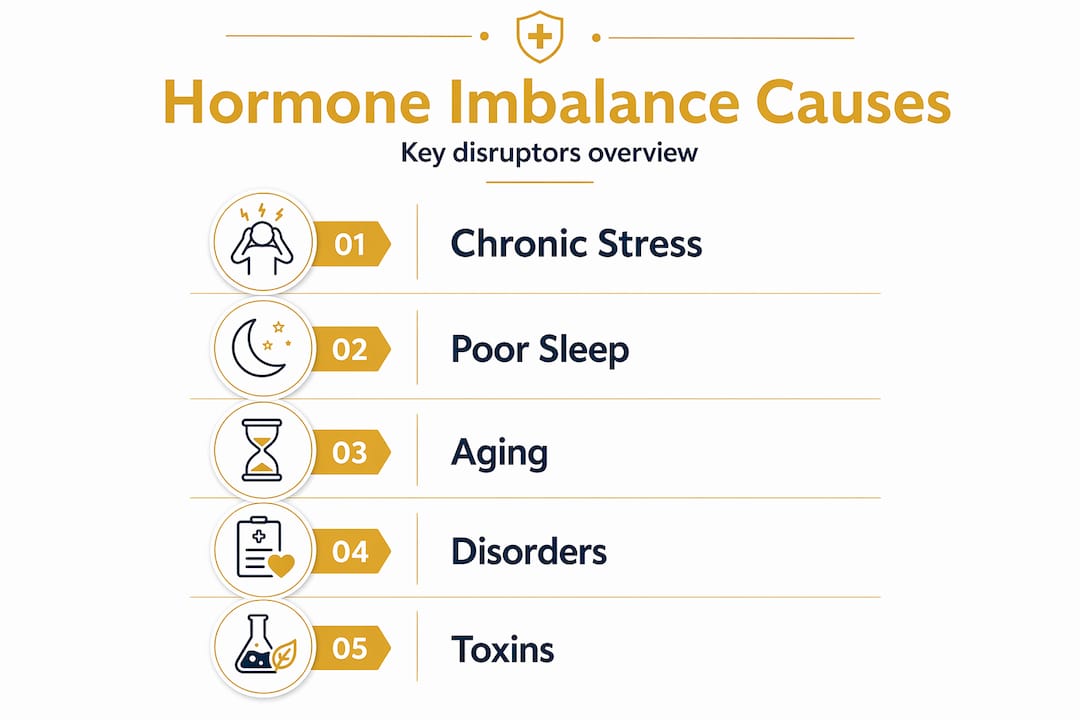
Poor sleep is equally damaging. Sleep deprivation elevates evening cortisol by up to 45%, disrupting the very hormones that govern metabolism and reproductive health. Growth hormone, which repairs tissue and supports lean body mass, releases primarily during deep sleep. Consistently cut that short and you cut your recovery.
Aging and menopause represent some of the most significant hormone shifts adults face. For women, the transition through perimenopause and menopause involves dramatic changes in estrogen and progesterone. Menopausal hormone therapy can relieve hot flashes, night sweats, vaginal dryness, and mood swings, but it carries risks including heart disease, stroke, and in some cases cognitive concerns when started after age 65. This is not a treatment to take casually or self-prescribe.
Other common hormone imbalance causes include thyroid disorders, polycystic ovary syndrome (PCOS), adrenal dysfunction, and exposure to endocrine-disrupting chemicals found in plastics and some personal care products. Age-related testosterone decline in men is another underdiagnosed driver of fatigue, muscle loss, and mood changes.
One myth worth addressing: a lot of people assume that feeling tired or gaining weight automatically means their hormones are "out of whack." Sometimes it does. Often it points to sleep debt, poor nutrition, or sedentary behavior that happens to affect hormones secondarily. That distinction matters when deciding what kind of help you need.
Natural methods to support hormone health
The good news is that several evidence-based lifestyle strategies genuinely move the needle on hormonal health. You do not need a prescription to start. Here is a practical framework:
-
Prioritize protein and healthy fats at every meal. Balanced nutrition supports insulin regulation, reduces systemic inflammation, and gives your body the building blocks it needs for hormone synthesis. Cholesterol, for example, is the precursor to every steroid hormone in your body. Cutting fat too aggressively can impair sex hormone production.
-
Treat sleep as a non-negotiable. Aim for seven to nine hours in a cool, dark room with a consistent schedule. Your body does its most significant hormonal work between midnight and 6 a.m. Disrupting that window repeatedly creates a compounding deficit.
-
Move regularly, but do not overtrain. Strength training improves insulin sensitivity and supports healthy testosterone levels. However, excessive endurance training without adequate recovery can raise cortisol and suppress reproductive hormones. Balance matters here too.
-
Manage stress with the same seriousness you manage diet. Meditation, breathwork, time in nature, and even consistent social connection all reduce cortisol output. This is not soft advice. It is physiology.
-
Support gut health. The gut microbiome plays a direct role in estrogen metabolism through a process involving enzymes that regulate how estrogen is reabsorbed or excreted. Probiotic-rich foods and high-fiber diets support this system.
-
Minimize exposure to endocrine disruptors. Swap plastic food containers for glass, check your personal care products for parabens and phthalates, and filter your drinking water when possible.
Pro Tip: Knowing how hormones affect your weight specifically can help you target the right lifestyle changes. Understanding how hormones drive weight loss gives you a clearer picture of where to focus first.
When to get tested and what to expect
Natural hormone balancing methods take you far, but they have limits. If your symptoms persist despite solid lifestyle habits, professional evaluation is the right next step.
The challenge with hormone testing is that results require context. A single estradiol reading means little without knowing where you are in your cycle, what time of day the sample was drawn, and what symptoms you are experiencing. Hormone tests must be interpreted alongside symptoms and patterns, not treated as standalone verdicts.
Here is a quick overview of the most common hormone panels and what they assess:
| Hormone test | What it measures | Key consideration |
|---|---|---|
| Estradiol and progesterone | Ovarian function, cycle health | Timing in cycle is critical for accurate interpretation |
| TSH, free T3, free T4 | Thyroid function | Subclinical thyroid issues are frequently missed with TSH alone |
| Cortisol (AM and PM) | Adrenal stress response | Diurnal pattern matters more than a single value |
| Testosterone (total and free) | Androgen status in men and women | Free testosterone often reveals more than total levels |
| Fasting insulin and glucose | Metabolic and hormonal function | Insulin resistance underlies many hormone symptoms |
For women navigating menopause specifically, the benefit-risk ratio of hormone therapy is most favorable for women under 60 or within 10 years of menopause onset. Starting therapy later in life carries meaningfully higher risks. This is exactly why personalized, physician-guided decisions outperform any general recommendation you find online, including this one.
The takeaway: get tested, but invest just as much in finding a clinician who evaluates the full picture rather than just reacting to a single number.
My take on what actually helps
I have seen a lot of people come in frustrated, convinced their hormones were destroying their health, armed with printouts from five different online calculators. And sometimes they were right. But just as often, what looked like a hormone problem turned out to be three years of poor sleep, a high-stress job, and a diet built around convenience. Their hormones were responding appropriately to a very difficult situation.
The obsession with finding the "perfect" hormone number misses the point entirely. What I have found is that the patients who make the most meaningful progress are the ones who shift their focus from the lab value to the lived experience. They ask: what changed recently? What is my sleep actually like? What is my stress load? Those questions lead somewhere useful.
I will also say this plainly: hormone balance in women going through perimenopause is one of the most undertreated areas in medicine. The symptoms are real, the quality of life impact is significant, and the evidence for thoughtful, well-timed intervention is solid. If you feel dismissed by a provider, you are right to seek a second opinion.
Gradual progress beats dramatic intervention. Your endocrine system responds well to consistency. A month of better sleep, tighter nutrition, and managed stress will show up in how you feel before it shows up in your labs. Trust that process and build on it.
— Roosevelt
Ready to understand your hormones at a deeper level?
If you have read this far, you already know more about your hormonal health than most people do. But knowing the concepts and acting on them with accurate data are two different things. That gap is exactly where Grownupmeds operates.

Grownupmeds connects you with licensed physicians who evaluate your hormone health in context, not just as a list of lab numbers. Through a quick online assessment, you get matched with a provider who builds a personalized protocol around your actual symptoms, history, and goals. Whether that means exploring men's vitality support, peptide therapy, NAD+ therapy, or GLP-1 options for weight and metabolic health, every recommendation is backed by clinical oversight. Start by completing your health optimization assessment today and get clarity on what your body actually needs.
FAQ
What is hormone balance in simple terms?
Hormone balance refers to your endocrine system maintaining hormone levels within healthy, functional ranges through natural feedback mechanisms. Because hormones fluctuate by time of day and life stage, balance is about dynamic regulation, not fixed numbers.
What are the most common signs of hormone imbalance?
The most frequent signs include persistent fatigue, unexplained weight changes, mood instability, poor sleep, low libido, brain fog, and irregular menstrual cycles. These symptoms overlap with many conditions, so medical evaluation is needed to confirm a hormonal cause.
What affects hormone levels the most?
Chronic stress, sleep quality, diet composition, exercise habits, aging, and exposure to environmental toxins are the primary factors that affect hormone levels. Cortisol from stress is particularly disruptive because it interferes with thyroid, progesterone, and insulin function simultaneously.
How can you achieve hormone balance naturally?
Supporting hormone balance naturally involves consistent, quality sleep, a protein and fat-rich diet, regular exercise, active stress management, and minimizing endocrine-disrupting chemicals. These lifestyle changes address the root inputs that your endocrine system depends on.
When should women consider hormone therapy for balance?
Women experiencing significant menopause symptoms may benefit from hormone therapy, particularly if they are under 60 or within 10 years of menopause onset, when the benefit-risk ratio is most favorable. Any decision should be made with a physician who can evaluate individual health history and risk factors.