Health assessment tools are instruments that collect and analyze health-related data to deliver personalized feedback, helping you identify risks, track changes, and make informed decisions about your wellness. These tools range from health risk assessments (HRAs) and biometric screenings to structured clinical questionnaires, each designed to surface what routine care often misses. The case for using them is direct: undiagnosed conditions like hypertension and elevated LDL cholesterol appear in nearly half of midlife adults who undergo preventive health exams. Understanding why health assessment tools belong in your wellness strategy starts with knowing exactly what they detect and how they work.
Why health assessment tools are critical for early risk detection
Health assessment tools identify hidden or asymptomatic conditions by combining two types of data: subjective information you report yourself and objective measurements from biometric or lab tests. Neither source alone is sufficient. Incomplete data in either domain reduces the accuracy of risk prediction models significantly, which is why thorough, blended assessments consistently outperform single-source screenings.
The detection power of these tools becomes clear when you look at what they find. Preventive health exams using combined questionnaire and biometric approaches reveal previously undiagnosed conditions in a substantial share of adults who believed they were healthy. That finding matters because conditions like hypertension and elevated cholesterol rarely produce symptoms until they cause serious events. Catching them early gives you time to act, not just react.

The table below compares common assessment methods and what each one detects most effectively.
| Assessment method | Primary detection capability | Data type |
|---|---|---|
| Health risk questionnaire (HRA) | Lifestyle risk factors, mental health indicators | Subjective |
| Biometric screening | Blood pressure, BMI, glucose, cholesterol | Objective |
| Lab panel (blood/urine) | Metabolic markers, organ function, lipid profile | Objective |
| Combined HRA + biometrics | Cardiovascular, metabolic, and behavioral risk | Both |
| Clinical structured interview | Emotional status, functional impact, care priorities | Subjective |
The combined approach in the final row is the most informative because it cross-references what you report with what your body measures. A questionnaire might flag high stress and poor sleep; a biometric screen might show elevated cortisol markers or blood pressure. Together, they tell a story no single data point can.
Pro Tip: Complete every section of a health questionnaire honestly, including lifestyle habits and mental health questions. Skipping or minimizing responses in those areas is the single most common reason assessments underestimate real risk.
What benefits do health assessment tools offer for cardiovascular and metabolic health?
The evidence on health assessment advantages for cardiovascular and metabolic health is both encouraging and instructive. A 2026 BMJ Open umbrella review synthesizing more than 35 years of evidence found that health checks improve cardiovascular risk factors including blood pressure, BMI, and cholesterol levels. The effect on preventing long-term cardiovascular events is mixed, but the improvement in measurable risk factors is consistent.
That distinction is worth understanding. Reducing your blood pressure or LDL cholesterol through an assessment-guided intervention does not guarantee you will never have a cardiac event. It does, however, shift your probability profile in a meaningful direction. The benefits of health assessment are most pronounced when the tools are used with high-risk populations and paired with follow-up support.
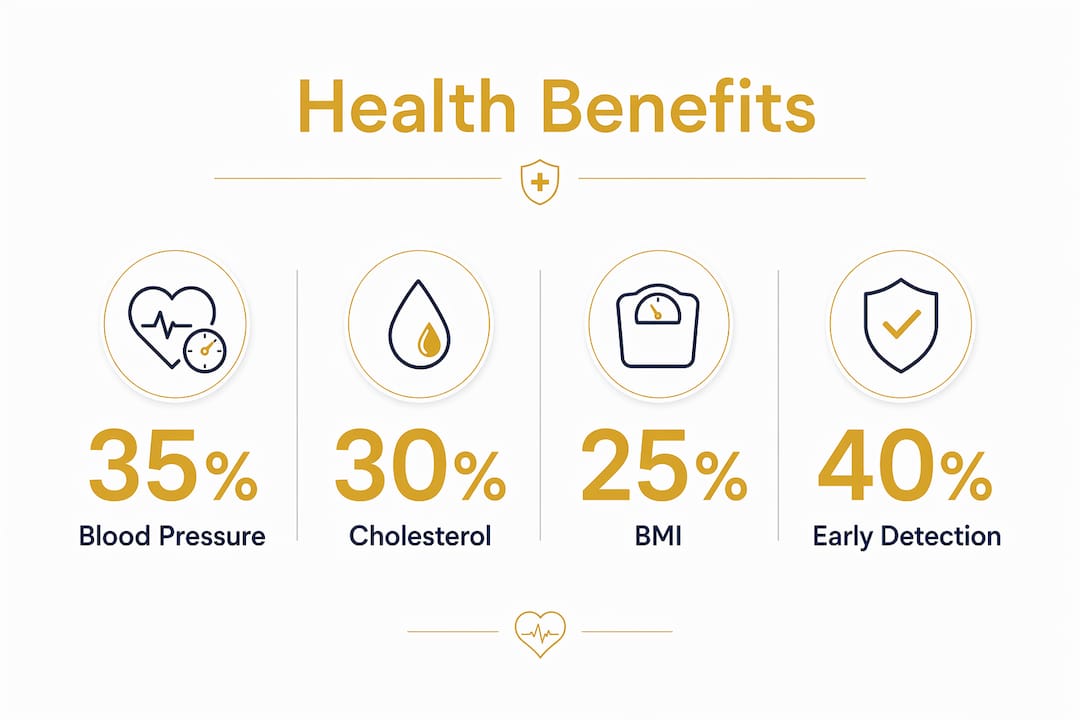
The data table below summarizes tracked improvements and the conditions under which assessments deliver the strongest return.
| Health metric | Documented improvement | Conditions for best results |
|---|---|---|
| Blood pressure | Consistent reduction in hypertensive individuals | Referral to treatment + follow-up |
| BMI | Moderate reduction with behavioral support | Behavior-change counseling included |
| LDL cholesterol | Measurable improvement in high-risk groups | Lab-confirmed baseline + intervention |
| Overall cardiovascular risk score | Reduced in targeted programs | High-risk population focus |
Cost-effectiveness follows the same pattern. Targeting high-risk populations enhances the return on assessment programs because the intervention cost is justified by the magnitude of risk reduction. Broad population screening without risk stratification dilutes that return. This is why personalized assessments, rather than generic health fairs, produce better outcomes per dollar spent.
The importance of health evaluation also extends to metabolic health. Tools that track fasting glucose, insulin sensitivity markers, and body composition give you a real-time picture of metabolic function. For adults managing weight, hormonal shifts, or energy levels, these metrics are often more actionable than a single annual checkup. You can explore how metabolic health programs translate assessment data into structured improvement plans.
How are health assessment tools designed for personalized feedback?
Health risk assessments combine questionnaires and biometric data to deliver personalized feedback via online or printed reports that guide individual risk reduction and ongoing monitoring. The design is intentional: rather than handing you a raw data dump, a well-built HRA translates numbers into recommendations you can act on.
Delivery modes vary. Online platforms generate instant reports with color-coded risk indicators and suggested next steps. In-person assessments add clinician interpretation. Paper-based formats remain common in workplace wellness programs. Each mode serves a different context, but the core function is the same: convert your data into a personalized picture of where you stand and what to prioritize.
Here is how to use health tools effectively through a structured workflow:
- Complete the intake questionnaire fully. Include lifestyle habits, family history, sleep quality, stress levels, and current medications. This is the subjective layer that gives context to your biometric data.
- Undergo biometric measurements. Blood pressure, weight, waist circumference, and a basic lab panel form the objective layer. Together with your questionnaire, they create a complete risk profile.
- Review your personalized report. Identify the two or three highest-priority risk areas flagged by the tool. Focus there first rather than trying to address every finding simultaneously.
- Set measurable goals based on the feedback. If your report flags elevated blood pressure, set a 90-day target with specific behavioral changes attached to it.
- Reassess at regular intervals. Ongoing tracking via health risk assessments establishes baselines and reveals trends over time, which is far more informative than a single measurement.
The role of health assessment tools in this workflow is not to replace your physician. It is to arrive at every clinical conversation with data that makes the discussion more focused and productive. You can learn more about what health assessment involves and how it builds a foundation for better health decisions.
Pro Tip: After receiving your assessment report, schedule a follow-up appointment specifically to discuss the findings. Treating the report as a conversation starter rather than a final verdict is what turns data into outcomes.
What is the role of health assessment tools in clinical and serious-illness settings?
In clinical settings, health assessment tools serve a purpose that goes beyond screening. Assessment tools in serious illness care guide clinicians on a patient's physical, emotional, and daily life status, supporting rather than replacing the patient-clinician dialogue. This distinction matters because it frames these tools correctly: they are conversation guides, not diagnostic substitutes.
Structured forms and symptom prompts help clinicians focus appointments on what matters most to each patient. Without a standardized tool, important concerns like fatigue, mood changes, or functional limitations can get overlooked in a time-pressured visit. With one, the clinician enters the conversation already oriented to the patient's priorities.
For patients and caregivers, the value is equally real. Assessment tools standardize patient experience data and prompt focus on key concerns, improving understanding without overwhelming the person being assessed. When framed as aids to guide what matters most rather than diagnostic checklists, patients engage more openly and honestly.
Key benefits of health evaluation tools in clinical communication include:
- Appointment focus: Structured prompts direct limited clinical time toward the patient's most pressing concerns.
- Trend monitoring: Repeated use of the same tool over multiple visits reveals whether symptoms are improving, stable, or worsening.
- Trust building: Patients who feel their full experience is being captured report higher satisfaction and greater engagement with their care plan.
- Caregiver inclusion: Tools designed for serious illness often include caregiver-facing sections, capturing the support network's perspective alongside the patient's.
- Clinical consistency: Standardized tools reduce variability in how different clinicians assess the same patient, improving continuity of care.
The physician-supervised telehealth protocols that integrate these tools into ongoing care plans demonstrate how assessment-driven conversations translate into better-targeted treatment decisions.
Key takeaways
Health assessment tools deliver their greatest value when they combine subjective questionnaire data with objective biometric results and connect findings to structured follow-up and behavior-change support.
| Point | Details |
|---|---|
| Early detection is the core advantage | Tools identify hidden conditions like hypertension and elevated cholesterol before symptoms appear. |
| Combined data improves accuracy | Questionnaire plus biometric data together produce more reliable risk models than either source alone. |
| Cardiovascular metrics improve with use | Blood pressure, BMI, and cholesterol show consistent improvement when assessments target high-risk groups. |
| Personalized feedback drives action | HRA reports translate raw data into prioritized, individual recommendations you can act on immediately. |
| Follow-up determines outcomes | Detection alone does not improve health. Referral access and behavior-change support are what convert findings into results. |
What I've learned from watching people use these tools well and poorly
The most common mistake I see is treating a health assessment as a one-time event. Someone completes a thorough HRA, gets a detailed report flagging elevated cardiovascular risk, and then files it away. Six months later, nothing has changed. The tool did its job. The follow-through did not.
The second mistake is the opposite: over-interpreting a single data point. One elevated fasting glucose reading does not mean you have diabetes. One high blood pressure reading at a stressful moment does not mean you need medication. Health assessment tools establish baselines and track trends. Their power is in the pattern, not the single number.
What I find genuinely useful about well-designed HRAs is that they surface the gap between how people think they are doing and how their body is actually performing. Most adults who discover undiagnosed hypertension through a preventive exam felt fine beforehand. That gap between perceived and actual health status is exactly where these tools earn their place.
The practical lesson is straightforward. Use assessments as decision aids, not diagnostic verdicts. Pair every assessment with a clear next step, whether that is a physician conversation, a behavioral change, or a follow-up measurement in 90 days. And recognize that social support and referral access are not optional extras. They are the mechanism by which detected risks become improved outcomes.
— Roosevelt
Take your health assessment further with Grownupmeds
Grownupmeds applies the same principle that makes health assessment tools effective: personalized data drives better decisions. The platform guides you through a physician-supervised assessment, connects you with licensed physicians, and builds a treatment plan around your specific findings.
For adults whose assessments reveal metabolic, hormonal, or cellular health concerns, Grownupmeds offers peptide therapy options and NAD+ therapy designed to address the root causes behind the numbers. These are not generic wellness products. They are science-backed protocols matched to your health profile, delivered through US-based pharmacies with ongoing physician oversight. If your assessment has surfaced risks worth addressing, Grownupmeds provides the clinical pathway to act on them.
FAQ
What are health assessment tools used for?
Health assessment tools collect and analyze health data including questionnaire responses and biometric measurements to identify risk factors, establish baselines, and guide personalized wellness decisions. They are used in both preventive care and clinical settings to surface conditions that may otherwise go undetected.
How do health assessment tools detect conditions early?
By combining self-reported lifestyle data with objective biometric and lab results, these tools identify patterns associated with conditions like hypertension and elevated cholesterol before symptoms appear. Research shows that preventive health exams using this blended approach detect undiagnosed conditions in nearly half of midlife adults.
Do health assessments actually improve health outcomes?
Health assessments improve measurable risk factors like blood pressure, BMI, and cholesterol consistently, particularly in high-risk populations. Long-term event prevention depends heavily on whether the assessment is paired with referral access and behavior-change support.
How often should you complete a health risk assessment?
Most health optimization programs recommend reassessing every 90 to 180 days to track trends rather than relying on a single measurement. Ongoing HRA tracking establishes the baseline data needed to measure whether interventions are working.
Are health assessment tools a substitute for seeing a doctor?
No. Health assessment tools are designed to support and focus clinical conversations, not replace them. They give you and your physician better data to work with, but clinical judgment and personalized treatment decisions require a licensed provider.