Most people assume a health assessment is just a routine checkup — a blood pressure reading, a quick listen with a stethoscope, and a "you're good to go." That framing undersells what a real health assessment actually does. Understanding what is health assessment in its full form means recognizing it as the foundational process that determines whether your care plan will actually work for you or simply follow a generic template. For adults focused on weight management, hormone health, and longevity, this distinction is not academic. It is the difference between a plan built around your biology and one built around an average that may not represent you at all.
Table of Contents
- What is a health assessment and why is it important?
- Core components of a comprehensive health assessment
- Types of health assessments and their purposes
- How health assessments work in telehealth and weight management
- Applying health assessments to your wellness and longevity plan
- Why conventional views of health assessments fall short and what truly matters
- Optimize your health with science-backed assessments and telehealth
- Frequently asked questions
Key Takeaways
| Point | Details |
|---|---|
| Foundational first step | A thorough health assessment is essential for building an effective personalized health plan. |
| Comprehensive scope | Health assessments must cover physical, psychosocial, functional, and environmental factors for best outcomes. |
| Timely execution | Home health assessments require strict timing coordination to comply with guidelines and ensure care continuity. |
| Different assessment types | Individual, preventive, and impact assessments serve distinct roles in health and community wellness. |
| Practical application | Use assessment insights to guide weight management and longevity strategies in coordination with telehealth services. |
What is a health assessment and why is it important?
The health assessment definition goes well beyond a single office visit. Health assessment is defined as the evaluation of an individual's health status through objective measures and self-reported information, forming the basis for person-centered care planning. That means it pulls together your lab values, your medical history, your lifestyle behaviors, and your own account of how you feel day to day.
The importance of health assessment becomes obvious when you consider what happens without one. A physician prescribing a weight loss protocol without knowing your metabolic baseline, your sleep quality, or your history with medications is guessing. A good assessment eliminates that guesswork.
Here is what a thorough health assessment captures:
- Objective clinical data: BMI, blood pressure, fasting glucose, lipid panels, hormone levels
- Medical history: past diagnoses, surgeries, chronic conditions, family history
- Current medications and supplements: to identify interactions and contraindications
- Lifestyle factors: diet patterns, physical activity, alcohol use, sleep duration
- Self-reported symptoms: fatigue, mood changes, energy levels, libido, cognition
The quality of your outcomes depends entirely on the quality of this data. Platforms built around science-backed health optimization understand that skipping or rushing this step produces plans that look good on paper but fail in practice.
"A health assessment is not a formality. It is the clinical foundation that separates personalized medicine from guesswork."
Core components of a comprehensive health assessment
With a foundational understanding of what health assessments are, let's explore their detailed components and how they are conducted.

Comprehensive assessments include physical, mental, social, environmental, and functional status. Interdisciplinary input and family involvement are critical for best results. This is where most people are surprised. They expect a physical exam. They do not expect questions about their living situation, their support network, or their cognitive function.
Here is what each domain actually covers:
- Physical status: vital signs, body composition, chronic disease markers, pain levels, and current health problems
- Psychosocial status: screening for depression, anxiety, cognitive decline, and social isolation, all of which directly affect adherence to any health plan
- Functional status: can you perform daily tasks independently? This matters more than most people realize for long-term health trajectories
- Environmental factors: home safety, access to healthy food, financial stress, and neighborhood walkability all influence whether a care plan is realistic
- Family and caregiver input: people close to you often report patterns you have normalized or overlooked
This is where comprehensive health optimization separates from a basic annual physical. A physician who only reviews your labs is missing at least half the picture. The person who cannot sleep because of financial stress, lives alone, and has no social accountability structure will not respond to the same protocol as someone with a stable environment and strong support.
Pro Tip: Before your next health assessment, write down three things that have changed in your daily life over the past six months. Stress, sleep shifts, new medications, and diet changes are often underreported because patients assume they are not relevant. They almost always are.
Types of health assessments and their purposes
Recognizing the types of assessments paves the way to understand practical processes and timelines involved in telehealth service models.
Not all health assessments serve the same purpose. The CDC outlines three primary types: individual health assessments focused on personal status, preventive assessments prioritizing USPSTF recommendations for screenings, and Health Impact Assessments that evaluate policy and project effects to promote health equity.
| Assessment type | Primary goal | Who it involves | Timeframe |
|---|---|---|---|
| Individual health assessment | Map current health, identify risks | Patient and physician | Ongoing, updated regularly |
| Preventive health assessment | Screen healthy adults for early risk detection | Patient, primary care provider | Every 1 to 2 years |
| Health Impact Assessment | Evaluate policy effects on community health | Public health teams, policymakers | Project-based, months to years |
For adults pursuing weight management and longevity, the individual and preventive types are most relevant. Preventive health assessments prioritize USPSTF A and B recommendations for routine screenings to detect risks and improve health outcomes. These include blood pressure checks, cholesterol panels, diabetes screening, and cancer screenings based on age and risk profile.
What most people miss is that preventive assessments are not just about catching disease early. They establish a baseline. If your fasting glucose is 94 today and 102 in two years, that trend is a signal even though both numbers fall within a "normal" range. Tracking change over time is where preventive health optimization delivers real value.
How health assessments work in telehealth and weight management
With clarity on processes, next is how you can apply health assessments practically to optimize your wellness journey.
Telehealth has changed the logistics of health assessment without changing the clinical standards. The process still follows a clear sequence, and timing matters more than most patients realize.
Here is how a structured telehealth health assessment typically unfolds:
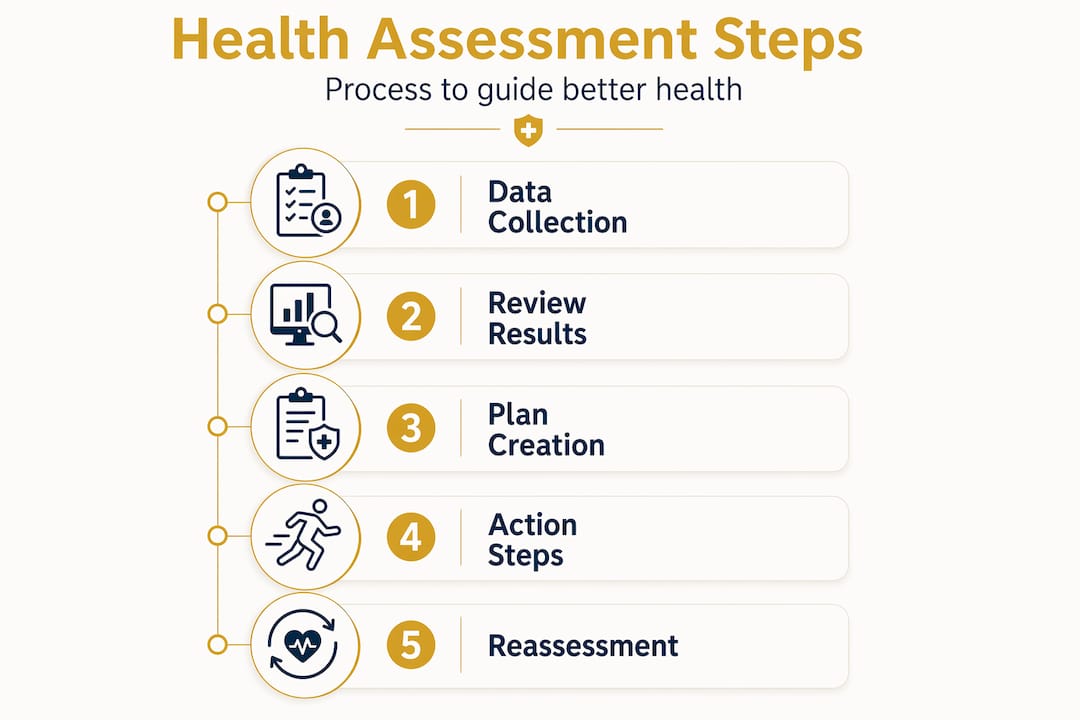
- Initial intake: You complete a detailed digital questionnaire covering medical history, current symptoms, medications, lifestyle, and goals. This is your self-reported layer.
- Lab work: You visit a local lab or use at-home testing kits to generate objective data, including hormone panels, metabolic markers, and inflammatory indicators.
- Physician review: A licensed physician reviews your full data profile, not just your labs, before any plan is created.
- Plan of care alignment: Your assessment results are matched to a physician-supervised protocol. CMS OASIS-E guidelines require comprehensive home health assessments within 5 days of care start, with follow-ups every 60 days. Assessments must align with physician plans to avoid reimbursement issues.
- Ongoing monitoring: Telehealth tools track weight, blood pressure, sleep, and other markers between formal reassessments.
- Periodic reassessment: Every 60 days, your data is reviewed and your plan is updated based on actual results, not assumptions.
Pro Tip: When using a telehealth platform for weight or longevity goals, ask specifically whether your assessment includes a medication review. Drug interactions and nutrient depletions caused by common medications are frequently missed and can undermine your results before you even start.
The 60-day reassessment cycle is particularly valuable for weight management. Most people plateau or shift in their response to interventions within that window. Catching it early with updated data prevents months of effort in the wrong direction. Platforms built around telehealth health optimization use this cycle to keep plans responsive rather than static.
Applying health assessments to your wellness and longevity plan
Before concluding, let's share a fresh perspective on why a deeper approach to health assessments is crucial beyond standard protocols.
A health assessment is only as useful as what you do with the results. Here is how to translate assessment data into a practical, evolving wellness strategy:
- Set specific, data-driven goals: Instead of "lose weight," use your assessment to define targets like reducing fasting insulin by 20% or reaching a body fat percentage of 22% within six months.
- Identify your actual barriers: If your assessment reveals poor sleep or high cortisol, those are not side issues. They are primary targets, because no weight loss protocol works well in a chronically stressed, sleep-deprived body.
- Use telehealth tools between assessments: Remote monitoring of weight trends, blood pressure, and glucose gives you real-time feedback and prevents small problems from becoming large ones.
- Involve your support network: If your assessment flags social isolation or caregiver stress as factors, address them directly. They will affect your adherence more than any supplement or medication.
- Schedule reassessments proactively: Do not wait until something feels wrong. Scheduled data reviews are how you catch drift early.
Person-centered plans resulting from comprehensive assessments improve health outcomes by considering individual strengths, goals, and barriers. The table below shows how specific assessment findings translate into actionable plan adjustments.
| Assessment finding | What it signals | Plan adjustment |
|---|---|---|
| Elevated fasting insulin | Early insulin resistance | Low-glycemic diet, consider GLP-1 evaluation |
| Low testosterone (men) | Hormonal contributor to weight gain | Hormone panel follow-up, possible TRT evaluation |
| Poor sleep quality | Cortisol dysregulation, appetite disruption | Sleep protocol, stress management, melatonin review |
| Social isolation noted | Adherence risk factor | Accountability structure, caregiver or partner involvement |
| Elevated CRP (inflammation) | Metabolic and cardiovascular risk | Anti-inflammatory nutrition, targeted supplementation |
Connecting your personalized wellness planning to real assessment data is what separates people who sustain results from those who cycle through programs without lasting change.
Why conventional views of health assessments fall short and what truly matters
Here is the uncomfortable truth about most health assessments: they are designed for compliance, not optimization. The standard annual physical checks boxes. It screens for obvious disease. What it almost never does is ask why you feel the way you feel, or what factors in your life are quietly pulling your health in the wrong direction.
Integrating family interviews and addressing psychosocial factors reveals barriers missed by patient-only reports and improves care outcomes. This finding from home health research applies directly to anyone pursuing weight loss or longevity goals. Your physician may not know that you have been the primary caregiver for an aging parent for the past year, that your sleep has been fragmented for months, or that financial stress has changed your eating patterns. You may not even connect those dots yourself. A thorough assessment does.
The second gap is functional. Most assessments measure what is wrong, not what your body is capable of. For adults focused on longevity, functional capacity, including grip strength, VO2 max, balance, and cognitive speed, predicts long-term health outcomes better than most standard lab values. These are rarely included in a basic checkup.
Telehealth, done right, can close both gaps. Digital intake forms can ask the questions a rushed office visit skips. Remote monitoring captures real-world data rather than a single-day snapshot. And ongoing physician relationships allow for the kind of iterative refinement that a once-a-year appointment cannot provide.
The mistake is treating telehealth as a shortcut to a prescription. The platforms that produce real results use it as a tool to conduct deeper, more frequent, and more personalized assessments than traditional care allows. Advanced health assessment insights are not about more tests. They are about asking better questions and acting on the answers with consistency.
Optimize your health with science-backed assessments and telehealth
Having explored how comprehensive health assessments can transform your wellness, Grown Up Meds is here to guide you every step of the way.
Grown Up Meds connects you with licensed physicians who review your full health profile before recommending any protocol. Our science-backed health optimization services cover weight management, hormone health, peptide therapy, and cellular support, all grounded in assessment data specific to you. You complete your intake online, your physician reviews your labs and history, and your plan is built around your actual biology. Reassessments every 60 days keep your plan current as your body responds and your goals evolve. If you are serious about weight management and longevity, the right assessment is where it starts.
Frequently asked questions
What is the main purpose of a health assessment?
The main purpose is to collect comprehensive data about your health status to create a personalized, effective care or wellness plan. A thorough health assessment is the essential first step in shared decision making and person-centered planning.
How often should adults take preventive health assessments?
Adults aged 19 to 49 should have screenings approximately every 1 to 2 years. USPSTF A and B recommendations guide which screenings are prioritized to detect risks early and improve long-term outcomes.
What does a comprehensive health assessment include beyond physical exams?
It includes psychosocial, cognitive, environmental, and functional status evaluations plus input from family or caregivers. Comprehensive assessments involve mental, social, environmental, and functional domains alongside physical health.
Why is timing critical in home health assessments under CMS guidelines?
Assessments must align with the physician's plan within strict timelines, including within 5 days of care start, to avoid payment denials. OASIS assessments must meet exact timing criteria to comply with payment rules and ensure uninterrupted care.