
The role of physician in online care is to deliver licensed, clinically sound, and patient-centered healthcare through virtual platforms, with full legal and ethical accountability intact. Telehealth, the recognized industry term for physician-delivered care via digital channels, has expanded rapidly through platforms like Teladoc Health and Doctor On Demand. Physicians in this space carry the same responsibilities they hold in a physical clinic, from state licensure compliance to diagnostic accuracy. Understanding what your online physician is actually required to do helps you get more from every virtual visit.
What legal and licensure responsibilities do physicians have in online care?
Licensure is the single most consequential legal requirement shaping how physicians practice in telehealth. A physician must hold an active license in the patient's state at the exact time of service. That rule applies whether the visit happens on a large platform or a small private practice portal.
The Interstate Medical Licensure Compact, known as the IMLC, is active in over 40 states and cuts paperwork and processing time to roughly 2–4 weeks per state. That speed matters for physicians who want to serve patients across multiple states. However, the IMLC is widely misunderstood.

The IMLC is not a single multistate license. It is a process that simplifies applying for individual state licenses. Each state retains its own jurisdiction, and a physician must be separately approved in every state where they see patients. Physicians who assume IMLC membership alone authorizes multistate practice risk serious regulatory violations.
Here is what this means for you as a patient:
- Your physician must be licensed in your state, not just the state where the platform is headquartered.
- Platforms operating across state lines are legally required to verify physician licensure for each patient location.
- If a platform cannot confirm your physician's state license, that is a red flag worth addressing before the visit.
- State-specific rules also govern what conditions can be treated, what medications can be prescribed, and whether an initial in-person visit is required.
Pro Tip: Before your first telehealth visit, ask the platform to confirm your physician holds an active license in your state. Reputable services like those offered through Grownupmeds make this verification part of their standard intake process.
Licensure compliance is not just a legal formality. It directly protects your right to safe, accountable care. When a physician is properly licensed in your state, you have a clear path to file complaints, seek second opinions, and hold providers accountable if something goes wrong.
How do physicians maintain clinical quality in telehealth?
Clinical quality in telehealth depends on physician behavior, platform capability, and training. The physician's liability for clinical decisions does not shrink because the visit happens on a screen. Physicians bear full legal responsibility for every clinical decision made in a virtual encounter, regardless of what the platform's marketing claims.
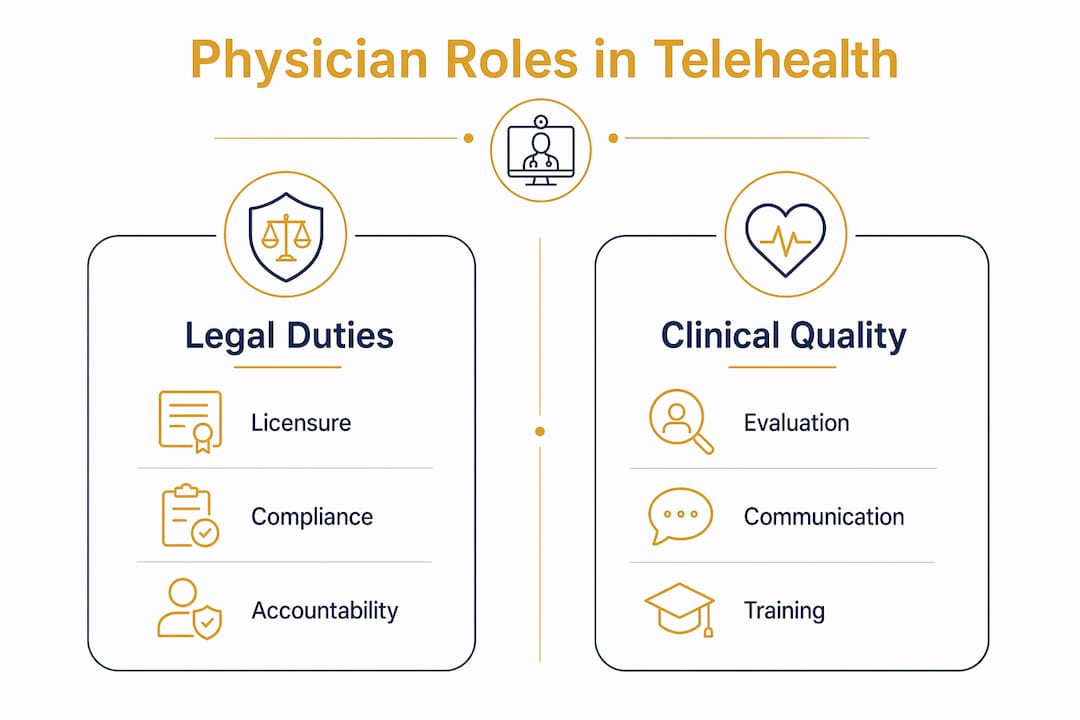
That accountability creates real pressure, especially given a significant training gap in the field. Fewer than half of physicians, specifically 44.3%, have received formal telemedicine training. That gap contributes to burnout and heightened concern about legal exposure in virtual practice. It also means the quality of your virtual visit can vary significantly depending on your physician's experience with digital care.
Physicians who deliver high-quality telehealth care tend to follow a consistent set of practices:
- Maintain eye contact through the camera, not the screen, to signal attention and build trust with the patient.
- Use plain, deliberate language and pause frequently to confirm the patient understands the diagnosis or treatment plan.
- Document thoroughly in real time, using electronic health record (EHR) integration to capture clinical notes during the visit rather than relying on memory afterward.
- Request supplemental data when a physical exam is not possible, including patient-reported vitals, recent lab results, or photos of visible symptoms.
- Refer appropriately, recognizing when a virtual visit is insufficient and an in-person evaluation or specialist consult is required.
Effective virtual communication requires physicians to actively counteract the distraction-prone nature of digital environments. Multitasking during a video call is a documented problem that reduces patient-centeredness. Physicians who treat the virtual visit with the same focus as an in-person appointment consistently produce better patient outcomes.
Pro Tip: If your physician seems distracted, is typing heavily without explanation, or rushes through your concerns, you are within your rights to ask them to slow down. Good telehealth physicians expect and welcome that kind of direct communication.
Platform technology also plays a direct role in clinical quality. Telehealth platforms must support comprehensive clinical workflows, including EHR integration and specialist collaboration tools, to enable accurate diagnosis and efficient care. A platform that only offers a video chat window without clinical infrastructure puts both the physician and the patient at a disadvantage.
How do physicians build patient relationships through virtual care?
The physician-patient relationship does not disappear in a virtual setting. It adapts. Research shows that relationship quality in telemedicine accounts for roughly 30% of the positive effect telemedicine adoption has on physician job satisfaction. That finding points to something important: physicians who invest in the relationship get more from virtual practice, and so do their patients.
One of the most underappreciated tools physicians use in digital health is the online health community. Physician-driven online communities improve patient wellbeing and disease self-management for chronic conditions including diabetes and depression. When a physician actively participates in these communities, rather than simply moderating them, patient engagement increases measurably and long-term health outcomes improve.
Strategies physicians use to build strong virtual relationships include:
- Sending follow-up messages after visits to check on symptom progression or medication tolerance.
- Providing written summaries of the visit so patients can review the plan without relying on memory.
- Using asynchronous messaging tools to answer non-urgent questions between appointments.
- Personalizing care by referencing prior visit notes at the start of each new encounter.
"The physician-patient relationship is the foundation of effective care. In virtual settings, that relationship requires more deliberate effort, not less."
For patients managing chronic conditions, the continuity that comes from a consistent physician relationship in telehealth is especially valuable. A physician who knows your history, tracks your progress, and communicates proactively between visits delivers a fundamentally different experience than one who treats each encounter as a standalone transaction. Platforms that support ongoing physician engagement rather than episodic visits are better positioned to produce lasting health improvements.
Direct-to-consumer vs. physician-supervised telehealth: what is the difference?
Not all telehealth models carry the same level of physician oversight. Understanding the difference protects you from platforms that prioritize volume over clinical rigor.
| Feature | Direct-to-Consumer Platforms | Physician-Supervised Protocols |
|---|---|---|
| Physician involvement | Varies, often minimal | Required at every stage |
| Treatment personalization | Algorithm-driven | Clinically assessed per patient |
| Prescription oversight | May incentivize volume | Based on clinical evaluation |
| Legal accountability | Diffuse across platform | Physician retains full liability |
| Follow-up care | Often absent | Structured and ongoing |
Physicians must evaluate the business model of any telehealth platform they join. Platforms that limit treatment options or create financial incentives tied to prescription volume put physicians in a legally and ethically compromised position. The physician remains liable for clinical decisions even when a platform's structure nudges them toward a particular outcome.
For patients, the practical test is straightforward. Ask whether a licensed physician reviews your intake assessment, whether your treatment plan is personalized to your health history, and whether follow-up care is built into the model. If the answer to any of those questions is no, the platform is operating closer to a direct-to-consumer model than a physician-supervised one. Grownupmeds publishes physician-supervised protocols that clarify exactly what clinical oversight looks like at each stage of care.
Key takeaways
Physicians in online care carry the same legal, clinical, and relational responsibilities as in-person providers, and the platforms they use must support those standards to protect both patient and physician.
| Point | Details |
|---|---|
| Licensure is non-negotiable | Your physician must hold an active license in your state at the time of every telehealth visit. |
| Training gaps are real | Fewer than half of physicians have formal telemedicine training, making platform choice and physician experience critical. |
| Clinical liability stays with the physician | Physicians remain fully responsible for decisions made in virtual care, regardless of platform policies. |
| Relationships drive outcomes | Physician-patient relationship quality accounts for 30% of telemedicine's positive effect on physician engagement and satisfaction. |
| Platform model matters | Physician-supervised protocols produce better outcomes than algorithm-driven direct-to-consumer models. |
The part most patients never think to ask about
I have spent years reviewing how digital health platforms present physician oversight to patients, and the gap between marketing language and clinical reality is wider than most people realize. Platforms use phrases like "board-certified physicians" and "medically supervised" as trust signals, but those terms tell you almost nothing about the actual depth of physician involvement in your care.
The question worth asking is not whether a physician is involved. The question is how the physician is involved and whether the platform's structure supports or undermines their clinical judgment. A physician working inside a platform that incentivizes prescription volume or limits diagnostic options is not delivering the same care as one operating under a genuinely supervised protocol.
The training gap compounds this problem. When fewer than half of practicing physicians have received formal telemedicine training, the quality of virtual care becomes highly variable. Patients who understand this are better equipped to advocate for themselves. Ask your telehealth physician directly about their telemedicine experience. Ask whether they have access to your full health history before the visit. Ask what happens if your condition requires in-person evaluation.
Telehealth genuinely expands access to quality care for millions of people who cannot easily reach a clinic. That potential is real. But it is only realized when physicians are empowered to practice with full clinical authority, and when patients know enough to recognize the difference.
— Roosevelt
How Grownupmeds puts physician supervision at the center of your care
Grownupmeds was built around the principle that physician oversight is not optional in health optimization. Every protocol on the platform, from peptide therapy to NAD+ cellular support, is designed and supervised by licensed physicians who review your intake assessment, personalize your treatment plan, and remain available throughout your care.

The platform connects you with US-based licensed physicians and sources medications exclusively from US-based pharmacies. That structure means your care is clinically grounded, legally compliant, and built for your specific health goals rather than a generic protocol. If you are ready to experience what physician-supervised telehealth actually looks like in practice, Grownupmeds is the place to start.
FAQ
What is the role of a physician in online care?
A physician in online care provides licensed, clinically accountable medical evaluation, diagnosis, and treatment through virtual platforms. Their responsibilities include state licensure compliance, accurate diagnosis, personalized treatment planning, and ongoing patient follow-up.
Do telehealth physicians need a license in my state?
Yes. Physicians must hold an active medical license in the patient's state at the time of every telehealth visit. The Interstate Medical Licensure Compact simplifies the application process but does not replace individual state licensure requirements.
How can i tell if a telehealth platform is physician-supervised?
Look for platforms where a licensed physician reviews your health history before prescribing, personalizes your treatment plan, and provides structured follow-up care. Platforms that rely solely on algorithms or questionnaires without physician review are not genuinely physician-supervised.
What happens if a telehealth company breaks the rules?
Physicians remain legally liable for clinical decisions made through a telehealth platform, even if the platform's business model contributed to the problem. Patients affected by substandard virtual care can file complaints with their state medical board.
Why does physician-patient relationship quality matter in telehealth?
Research shows that relationship quality accounts for roughly 30% of the positive effect telemedicine has on physician job satisfaction and engagement. Stronger relationships also correlate with better patient adherence, improved chronic disease management, and higher overall satisfaction with virtual care.