Finding a weight management program online sounds simple until you start sorting through meal-replacement shakes, 21-day challenges, and apps that promise 30 pounds gone by summer. For adults who want real, lasting results with actual clinician oversight, this guide to safe weight management online cuts through the noise. You will learn what safe weight loss actually looks like, how to evaluate online programs before you commit, how to execute a plan that adapts to you, and what it takes to keep the weight off for good.
Table of Contents
- Understanding safe weight management basics
- Preparing to start an online weight management program
- Executing your online weight management plan effectively
- Monitoring progress and maintaining weight loss long-term
- Why safe, clinician-backed online programs beat quick-fix diets
- Explore medically supervised weight management with Grown Up Meds
- Frequently asked questions
Key Takeaways
| Point | Details |
|---|---|
| Gradual weight loss | Losing 1 to 2 pounds weekly supports lasting fat loss and better health outcomes. |
| Professional support | Clinician involvement and trained professional guidance ensure safe, personalized plans. |
| Track and adapt | Using online trackers and apps helps you monitor habits and adjust your approach effectively. |
| Long-term maintenance | Sustained success requires ongoing physical activity, follow-up, and lifestyle habits. |
Understanding safe weight management basics
Safe weight management is not a set of rules. It is a framework built on biology, behavior, and consistency. Before you search for an online diet plan or sign up for anything, knowing what "safe" actually means gives you the lens to judge every option you encounter.

The single most important benchmark: gradual weight loss of 1-2 lbs per week is the pace that research consistently supports as the safest and most likely to last. Faster rates of loss almost always come at a cost, whether that is muscle mass, nutritional deficiency, or eventual weight regain.
Here is something most online weight loss guides skip over: you do not need to lose a dramatic amount of weight to change your health trajectory. Losing just 3% to 5% of body weight produces measurable improvements in blood pressure, fasting glucose, and triglycerides. For a 200-pound adult, that is 6 to 10 pounds. Meaningful clinical change is closer than most people think.
"Safe weight management is never just about the scale. It is about the interaction between what you eat, how you move, and how consistently you can maintain new behaviors over time."
Effective, safe weight management always combines three elements working together:
- Nutritional changes that create a modest, sustainable calorie deficit without eliminating food groups
- Physical activity introduced gradually and matched to your current fitness level
- Behavior change support that addresses the habits, patterns, and triggers driving food choices
The behavior change piece is the one most self-directed online programs underdeliver on. You can follow a meal plan. Changing the decision-making patterns that led to weight gain in the first place requires structured professional support.
Pro Tip: Before starting any online program, read the long-term weight loss tips that apply after the first 90 days. Most program failures happen in month four, not month one.
Preparing to start an online weight management program
Now that you understand the basics of safe weight loss, the next step is choosing the right program for your specific needs. This is where most adults make costly mistakes, either selecting programs based on marketing or skipping the verification process entirely.
Before you spend money or time on any program, consult your healthcare provider and ask them to assess your current health status, any metabolic or cardiovascular risks, and whether any medications could affect your weight loss plan. This is not a formality. It is a clinical safeguard that protects you from programs that could interact badly with existing conditions.
Once you have that baseline, use this evaluation checklist before enrolling in any program:
- Ask who supervises the program. Is there a licensed physician, registered dietitian, or certified health coach involved? Get specific names or credentials, not just branding language.
- Request evidence of effectiveness. What outcome data does the program publish? Peer-reviewed outcomes are a strong signal. Testimonials alone are not.
- Confirm the level of personalization. Does the program adapt to your specific history, or does everyone get the same plan?
- Understand the follow-up structure. How often will a professional review your progress and adjust your protocol?
- Review the safety escalation process. What happens if you experience side effects, plateaus, or a health event during the program?
Use this comparison table when reviewing programs you are considering:
| Feature | What to look for | Warning sign |
|---|---|---|
| Clinician involvement | Licensed physician or specialist oversight | No clinical credentials listed |
| Weight loss pace | 1-2 lbs/week targets | "Lose 10 lbs in 10 days" claims |
| Personalization | Plan built from your health intake | One-size-fits-all meal templates |
| Behavior support | Structured coaching or check-ins | Meal plan only, no human contact |
| Progress tracking | Regular reviews with feedback | No check-ins after enrollment |
| Transparency | Ingredients, protocols, clinician bios | Hidden costs, vague program details |
Pro Tip: Review programs the same way you would evaluate choosing safe weight loss treatments for medical therapies. The standard for an online program should not be lower just because it arrives via app.
Executing your online weight management plan effectively
With the right program selected, the next step is to implement your plan actively and track progress daily for success. Enrollment is the easy part. Execution over weeks and months is where most plans either compound into results or quietly fall apart.
Tracking is your first non-negotiable. Using online trackers and apps to record food intake, physical activity, and weekly weight gives you a data stream that your clinician or coach can actually use. Without consistent tracking, no professional can give you meaningful feedback.
What to track daily:
- Calorie and macronutrient intake (protein is especially important to log)
- Physical activity type, duration, and perceived effort level
- Sleep hours, since poor sleep elevates hunger hormones and stalls fat loss
- Body weight, same time each morning, after using the bathroom and before eating
- Mood and energy levels, which often flag early signs of over-restriction
Goal-setting matters just as much. Setting specific activity goals like "walk 20 minutes on Monday, Wednesday, and Friday after lunch" produces far better adherence than "I want to be more active." Here is a practical side-by-side that shows the difference:
| Category | Vague goal | Specific, measurable goal |
|---|---|---|
| Physical activity | "Exercise more" | "Walk 25 minutes, 4 days per week" |
| Nutrition | "Eat healthier" | "Add vegetables to two meals daily" |
| Protein intake | "Eat more protein" | "Include 25-30g protein at breakfast" |
| Calorie tracking | "Watch what I eat" | "Log every meal in the app before eating" |
| Check-ins | "Stay in touch with my coach" | "Message coach every Sunday with weekly summary" |
Beyond tracking, your relationship with program professionals is what separates adequate results from meaningful ones. Schedule regular feedback sessions into your calendar and come prepared with your data. Use a weight loss step guide to structure your progress conversations so you cover nutrition, activity, and behavior every time.
Pro Tip: If your program does not proactively reach out to you within the first two weeks, that tells you something important about how much professional oversight you are actually getting.
Monitoring progress and maintaining weight loss long-term
After executing your plan, the verification phase separates people who maintain their results from those who regain weight within a year. Progress monitoring is not just about celebrating wins. It is a clinical feedback loop that keeps your protocol calibrated.
Research shows that progress at week five reliably predicts longer-term outcomes. Effective programs do not wait until month three to intervene. If weight loss is below target by week five, good programs escalate support immediately, whether through a plan adjustment, an added coaching session, or a clinical reassessment.
Key strategies for long-term weight maintenance:
- Weigh yourself consistently, same day and time each week, and look at four-week trends rather than daily fluctuations
- Keep logging food even after you hit your goal weight, at least for the first six months of maintenance
- Maintain clinical contact, a check-in every 60 to 90 days with your physician or program professional prevents silent drift
- Do not wait for a 10-pound regain to take action. A 3-pound increase over two weeks is your early warning signal
- Build your activity floor, not a ceiling, meaning 300 minutes per week of moderate activity becomes your minimum, not your peak
"Most people treat maintenance as the absence of effort. The data says the opposite. Maintenance is an active skill that requires the same structured behaviors as initial weight loss, just with fewer calories to reduce."
The physical activity target for maintenance is not negotiable: at least 300 minutes per week of moderate-intensity movement is the evidence-based threshold for preventing weight regain. For most adults, that is about 45 minutes most days. Walking counts. Swimming counts. Cycling counts.
Review the maintaining weight loss tips that address the psychology of maintenance, because what keeps people at goal weight is not willpower. It is structure, monitoring, and having a plan for the inevitable hard weeks.
Why safe, clinician-backed online programs beat quick-fix diets
Here is the uncomfortable truth about the online weight loss industry: the majority of products marketed as "programs" are simply content delivery systems. An app that sends you recipes is not a weight management program. A PDF meal plan is not clinical oversight. The word "program" has been so widely misused that people genuinely cannot tell the difference anymore.
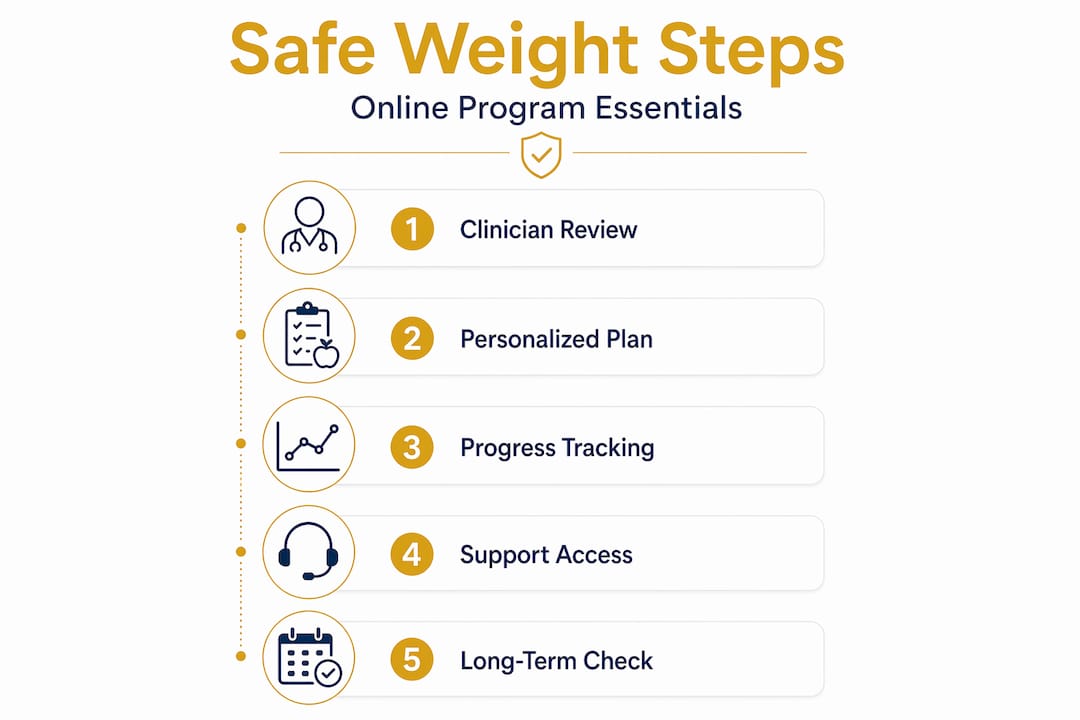
What makes something a real, safe weight management program is not the platform. It is the components. Evidence-based online programs include weekly tailored sessions, structured behavior change, trained professional support, and feedback mechanisms that adapt based on your actual progress. Without those elements, you are buying a product, not accessing a protocol.
Quick-fix diets fail at scale for a structural reason, not a willpower reason. They do not include adaptive clinical oversight. When you hit a plateau at week eight, a fad diet gives you no mechanism for adjustment. A physician-supervised program reassesses your intake, activity, medications, and metabolic markers, then updates your protocol accordingly. That is not a luxury. That is the mechanism behind durable results.
The other issue with quick-fix approaches is safety monitoring. Adults with hypertension, insulin resistance, or thyroid conditions face real clinical risks from aggressive caloric restriction or unmonitored supplement stacks. A licensed clinician reviewing your labs and health history is the safeguard that turns a potentially dangerous plan into a personalized, safe one.
Medical supervision in online safe weight loss treatments also changes what therapies become available to you. GLP-1 receptor agonists, for example, are clinically validated tools for weight management that require physician prescribing and monitoring. No app can provide that. A qualified telehealth platform can.
When you evaluate your options, look past the before-and-after photos and the marketing copy. Ask directly: who reviews my data, how often, and what authority do they have to change my treatment? If the answer is vague, keep looking.
Explore medically supervised weight management with Grown Up Meds
Understanding what safe, clinician-backed weight management looks like is one thing. Having access to it is another.

Grown Up Meds is a telehealth platform built specifically for adults who want physician-supervised, science-backed weight management without waiting rooms or rigid clinic schedules. Start with an online weight management assessment that collects your health history, goals, and current labs so a licensed physician can build a protocol around your specific metabolic profile. For those who are candidates, GLP-1 weight management therapy is available under full clinician supervision with ongoing monitoring and delivery from US-based pharmacies. If your health goals extend beyond weight, the men's vitality and weight management program integrates body composition, hormone health, and energy optimization into a single supervised protocol.
Frequently asked questions
What makes an online weight management program safe and effective?
A safe and effective program includes weekly tailored sessions, licensed professional oversight, structured tracking, and regular feedback loops that adapt your plan based on actual progress, not just a fixed template. Online programs need professional support and structured feedback to produce safe, lasting results.
How fast should I expect to lose weight safely?
Safe weight loss runs about 1-2 lbs per week, which is both medically safer and more likely to last than rapid loss approaches that sacrifice muscle and create nutrient deficits.
Why is clinician oversight important in online weight management?
Clinician oversight means your plan is built around your actual health history, your progress is monitored for safety signals, and your protocol gets adjusted when you plateau or experience side effects. Licensed clinician oversight is what separates a safe program from a product.
Can I maintain my weight loss long-term with online programs?
Yes, provided the program includes ongoing follow-up, physical activity targets, behavioral support, and a mechanism for plan adjustments. Regular follow-up and 300 min/week of moderate activity are the two most evidence-supported anchors for preventing regain.