
Most adults trying to lose weight have already tried something. A restrictive diet, a new gym routine, a 30-day challenge. The problem is rarely effort. It is structure. A step by step weight loss guide built around science and physician oversight changes that. Instead of white-knuckling through another unsustainable plan, you get a framework that addresses nutrition, activity, sleep, stress, and medical support in sequence. Each step informs the next. This guide walks you through that framework from baseline tracking to long-term maintenance, with the clinical rigor that actually moves the needle.
Table of Contents
- Understanding your why and tracking your starting point
- Setting realistic goals and creating a sustainable eating and activity plan
- Executing your weight loss plan with monitoring and adjustments
- Integrating medical options and long-term maintenance strategies
- Rethinking weight loss: realistic expectations and the power of the feedback loop
- How Grown Up Meds supports your personalized weight loss journey
- Frequently asked questions
Key Takeaways
| Point | Details |
|---|---|
| Motivation matters | Clarifying your personal reasons for weight loss helps keep you focused and committed over time. |
| Track multiple factors | Monitoring nutrition, activity, sleep, and stress provides a complete baseline for effective plan adjustments. |
| Set realistic goals | Specific, measurable goals that fit your lifestyle improve your chances of long-term success. |
| Lifestyle first | Sustainable eating and physical activity are central; medical interventions support but do not replace these. |
| Expect plateaus | Weight loss slows naturally; adjusting your plan and focusing on sleep and emotional health helps overcome stalls. |
Understanding your why and tracking your starting point
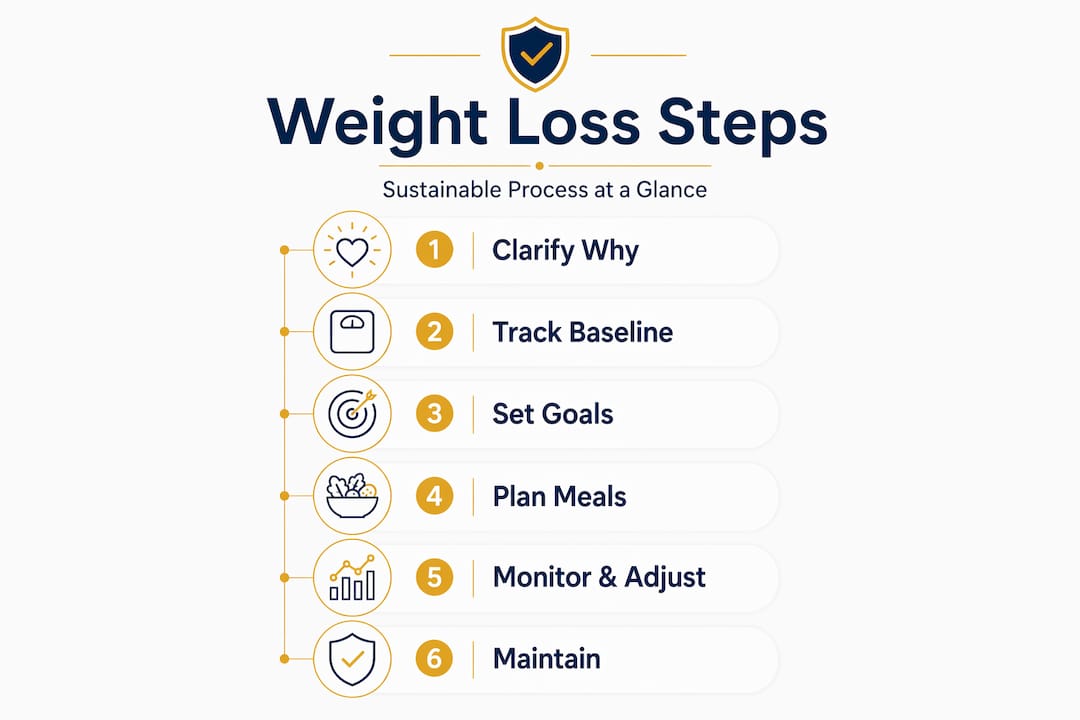
This is where every effective step by step weight loss guide begins. Not with a calorie target or a meal plan, but with clarity on motivation and an honest look at where you currently stand. CDC weight loss steps confirm that a practical starter plan is built around five steps: understand your "why," track where you are across nutrition, physical activity, sleep, and stress, set specific goals, find support, and monitor progress.

Why does motivation matter this much? Because weight loss takes months, not weeks. The people who stay consistent are not the ones with the most willpower. They are the ones who connected their effort to something personally meaningful, whether that is managing a chronic condition, keeping up with their kids, or reclaiming energy they have not felt in years.
Here is what to track during your first week:
- Nutrition: What you eat, when you eat, and approximate portion sizes
- Physical activity: Steps taken, workouts completed, sedentary hours
- Sleep: Total hours and quality (restless vs. restful)
- Stress: Daily stress level on a 1 to 10 scale, plus any emotional eating triggers
Use a journal or an app. The goal is not perfection. It is pattern recognition.
| Tracking domain | Tool options | What to look for |
|---|---|---|
| Nutrition | MyFitnessPal, paper diary | Calorie gaps, sugar spikes, skipped meals |
| Physical activity | Fitness tracker, step counter | Daily movement trends, sedentary windows |
| Sleep | Sleep app, wearable | Hours logged, sleep consistency |
| Stress | Mood journal, app | Triggers linked to overeating or inactivity |
Pro Tip: Write your top three reasons for losing weight on a sticky note and put it somewhere you see every morning. It sounds simple. It works because it interrupts automatic behavior before the day pulls you off course.
This baseline data is the foundation for science-backed health optimization. Without it, you are guessing. With it, you are planning.
Setting realistic goals and creating a sustainable eating and activity plan
Vague goals fail. "I want to lose weight" gives your brain nothing to act on. Specific goals with timelines do. Think: "I will reduce my daily calorie intake by 300 calories and walk 30 minutes five days a week for the next four weeks." That is measurable, achievable, and time-bound.
NIDDK healthy eating and activity guidelines are clear that the key drivers of weight loss are choosing a healthy eating plan you can maintain and being physically active, with the Dietary Guidelines recommending reducing calories and increasing activity rather than pursuing extreme restriction.
A sustainable eating plan looks like this:
- Build meals around whole foods: vegetables, legumes, whole grains, and lean proteins
- Include healthy fats from sources like avocado, olive oil, and nuts
- Limit added sugars, saturated fats, and high-sodium processed foods
- Eat at consistent times to regulate hunger hormones
- Do not skip meals. Skipping meals often leads to overeating later in the day.
On the activity side, a realistic approach includes aerobic activity of at least 150 minutes per week of moderate intensity, plus two strength training sessions weekly. Strength training is often undervalued in a beginner weight loss guide, but it matters enormously. Muscle tissue burns more calories at rest than fat tissue, so building it accelerates your resting metabolism over time.
What to avoid in the early stages:
- Crash diets or very low-calorie plans under 1,200 calories without medical supervision
- Overtraining before your body has adapted to increased activity
- Cutting entire food groups without a clinical reason to do so
Pro Tip: Sleep is a weight loss variable, not a bonus. Adults who consistently get fewer than 7 hours per night have measurably higher levels of ghrelin, the hunger hormone, and lower levels of leptin, the satiety hormone. Protecting your sleep is protecting your results.
The health optimization services at Grown Up Meds are designed to support exactly this kind of structured, sustainable plan rather than quick-fix approaches that burn out fast.
Executing your weight loss plan with monitoring and adjustments
Execution is where most plans fall apart, not because people stop trying, but because they stop adapting. A plan that worked in week two may not work in week eight. Your body is not passive. It adjusts to reduced calories and increased activity, which is why plateaus happen to almost everyone.
Progress is managed through tracking your baseline, setting goals, getting support, and monitoring results to revise plans continuously rather than treating weight loss as a one-time diet.
How to monitor progress effectively:
- Weigh yourself at the same time each day, ideally in the morning, and track weekly averages rather than daily fluctuations
- Log food intake at least five days per week to catch calorie creep
- Track activity minutes and intensity, not just steps
- Rate your sleep quality and stress level weekly
- Take monthly body measurements (waist, hips, chest) because the scale does not capture muscle gain
| Plateau trigger | Likely cause | Adjustment strategy |
|---|---|---|
| Weight stalled for 2+ weeks | Metabolic adaptation | Recalculate calorie needs, add 20 min of activity |
| Hunger increasing | Inadequate protein or fiber | Increase protein to 25 to 30% of daily calories |
| Fatigue, poor recovery | Overtraining or under-eating | Add a rest day, review calorie floor |
| Emotional eating spikes | Unmanaged stress | Add stress management practice, consider counseling |
Plateau management requires adjusting your plan by recalculating calorie needs or adding movement, and focusing on sleep and emotional health rather than simply pushing harder.
Non-food rewards keep motivation alive. Book a massage after hitting a 30-day streak. Buy new workout gear after a milestone. These reinforce the behavior without creating a food reward cycle.
Pro Tip: If you have been eating the same calorie target for more than six weeks, recalculate. Your calorie needs drop as your weight drops. What was a deficit at 200 pounds may be maintenance at 185. Adjust or plateau.
The weight loss monitoring and support available through physician-supervised telehealth makes this recalibration process far more precise than self-guided tracking alone.
Integrating medical options and long-term maintenance strategies
Lifestyle changes are the foundation of any personalized weight loss program. But for some adults, they are not enough on their own. That is not a personal failure. It is biology. Genetics, hormonal imbalances, and metabolic conditions can make weight loss significantly harder, and that is where medical options become relevant.
Weight-loss medications support but do not replace lifestyle changes. Monitoring and adapting plans remain essential for sustained outcomes. Medications work best as adjuncts to a structured eating and activity plan, not as substitutes for one.
When to consider medical intervention:
- BMI of 30 or higher with no obesity-related conditions
- BMI of 27 or higher with at least one obesity-related condition such as type 2 diabetes or hypertension
- Bariatric surgery is generally considered for BMI of 35 or higher, or 30 or higher with serious comorbidities
| Approach | Best for | Key consideration |
|---|---|---|
| Lifestyle only | Motivated adults with moderate weight goals | Requires strong self-monitoring and consistency |
| Medication plus lifestyle | Adults who have plateaued or have metabolic barriers | Physician supervision required; ongoing commitment needed |
| Bariatric surgery | Severe obesity with comorbidities | Major procedure; lifelong dietary and behavioral changes |
For long-term maintenance, aim for at least 300 minutes per week of moderate-intensity physical activity as a lifelong habit to prevent weight regain. That is double the initial recommendation, and it reflects the reality that keeping weight off requires more sustained effort than losing it.
Long-term success also depends on frequent self-monitoring, continued behavioral strategies, and regular check-ins with a health professional. This is not a finish line. It is a new baseline.
Pro Tip: Think of maintenance as its own phase with its own goals. Adults who treat maintenance as "done" are the ones who regain. Adults who treat it as an ongoing practice with quarterly check-ins and continued tracking are the ones who hold their results.
Personalized health optimization through a telehealth platform gives you the clinical oversight to make these decisions with real data behind them.
Rethinking weight loss: realistic expectations and the power of the feedback loop
Here is the uncomfortable truth most weight loss content skips: the plan is not the hard part. The feedback loop is.
Anyone can follow a diet for two weeks. The real skill is learning to read your body's signals, interpret your tracking data, and make small adjustments before a stall becomes a surrender. That is a learned behavior, and most people never get taught it.
The most successful weight-loss plans are those you can maintain long enough to change outcomes through sustainable eating and activity rather than quick fixes. The research on this is unambiguous. Duration and consistency outperform intensity every time.
What this means practically is that a moderate calorie deficit held for 12 months produces better outcomes than an aggressive deficit held for 6 weeks. Boring? Yes. Effective? Dramatically more so.
The second thing most guides get wrong is treating sleep and emotional health as soft variables. They are not. Plateaus are normal and require adjusting your plan rather than giving up, with sleep, emotional health, and strength training all playing vital roles. A client who is sleeping 5 hours a night and managing high chronic stress will not respond to dietary changes the way a well-rested, emotionally supported person will. The physiology is different.
The feedback loop we are describing is not complicated. Track. Analyze. Adjust. Repeat. But it requires honesty, patience, and ideally a clinical partner who can interpret what the data actually means. That is where weight loss expert guidance changes the outcome. Not because the physician does the work for you, but because they help you stop guessing and start responding to what your body is actually telling you.
How Grown Up Meds supports your personalized weight loss journey
Understanding the steps is one thing. Having the right support system behind you is what makes them stick.

Grown Up Meds telehealth services connect you with licensed physicians who build personalized weight loss programs around your specific health profile, not a generic template. The platform covers nutritional guidance, activity planning, medication management where appropriate, and continuous progress monitoring. Everything is accessible from home, with no waiting rooms and no one-size-fits-all protocols. Whether you are just starting out with a beginner weight loss guide or navigating a plateau after months of effort, the clinical team at Grown Up Meds helps you adjust your plan with precision and stay accountable through every phase of the process.
Frequently asked questions
What is the first step in a successful weight loss plan?
The first step is clarifying your personal reasons for wanting to lose weight and writing them down to stay focused when motivation dips.
How much physical activity is recommended for weight loss maintenance?
At least 300 minutes per week of moderate-intensity physical activity is recommended to help prevent weight regain over the long term.
When should weight-loss medications be considered?
Medications may be appropriate when lifestyle changes alone are insufficient and should always be used alongside healthy eating and activity, not instead of them, under physician-supervised protocols.
How do I handle a weight loss plateau?
Plateaus require plan adjustment, not abandonment. Review your calorie intake, increase activity, and address sleep and stress before concluding the approach is not working.