
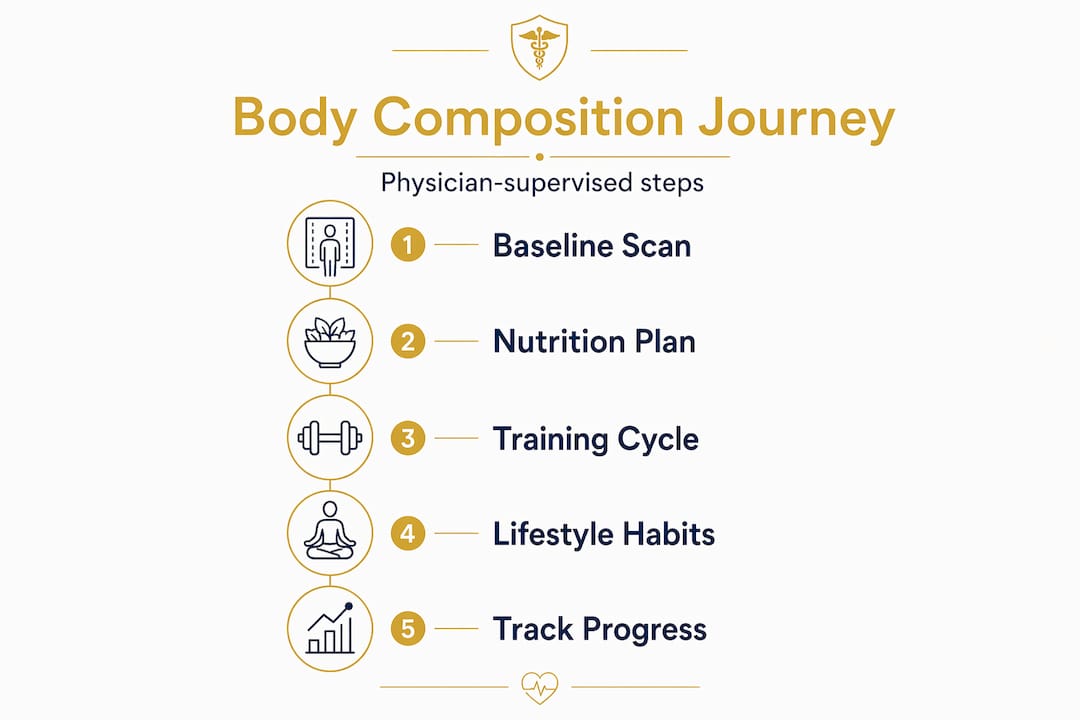
Most people trying to change their bodies are tracking the wrong number. The scale tells you how much gravity is pulling on you, not whether you're losing fat or gaining muscle. Learning how to manage body composition correctly means measuring what actually matters: fat mass, lean mass, and how they shift over time. This guide takes a physician-supervised approach to that process, giving you the measurement tools, nutrition targets, training protocols, and recovery strategies that produce real, verifiable results rather than guesses based on weekly weigh-ins.
Table of Contents
- How to manage body composition: start with accurate measurement
- Set your nutrition foundation: energy deficits and high-protein intake
- Train strategically: resistance training and aerobic activity
- Optimize recovery and lifestyle habits for sustainable results
- Track, review, and adjust: ensuring meaningful, data-driven progress
- Why relying on scale weight alone undermines true body composition success
- Explore physician-supervised body composition management with Grown Up Meds
- Frequently asked questions
Key Takeaways
| Point | Details |
|---|---|
| Accurate measurement | Start with standardized, precise body composition methods like DEXA to establish your baseline. |
| Nutrition matters | Combine a modest calorie deficit with high protein intake to lose fat while preserving muscle. |
| Train smart | Use resistance training plus cardio to maximize fat loss and muscle gain. |
| Lifestyle factors | Prioritize sleep, stress management, and moderate alcohol to support your body composition goals. |
| Monitor and adjust | Track progress regularly with scans and logs to make informed plan tweaks. |
How to manage body composition: start with accurate measurement
Before you change anything, you need a reliable baseline. Body composition has four primary components: fat mass, lean mass (muscle and organ tissue), bone density, and water. The ratio of fat to lean mass is what defines your composition, and it can shift dramatically even when your scale weight stays flat.
Measurement methods compared:
| Method | Accuracy | Cost | Best for |
|---|---|---|---|
| DEXA scan | Very high | Moderate | Clinical tracking, bone density |
| BIA (bioelectrical impedance) | Moderate | Low | Home/gym use, trend monitoring |
| Skinfold calipers | Moderate | Low | Field testing with trained technician |
| Tape measure | Low | Free | Basic circumference tracking |
DXA is the clinical gold standard for measuring fat mass, lean mass, and bone density, while BIA is less accurate and sensitive to hydration and meal timing. That sensitivity matters more than most people realize. A single large meal or a hard training session the day before a BIA test can shift your "body fat percentage" by 2 to 4 points without any actual change in tissue.
Standardization of hydration, fasting, and pre-test conditions is critical to reduce noise in DEXA and BIA measurements. Follow these protocols before any body composition test:
- Fast for 8 to 12 hours beforehand
- Avoid alcohol for at least 24 hours
- Skip intense exercise for 24 to 48 hours prior
- Maintain consistent hydration (not excessive)
- Test at the same time of day each session
These clinical body composition approaches are what separate meaningful data from measurement noise. Without standardization, you're comparing apples to oranges every time you test.
Set your nutrition foundation: energy deficits and high-protein intake
Once you have a baseline, nutrition becomes the primary lever for changing body composition. The goal is not simply to eat less. It's to create conditions where your body preferentially burns fat while holding onto muscle.
A modest energy deficit of 250 to 500 kcal/day supports fat loss of roughly 0.5 to 1 pound per week while preserving muscle when paired with resistance training. Larger deficits accelerate weight loss but often at the cost of lean mass, which slows your metabolism and makes long-term maintenance harder.
Protein is the single most important macronutrient for body recomposition. High protein intake of 1.6 to 2.2 g/kg/day combined with resistance training produces the largest fat loss and muscle retention effects during weight loss. For a 180-pound (82 kg) person, that means roughly 131 to 180 grams of protein daily.
Practical nutrition targets for body recomposition:
| Goal | Target |
|---|---|
| Daily calorie deficit | 250 to 500 kcal below TDEE |
| Protein intake | 1.6 to 2.2 g/kg body weight |
| Fiber intake | 25 to 38 g/day |
| Meal frequency | 3 to 5 meals with protein distributed evenly |
Very-low-calorie diets need adequate protein and resistance training to avoid lean mass loss and other risks. Dropping below 1,200 to 1,400 calories without physician supervision is where things go wrong fast, including nutrient deficiencies, hormonal disruption, and muscle loss that can take months to rebuild.
Pro Tip: Distribute your protein across all meals rather than loading it at dinner. Research consistently shows muscle protein synthesis responds better to 30 to 40 grams per meal, spread across the day, than to one large protein bolus.
With your physician-supervised nutrition plans in place, the next step is pairing that foundation with training that reinforces it.
Train strategically: resistance training and aerobic activity
Nutrition creates the conditions for fat loss. Training determines what your body does with those conditions. Without resistance training, a calorie deficit will pull from both fat and muscle. With it, you direct your body to preserve and build lean tissue while burning stored fat.
Here's how to structure your training for body recomposition:
- Prioritize compound movements. Squats, deadlifts, rows, presses, and lunges recruit the most muscle mass and generate the greatest hormonal response for muscle growth.
- Hit each muscle group 2 to 4 times per week. Resistance training of 8 to 12 quality sets per muscle group per week maximizes muscle retention and growth.
- Add aerobic work for fat reduction. At least 150 minutes of moderate-intensity aerobic exercise weekly yields meaningful reductions in body fat and waist circumference.
- Increase your NEAT. Non-exercise activity thermogenesis (NEAT), meaning all the movement you do outside formal workouts, can account for 200 to 400 extra calories burned daily just by hitting 8,000 to 10,000 steps.
- Keep protein high on training days. Increasing protein intake during energy restriction and resistance training supports favorable fat-free mass changes, particularly in the 24 to 48 hours following a session.
Key training guidelines:
- Resistance sessions: 3 to 4 days per week, 45 to 60 minutes
- Cardio: 150 to 300 minutes moderate intensity weekly
- Rest between sets: 60 to 90 seconds for hypertrophy, 2 to 3 minutes for strength
- Progressive overload: increase weight or reps each week to continue driving adaptation
Pro Tip: If you're short on time, prioritize resistance training over cardio. Muscle tissue burns more calories at rest than fat tissue, so building lean mass raises your baseline calorie expenditure permanently. Cardio is additive, not foundational.
Explore exercise guidance for body recomposition to find programs designed around these principles with physician oversight built in.
Optimize recovery and lifestyle habits for sustainable results
You can train hard and eat right and still stall if your recovery is poor. Sleep, stress, and alcohol are the three lifestyle factors most people underestimate, and all three directly affect the hormonal environment that governs fat storage and muscle repair.

Short sleep duration links to visceral fat accumulation; aim for 7 to 9 hours of restful sleep in a cool, dark room. Sleep is when growth hormone peaks, cortisol resets, and muscle tissue repairs. Cutting it short by even 90 minutes measurably increases hunger hormones (ghrelin) and reduces the satiety hormone leptin, making dietary adherence significantly harder the next day.
Chronic stress elevates cortisol, which promotes fat storage (particularly around the abdomen) and accelerates muscle breakdown. Daily stress management doesn't require a meditation retreat. Effective techniques include:
- 5 to 10 minutes of diaphragmatic breathing after waking
- A 20-minute walk outdoors at lunch
- Journaling 3 to 5 things you accomplished that day
- Limiting news and screen exposure in the hour before bed
Moderate alcohol within dietary guidelines supports body composition goals by minimizing disruption to sleep quality and muscle protein synthesis. In practice, that means no more than 2 drinks per day for men and 1 drink per day for women, and ideally not daily. Alcohol blunts muscle protein synthesis for up to 24 hours after consumption and fragments sleep architecture even when you don't feel it.
Pro Tip: Track your sleep quality, not just duration. A sleep tracker that monitors resting heart rate and heart rate variability gives you an objective signal of whether your recovery is actually sufficient, which directly predicts how well your body will respond to training that week.
These holistic wellness strategies are often the missing piece for people who are doing everything else right but not seeing results.
Track, review, and adjust: ensuring meaningful, data-driven progress
Measurement without action is just data collection. The goal of tracking is to catch trends early, before weeks of effort go in the wrong direction, and to make precise adjustments rather than guessing.
Here's a practical tracking system that works:
- DEXA scans every 4 to 12 weeks. Trending fat and muscle over time using DXA rather than relying solely on BMI or scale weight improves clinical decision-making and catches issues like muscle loss that the scale completely misses.
- Weekly weigh-ins under identical conditions. Same time, same day, same state of dress, after using the bathroom and before eating. Average across 4 weeks to smooth out water fluctuation.
- Training logs. Record weight, reps, and perceived effort for every session. If your lifts are stagnating or declining, your calorie deficit may be too aggressive.
- Food diary 3 to 4 days per month. You don't need to log every meal forever. Periodic spot-checks catch the "calorie creep" that derails most long-term efforts.
- Adjust based on what the data shows. If fat is dropping but muscle is stagnating, increase calories by 100 to 150 per day. If nothing is moving, add 20 to 30 minutes of cardio weekly before cutting calories further.
Standardized DEXA or other tests every 4 to 12 weeks provide the best balance of cost and useful feedback for body composition tracking. Pre-test conditions and consistency are critical to minimize measurement noise, especially for BIA.
Pro Tip: Build your tracking schedule around your training cycles. If you're in a 12-week fat loss phase, schedule DEXA at weeks 1, 6, and 12. This gives you a midpoint check to course-correct before the phase ends.
Use data-driven body composition monitoring to build a system that adapts with you rather than leaving you guessing.
Why relying on scale weight alone undermines true body composition success
Here's an uncomfortable truth most fitness content won't say directly: the scale has made millions of people worse at managing their health. Not because weight doesn't matter, but because it's treated as the primary signal when it's actually one of the least informative ones available.
Body composition measurement supplements BMI by providing accurate adiposity assessment, sarcopenic obesity detection, and bone health monitoring not possible with scale weight alone. Sarcopenic obesity, where someone has normal or even low body weight but dangerously low muscle mass and high fat percentage, is invisible to BMI. It's associated with metabolic disease, falls, and poor surgical outcomes. You'd never catch it by stepping on a scale.
The people who succeed long-term at improving body composition are the ones who stop asking "how much do I weigh?" and start asking "how much of me is functional?" That shift in framing changes everything. It changes what you eat, how you train, what you prioritize in recovery, and how you interpret setbacks.
Physician supervision matters here not just for access to better tools, but for interpretation. A physician who understands body composition can tell you whether a 3-pound weight gain after a training block is muscle growth (good) or water retention from inflammation (neutral) or fat gain from dietary drift (needs correction). Those are three completely different responses requiring three different actions. Without clinical insights on body composition, you're guessing at which one it is.
The other thing conventional advice gets wrong is treating body composition as a purely aesthetic goal. Muscle mass is one of the strongest predictors of longevity, metabolic health, and functional independence as you age. Improving your composition isn't vanity. It's one of the most evidence-backed investments you can make in your long-term health.
Explore physician-supervised body composition management with Grown Up Meds
If you're serious about improving your body composition with the precision this guide describes, the next step is working with a team that can actually implement it with you.

At Grown Up Meds, physician-supervised body composition management means access to personalized nutrition and training protocols, integration of recovery-focused therapies like hormone optimization and NAD+ support, and ongoing monitoring that adapts to your actual data. You're not handed a generic plan. You're connected with a licensed physician who reviews your baseline, your goals, and your history, then builds a protocol around you. Explore health optimization services and take the first step toward measurable, sustainable results.
Frequently asked questions
What is the best method to measure body composition?
DXA is the clinical gold standard for accurately measuring fat mass, lean mass, and bone density, especially when performed under standardized pre-test conditions for consistent, reliable results.
How much protein should I consume to preserve muscle while losing fat?
Aim for 1.6 to 2.2 g/kg/day of protein combined with resistance training, which produces the largest fat loss and muscle preservation effects during a calorie deficit.
How often should I get a body composition scan?
DEXA scans every 4 to 12 weeks provide the best balance of cost and actionable feedback, with the exact frequency depending on your current training phase and specific goals.
Can stress and sleep affect my body composition?
Yes. Short sleep correlates with greater visceral fat accumulation, while chronic stress elevates cortisol and promotes fat storage and muscle breakdown, both directly working against your body composition goals.
Are very-low-calorie diets safe for preserving lean mass?
Without physician supervision, VLEDs can cause lean mass loss and micronutrient deficiencies; adequate protein intake and resistance training are essential safeguards when using any aggressive calorie restriction approach.