
Body composition is defined as the proportional breakdown of fat mass, lean mass, bone mineral content, and total body water that make up the human body. Unlike body weight or BMI, it tells you what your body is actually made of, not just how much it weighs. A 180-pound man with 12% body fat and a 180-pound man with 28% body fat carry the same number on the scale but face radically different health risks. Tools like DEXA scanning and bioelectrical impedance analysis (BIA) now make body composition analysis accessible outside clinical labs, and understanding your numbers is one of the most direct paths to smarter health decisions.
What is body composition and why does it matter more than weight?
Body composition describes the ratio of fat tissue to lean tissue in your body, and that ratio predicts disease risk far better than weight alone. Body composition offers better health insights than BMI because it separates metabolically active muscle from stored fat, preventing the misclassification of muscular individuals as overweight. A competitive athlete and a sedentary adult can share identical BMI scores while having completely different metabolic profiles.
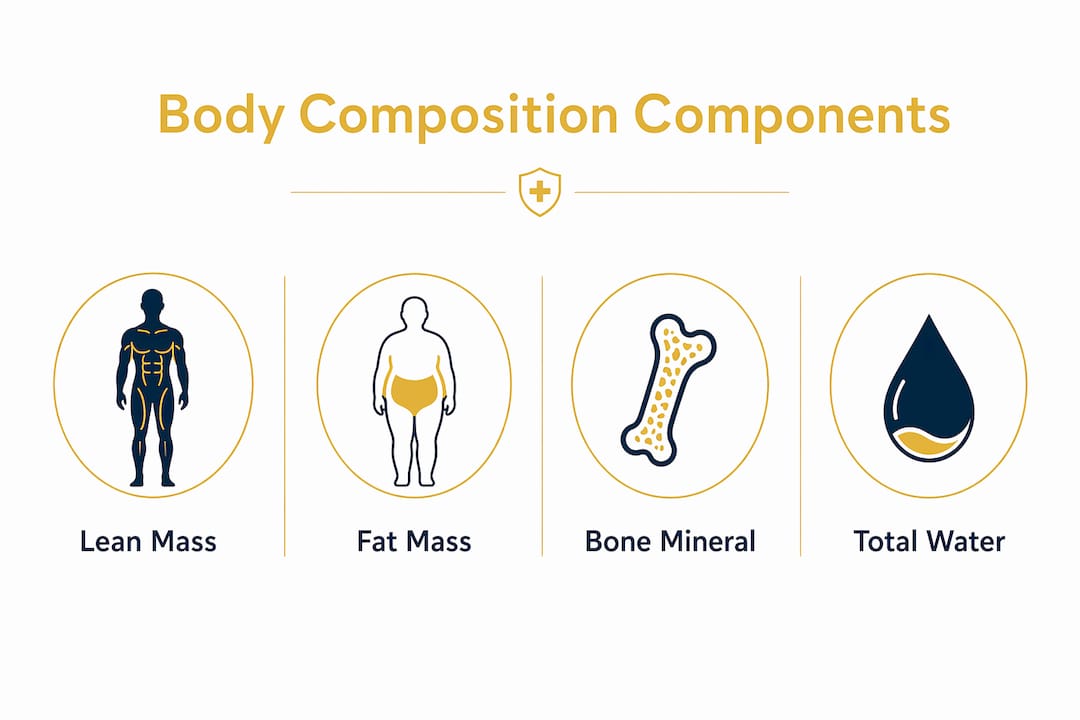
The four primary components are fat mass, skeletal muscle, bone mineral content, and total body water. Each plays a distinct physiological role. Fat mass includes both essential fat (needed for hormone production and organ protection) and storage fat (subcutaneous and visceral). Lean mass covers muscle, organs, connective tissue, and the water distributed throughout those tissues.

Health standards classify body fat over 25% for men and over 30% for women as "overfat," a threshold linked to elevated risk for type 2 diabetes, cardiovascular disease, and metabolic syndrome. Crossing that threshold does not require being visibly obese. Many individuals at normal weight carry excess visceral fat that places them in the overfat category without knowing it.
Understanding your body composition is the starting point for any serious weight management or metabolic health program. It replaces guesswork with data, and data is what drives results.
What are the key components of body composition and how do they impact health?
Each component of body composition carries specific health implications, and none of them exist in isolation.
Fat mass divides into two functionally different categories:
- Essential fat is stored in the brain, bone marrow, and organs. Men need roughly 2 to 5% and women need 10 to 13% for basic physiological function.
- Subcutaneous fat sits beneath the skin and serves as an energy reserve. Moderate levels are not inherently dangerous.
- Visceral adipose tissue (VAT) surrounds the abdominal organs. VAT is an active endocrine organ/10%3A_Body_composition_(Chapter_11)/10.01%3A_Anthropometric_assessment_of_body_composition_(11.0)) that independently predicts cardiovascular and metabolic disease risk, separate from total body fat. This means a person with a flat stomach can still carry dangerous levels of visceral fat internally.
Lean mass is the workhorse of your metabolism. Muscle mass drives glucose regulation/10%3A_Body_composition_(Chapter_11)/10.01%3A_Anthropometric_assessment_of_body_composition_(11.0)), recovery speed, resting metabolic rate, and physical function. Losing muscle through crash dieting or inactivity directly lowers the number of calories your body burns at rest, making future fat gain more likely.
Bone mineral content reflects skeletal density and long-term structural health. Low bone density increases fracture risk and is often overlooked until a break occurs. Total body water accounts for roughly 60% of body weight in healthy adults and affects every cellular and metabolic process, including how accurately body composition devices read your numbers.
Pro Tip: Measure your body composition first thing in the morning, before eating or drinking, to minimize hydration fluctuations that skew results, especially with BIA devices.
How is body composition measured?
Body composition analysis uses several models and devices, each with different levels of precision and practical accessibility.
Understanding compartment models
The simplest approach is the 2-compartment model, which divides the body into fat mass and fat-free mass. It is fast and inexpensive but assumes a fixed ratio of water, protein, and bone mineral in lean tissue. 2-compartment model assumptions fail/12%3A_Body_Composition-Laboratory_Methods(Chapter_14)/12.01%3A_An_introduction_to-techniques_used_to_measure_body_composition_(14.0)) for elderly individuals or those with metabolic disease, where those ratios shift significantly. The 4-compartment model separates fat, muscle, bone, and water individually. The 4-compartment model is the clinical gold standard because it eliminates the assumptions that make simpler models inaccurate.
Comparing the most common measurement methods
| Method | Accuracy | Cost | Best use case |
|---|---|---|---|
| DEXA scan | High (direct measurement) | Moderate to high | Clinical baseline and bone density tracking |
| BIA (bioelectrical impedance) | Moderate (estimate-based) | Low to moderate | At-home trend monitoring |
| Skinfold calipers | Moderate (technician-dependent) | Low | Field assessments and gym settings |
| 4-compartment model | Highest | High | Research and clinical populations |
DEXA (dual-energy X-ray absorptiometry) directly measures fat tissue, lean tissue, and bone mineral density in a single 10-minute scan. DEXA measures components directly while BIA relies on electrical resistance and predictive equations, which introduces variability based on hydration status, skin temperature, and the algorithm the device uses. Skinfold calipers measure subcutaneous fat at specific sites and require a trained technician for reliable results.
Reliability matters as much as accuracy. A test with 90% positive predictive value correctly identifies 90 out of 100 flagged individuals as truly overfat, which illustrates why device and method selection affects the quality of health decisions made from the data.
Pro Tip: If you use a home BIA scale, track trends over time rather than treating any single reading as absolute truth. Consistency in method matters more than chasing a perfect number.
What do body composition results mean for your health and fitness goals?
Body composition data translates directly into health risk assessment and goal setting, but only if you know how to read the numbers.
The overfat thresholds of greater than 25% for men and greater than 30% for women are clinical markers, not aesthetic benchmarks. Exceeding them correlates with insulin resistance, elevated triglycerides, hypertension, and increased all-cause mortality. The critical nuance is that visceral fat distribution, not total fat alone, independently predicts metabolic disease risk/10%3A_Body_composition_(Chapter_11)/10.01%3A_Anthropometric_assessment_of_body_composition_(11.0)). Two people at identical body fat percentages can carry vastly different disease risk depending on where that fat is stored.
BMI remains widely used in clinical settings, but it consistently misclassifies both ends of the spectrum. A 200-pound strength athlete with 10% body fat registers as "overweight" by BMI. A sedentary 150-pound adult with 32% body fat registers as "normal." Body composition analysis closes that gap by measuring what actually drives health outcomes.
Here is what your results should inform:
- High body fat with low muscle mass: Prioritize resistance training and protein intake before cutting calories aggressively. Losing weight without building muscle worsens your composition ratio.
- Normal weight with high visceral fat: Reduce refined carbohydrates and increase aerobic activity. Waist circumference above 40 inches for men and 35 inches for women signals elevated visceral fat even without obesity.
- Low body fat with low bone density: Increase calcium and vitamin D intake and add weight-bearing exercise. Low bone density at any body fat level is a long-term fracture risk.
- Healthy composition with declining muscle mass: Common after age 40. Prioritize progressive resistance training and adequate dietary protein to counter age-related muscle loss (sarcopenia).
How can you monitor and improve your body composition effectively?
Improving body composition requires a consistent measurement strategy and targeted lifestyle changes. One-time assessments are useful baselines. Repeated measurements over months reveal whether your approach is working.
- Establish a baseline with a reliable method. A DEXA scan or a professionally administered BIA test gives you a starting point. Record the date, time of day, hydration status, and device used so future comparisons are valid.
- Retest under identical conditions. Body weight fluctuates by two to four pounds daily based on hydration and food volume. Using the same device consistently over time treats data as relative trends rather than absolute clinical truth, which is the correct approach for tracking progress.
- Prioritize resistance training. Strength training two to four times per week builds skeletal muscle, raises resting metabolic rate, and improves insulin sensitivity. These changes improve body composition even when the scale does not move.
- Manage nutrition around lean mass goals. Protein intake of 0.7 to 1.0 grams per pound of body weight supports muscle retention during fat loss. Cutting calories without adequate protein accelerates muscle loss and worsens your fat-to-muscle ratio.
- Address sleep and stress. Chronic sleep deprivation elevates cortisol, which promotes visceral fat accumulation and muscle breakdown. Seven to nine hours of sleep per night is a non-negotiable input for body composition improvement.
- Work with a physician for personalized guidance. A physician-supervised body composition plan accounts for hormonal factors, metabolic rate, and clinical history that generic programs ignore.
Pro Tip: Photograph your body composition reports and log them in a single document. Visual trend lines over six to twelve months are far more motivating and informative than comparing two isolated data points.
Key takeaways
Body composition analysis, not body weight or BMI, is the most accurate tool for assessing health risk and guiding fitness decisions.
| Point | Details |
|---|---|
| Definition matters | Body composition measures fat, muscle, bone, and water, not just total weight. |
| Visceral fat is the key risk driver | VAT independently predicts cardiovascular disease even in normal-weight individuals. |
| DEXA is the gold standard | DEXA directly measures all tissue types; BIA estimates using electrical resistance. |
| Overfat thresholds are clinical markers | Greater than 25% body fat for men and 30% for women signals elevated chronic disease risk. |
| Consistency beats precision | Using the same measurement method over time produces more useful trend data than switching devices. |
Why I think most people are measuring the wrong thing
I have spent years watching people obsess over the scale while ignoring the number that actually predicts their long-term health. The scale tells you how much gravity is pulling on your body. Body composition tells you whether that pull is mostly muscle or mostly fat. Those are not the same conversation.
The most striking pattern I have seen is the "normal weight, high risk" profile. Someone hits their goal weight, feels satisfied, and stops there. But their body fat percentage is 31%, their visceral fat is elevated, and their muscle mass has actually declined because they lost weight through calorie restriction alone without resistance training. They look fine on paper and feel worse than before.
The shift I encourage is simple: stop treating weight loss as the goal and start treating body composition improvement as the goal. That reframe changes everything. It means you celebrate gaining two pounds of muscle while losing two pounds of fat, even though the scale did not move. It means you track waist circumference alongside body fat percentage. It means you monitor body composition over time rather than checking it once and moving on.
Advanced measurement tools like DEXA are no longer reserved for research hospitals. They are accessible, affordable, and worth doing at least once a year. If you have never had a full body composition analysis, that is the single most useful health investment you can make right now.
— Roosevelt
How Grownupmeds supports your body composition goals

Grownupmeds offers physician-supervised health optimization built around your actual biology, not generic protocols. The platform connects you with licensed physicians who interpret your body composition data and build personalized plans covering nutrition, metabolic health, and targeted therapies. For those looking to accelerate results, Grownupmeds also offers peptide therapy and NAD+ support to complement body composition improvements at the cellular level. Start with a full assessment and get a clear picture of where you stand today. Take the first step at Grownupmeds and let a physician turn your numbers into a plan that works.
FAQ
What is body composition in simple terms?
Body composition is the percentage breakdown of fat, muscle, bone, and water in your body. It provides a more accurate picture of health than body weight or BMI alone.
What is a healthy body fat percentage?
Health standards classify body fat above 25% for men and above 30% for women as overfat, increasing risk for chronic disease. Optimal ranges vary by age, sex, and fitness level.
How is body composition measured at home?
Bioelectrical impedance analysis (BIA) scales are the most accessible home option. Accuracy varies by device and hydration status, so use the same scale consistently and track trends rather than individual readings.
Is body composition better than BMI for health assessment?
Body composition is more accurate than BMI because it distinguishes fat from lean tissue, preventing misclassification of muscular individuals as overweight and sedentary individuals as healthy.
How often should I check my body composition?
Testing every eight to twelve weeks gives enough time for meaningful changes to appear. Retesting under identical conditions, same time of day, same hydration level, and same device, produces the most reliable trend data.