
GLP-1 medications have reshaped how medicine approaches obesity and type 2 diabetes, and if you have been watching the headlines, you know the results are striking. But most coverage either oversimplifies how these drugs work or skips the details that actually matter before you start treatment. This guide covers what are GLP-1 medications in plain terms, how they work in your body, who qualifies, what the real benefits look like, what side effects to prepare for, and what a smart treatment plan actually requires in 2026.
Key Takeaways
| Point | Details |
|---|---|
| GLP-1 drugs mimic a natural hormone | They slow digestion, reduce appetite, and improve blood sugar regulation simultaneously. |
| FDA approval requires specific criteria | Adults with BMI ≥30 or BMI ≥27 with a related condition qualify for approved medications. |
| Weight loss is significant but not universal | Average loss is 15 to 20%, yet genetic variation means some patients lose very little. |
| Side effects are common and manageable | Up to 50% of patients experience GI symptoms, which can be reduced with slow dose escalation. |
| Stopping means regaining weight | These are chronic therapies, not short-term fixes, and weight returns for most people who stop. |
What are GLP-1 medications and how they work
GLP-1 stands for glucagon-like peptide-1, a hormone your gut releases naturally after you eat. GLP-1 receptor agonists are medications that mimic this hormone by binding to the same receptors throughout your body. The result is a chain reaction your physiology already understands: your stomach empties more slowly, your brain receives satiety signals, and your pancreas releases insulin in proportion to your blood sugar levels.

That last point is worth pausing on. Unlike older diabetes medications that force insulin release regardless of blood sugar, GLP-1 receptor agonists only stimulate insulin when glucose is actually elevated. That means the risk of dangerous low blood sugar episodes is significantly lower than with some traditional treatments.
Here is what GLP-1 receptor agonists do inside your body:
- Slow gastric emptying: Food stays in your stomach longer, which extends the feeling of fullness after meals.
- Reduce appetite signals: They act on brain receptors involved in hunger, making it easier to eat less without constant willpower battles.
- Improve blood sugar control: They lower post-meal glucose spikes, which matters for both diabetes management and metabolic health broadly.
- Support weight loss: The combined effect of reduced hunger and slower digestion leads to meaningful caloric reduction over time.
Originally approved as GLP-1 treatment for diabetes, these medications have since been recognized as powerful tools for weight management in people without diabetes. That shift has driven most of the recent growth in prescriptions, and the science behind it is solid.
Approved medications and who qualifies in 2026
The FDA has approved several GLP-1 receptor agonists specifically for weight management, with semaglutide (marketed as Wegovy) and tirzepatide (marketed as Zepbound) leading the class. Tirzepatide is technically a dual GLP-1 and GIP receptor agonist, meaning it activates two separate hormone pathways, which explains why its results often exceed those of single-agonist drugs.
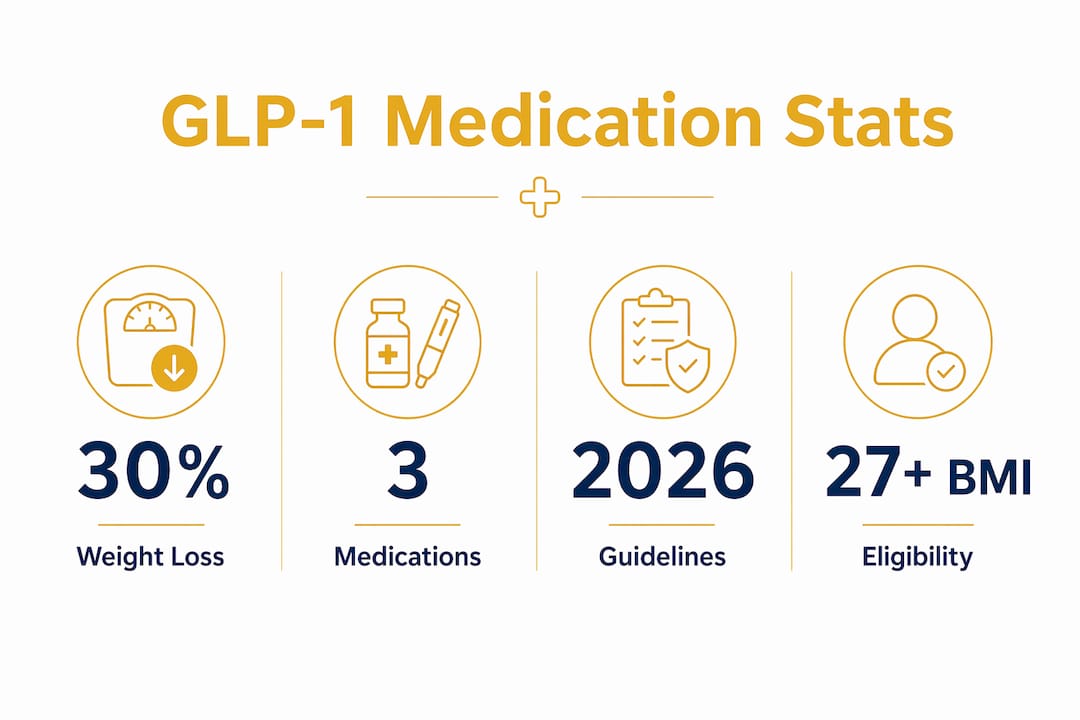
To qualify for these medications, you generally need a BMI of 30 or higher, or a BMI of 27 or higher combined with a weight-related condition such as high blood pressure, type 2 diabetes, or obstructive sleep apnea. That standard applies to both semaglutide and tirzepatide approvals.
| Medication | Brand Name | Type | Primary Approval |
|---|---|---|---|
| Semaglutide | Wegovy | GLP-1 agonist | Chronic weight management |
| Tirzepatide | Zepbound | GLP-1 / GIP dual agonist | Chronic weight management |
| Semaglutide | Ozempic | GLP-1 agonist | Type 2 diabetes |
| Liraglutide | Saxenda | GLP-1 agonist | Chronic weight management |
Treatment typically starts at a low dose and escalates gradually over several months. That slow escalation is not just protocol. It is the primary strategy for minimizing the GI side effects that catch many patients off guard. Oral GLP-1 formulations are in advanced development with absorption profiles comparable to injectables, which could expand access for people who prefer not to self-inject.
Pro Tip: If cost is a barrier, ask your physician or pharmacist specifically about manufacturer savings programs. Monthly costs can exceed $1,000 without insurance, but assistance programs do exist and can substantially reduce out-of-pocket expenses.
Benefits and effectiveness of GLP-1 therapy
The clinical numbers on GLP-1 medications are genuinely impressive. Semaglutide produces average weight loss of 15 to 17% of body weight, while tirzepatide regularly surpasses 20%. For a 250-pound adult, that translates to 37 to 50 pounds. Those figures approach what bariatric surgery achieves, which has shifted the conversation about medical weight management dramatically.
Beyond the scale, the metabolic benefits matter just as much.
"People using GLP-1 medications often see improvements in blood pressure, cholesterol, fasting glucose, and inflammatory markers, sometimes before they have lost significant weight. The weight loss is the headline, but the metabolic reset happening underneath it is where the long-term health value lives."
Blood sugar control improves substantially even in people without diabetes, which reduces the risk of developing type 2 diabetes in the first place. For people who already have diabetes, these medications can reduce or eliminate the need for additional glucose-lowering drugs. Cardiovascular risk also drops, and clinical trials have shown reductions in major cardiac events for high-risk patients on semaglutide.
That said, results are not uniform. Genetic variation in GLP-1 receptor genes helps explain why some patients lose more than 25% of their body weight while others lose less than 5% or see no benefit at all. This variability is not a failure of willpower. It is biology, and understanding that upfront helps set realistic expectations.
Effectiveness also depends on how the medication is used. Patients who combine GLP-1 therapy with consistent dietary changes and physical activity tend to achieve better results and maintain them longer than those relying on medication alone. You can explore weight loss medication options to understand where GLP-1 drugs fit within the broader spectrum of treatments.
Side effects, risks, and nutritional gaps to know
GLP-1 therapy is not without trade-offs. Being clear-eyed about what to expect makes a real difference in whether you stay the course through the early months or abandon treatment prematurely.
- Nausea and vomiting: These are the most reported complaints, affecting up to 50% of patients during dose escalation. They usually improve as your body adjusts, but they can be disruptive.
- Diarrhea or constipation: GI motility changes affect people differently. Some experience loose stools; others deal with constipation. Hydration and fiber intake make a measurable difference.
- Nutrient deficiencies: This is the side effect most patients do not hear enough about. GLP-1 users often consume 21% fewer calories overall, which dramatically reduces intake of key micronutrients. Deficiencies in calcium, iron, magnesium, zinc, and vitamins including B12 and D are documented concerns during therapy.
- Lean mass loss: Up to 40% of total weight lost during GLP-1 therapy can come from muscle rather than fat. That is a meaningful concern for long-term metabolic health, physical function, and body composition.
- Contraindications: People with a personal or family history of medullary thyroid cancer or multiple endocrine neoplasia syndrome type 2 should not use these medications. A medical evaluation before starting is not optional.
The lean mass concern deserves special attention because it rarely gets enough airtime. Losing muscle while losing weight can slow your metabolism, reduce strength, and make weight regain more likely after stopping.
Pro Tip: Prioritize protein at every meal while on GLP-1 therapy, aiming for at least 1.2 grams per kilogram of body weight daily. Pairing this with resistance training two to three times per week significantly reduces muscle loss and preserves long-term metabolic health.
Also worth noting: rising GLP-1 prescriptions have extended beyond approved populations, which makes careful clinical oversight more important than ever. Starting this therapy without proper medical evaluation puts you at risk in ways that are entirely avoidable.
Practical guidance for using GLP-1 medications safely
Knowing the mechanism and the risks is only useful if you apply that knowledge to how you actually manage your treatment. Here is what makes the difference between GLP-1 therapy that transforms your health and one that disappoints you six months in.
- Treat it as a chronic therapy, not a course of antibiotics. Stopping GLP-1 medication typically leads to significant weight regain. These drugs work more like blood pressure medication than a finite intervention. Planning for long-term use from the start is more honest than assuming you will "taper off."
- Get your nutritional status assessed before you start. Baseline blood work helps identify deficiencies that may worsen during treatment and gives your provider a benchmark for monitoring changes over time.
- Use the reduced appetite as an opportunity, not a license to eat less of everything. Smaller meals should be more nutrient-dense, not just smaller. Prioritize protein, vegetables, and whole foods over processed snacks.
- Ask your provider these questions before prescribing: How will you monitor my muscle mass? What nutritional supplements do you recommend? What is the plan if I experience persistent nausea? What does long-term treatment look like for someone at my health status?
- Monitor your response with data, not just the scale. Track energy levels, strength, blood sugar trends if relevant, and how your clothing fits. Weight alone is an incomplete picture of how the medication is working.
Reviewing safe weight management practices before starting any prescription therapy is a step many people skip and later regret. The medication is one part of a strategy, not the whole strategy.
My honest take after seeing patients navigate this
What I have seen consistently is that patients who come in expecting GLP-1 medications to do the work for them are the ones who end up frustrated. Not because the medication failed, but because their expectations were not aligned with how the biology actually works.
I think of GLP-1 therapy the same way I think about treating hypertension. You would not prescribe a blood pressure medication and send someone home without talking about sodium, exercise, and stress management. GLP-1 works exactly the same way. The medication creates a physiological window. What you do inside that window determines whether your health genuinely transforms or just your weight temporarily shifts.
The genetic variability data has also changed how I talk to patients. Some people will lose 30 pounds. Others will lose five. Neither outcome is a character judgment. Knowing this upfront removes a lot of the shame that derails people from continuing treatment when early results feel slow.
One more thing I believe strongly: GLP-1 therapy and bariatric surgery are not competitors. For some patients, they work best together, with medication helping maintain results after surgery or preparing a higher-risk patient for a safer surgical outcome. The framing of "drug versus surgery" has never served patients well.
If you are going to use these medications, go in with your eyes open, work with a physician who monitors more than just your weight, and be honest about your lifestyle habits. The medication is powerful. You still have to show up.
— Roosevelt
Start your GLP-1 journey with physician support
If you are seriously considering GLP-1 therapy, the quality of your medical oversight matters as much as the medication itself. Grownupmeds offers physician-supervised peptide therapy programs designed specifically for adults focused on metabolic health and sustainable weight management. Every treatment plan starts with a thorough assessment to identify your baselines, flag contraindications, and personalize your approach.

Grownupmeds connects you with licensed physicians and sources medications from US-based pharmacies, so you are never navigating this alone or guessing at dosing. Whether you are just starting to research your options or ready to begin a supervised program, a health assessment is the right first step toward a plan built for your specific biology.
FAQ
What is a GLP-1 medication exactly?
A GLP-1 medication is a drug that mimics the natural glucagon-like peptide-1 hormone in your body. It slows digestion, reduces appetite, and helps regulate blood sugar.
How much weight can you lose on GLP-1 drugs?
Average weight loss ranges from 15 to 17% with semaglutide and over 20% with tirzepatide, though individual results vary significantly based on genetics, lifestyle, and adherence.
Who should use GLP-1 medications?
Adults with a BMI of 30 or higher, or BMI of 27 or higher with a weight-related condition like type 2 diabetes or high blood pressure, currently meet FDA approval criteria for these drugs.
What are the most common side effects of GLP-1 medications?
Nausea, vomiting, and diarrhea are the most frequent complaints, affecting up to half of patients during the initial dose escalation phase. Symptoms typically improve over time.
Do you regain weight after stopping GLP-1 therapy?
Yes. Most patients regain a significant portion of lost weight after discontinuing treatment, which is why physicians increasingly approach these medications as long-term therapies rather than short-term prescriptions.