
An online health assessment is a structured digital survey that evaluates your current health status by collecting data on medical history, symptoms, and lifestyle habits to identify potential health risks and guide personalized care. These tools sit at the center of modern telehealth, giving adults a way to understand their health picture before ever speaking with a physician. Platforms like Grownupmeds have built entire care pathways around this starting point, connecting assessment data directly to physician-supervised protocols for weight management, hormone health, and metabolic optimization. If you want to define health assessment online accurately, the short answer is this: it is a screening tool, not a diagnosis, and knowing that distinction changes how you use it.
What does an online health assessment actually collect?
The data scope of a virtual health assessment is broader than most people expect. Structured questionnaires typically contain 20 to 30 items and address six core domains: physical health, nutrition, exercise habits, sleep quality, stress management, and emotional well-being. That means a single session captures a cross-section of your life, not just your symptoms.

Most assessments take between 3 and 15 minutes to complete, though some programs tied to insurance or employer wellness plans require completion within 90 days of enrollment. The brevity is intentional. The goal is to lower the barrier to entry so more people actually finish the process.
Here is what a well-designed online health evaluation typically asks about:
- Medical history: Chronic conditions, past diagnoses, current medications, and family history
- Current symptoms: Fatigue, pain, digestive issues, mood changes, or anything that has shifted recently
- Lifestyle habits: Frequency of exercise, dietary patterns, alcohol use, and tobacco status
- Sleep and stress: Average hours of sleep, sleep quality, and self-reported stress levels
- Emotional well-being: Anxiety, depression screening items, and social support indicators
Clinical-grade platforms go one step further by integrating biometric data. Blood pressure readings, body mass index, and lab results like fasting glucose or lipid panels can be uploaded or entered manually, giving the assessment a measurable baseline rather than relying entirely on self-report.
Pro Tip: Before you start any online health screening, pull together your most recent lab results and a current medication list. Entering accurate numbers instead of estimates produces feedback that is specific to your actual biology, not a generic population average.
How do clinical-grade assessments differ from basic health quizzes?
Not all health assessment tools online are built the same way, and the gap between a basic lifestyle quiz and a clinical-grade assessment is significant.
| Feature | Basic health quiz | Clinical-grade assessment |
|---|---|---|
| Data inputs | Self-reported lifestyle answers | Self-report plus biometric and lab data |
| Question depth | 5 to 15 general questions | 20 to 30 structured, evidence-based items |
| Results turnaround | Immediate, generic score | Results within roughly 8 days for blood-work-integrated reviews |
| Recommendation detail | General wellness tips | Prioritized health targets with clinical context |
| Physician involvement | None | Optional or built-in telehealth follow-up |
| Diagnostic value | Informational only | Screening tool feeding into clinical evaluation |
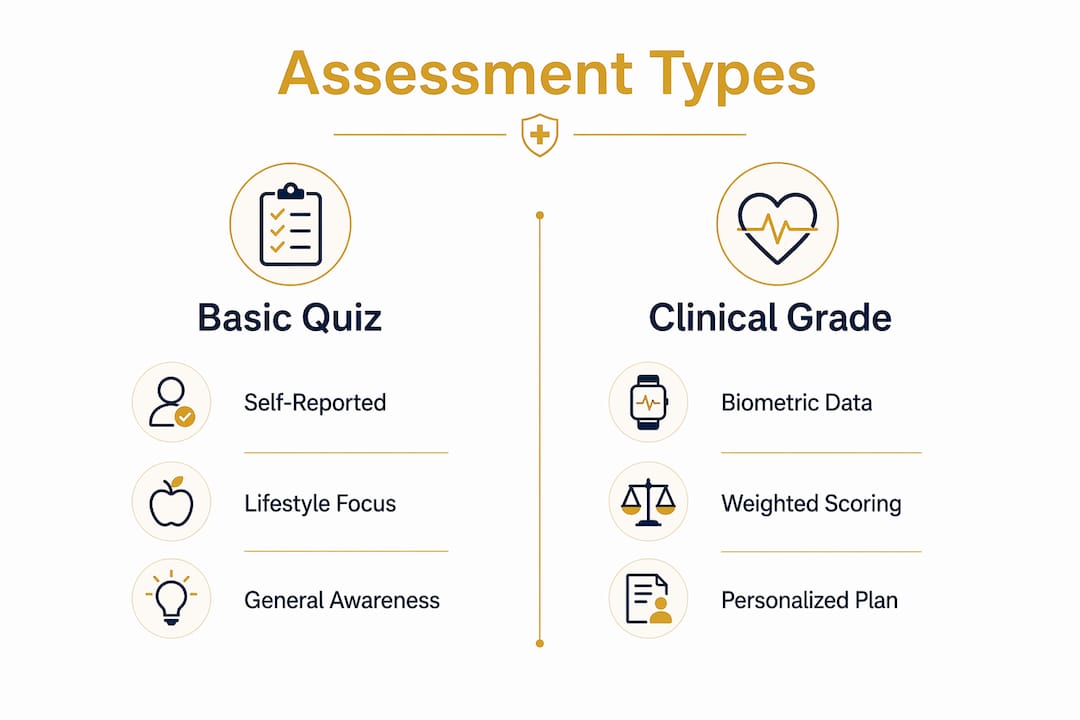
Basic quizzes work well for general awareness. They tell you that your sleep habits are poor or that your stress levels are elevated. Clinical-grade assessments do something more useful: they rank your health factors by impact. Tools that use weighted scoring systems assign higher priority to metrics like blood pressure and lipid levels, while treating sleep and stress as supportive factors. That hierarchy helps you focus your energy where it will produce the most measurable change.
The critical limitation applies to both types. Health scores are screening tools, not definitive medical diagnoses. A high-risk score on a cardiovascular screening item does not mean you have heart disease. It means that finding warrants a conversation with a physician. Confusing the two is the most common mistake people make with these tools.
Pro Tip: When comparing health assessment tools online, look for explicit statements about what the tool can and cannot diagnose. Any platform that presents its scores as medical diagnoses is overstepping its clinical role.
How assessment results guide your next health steps
The real value of an online health evaluation is what happens after you submit your answers. Assessments convert scattered health data into a ranked list of priorities, pointing you toward the interventions or tests most likely to move the needle on your health. They are designed to direct attention, not replace clinical judgment.
Here is how a well-structured follow-up process typically works:
- Review your priority list. Most clinical-grade platforms return a ranked output showing which health domains scored highest for risk or improvement potential. Start there, not with the lowest-priority items.
- Identify gaps in your data. If your assessment flagged metabolic health but you have not had a fasting glucose or HbA1c test in over a year, that is your first concrete action. Online assessments serve as the first step in a diagnostic chain that leads to lab work and clinical evaluation.
- Schedule a telehealth consultation. A physician reviewing your assessment output can contextualize your scores, order targeted lab work, and build a protocol around your specific numbers rather than general guidelines.
- Address lifestyle factors in parallel. While waiting for lab results, use the assessment's lifestyle findings to make immediate changes to sleep, nutrition, or exercise. These adjustments cost nothing and compound over time.
- Repeat the assessment at 90-day intervals. Tracking changes across multiple assessments shows whether your interventions are working. A single data point is a snapshot. A series of them is a trend.
One underappreciated benefit of the virtual format is disclosure comfort. Patients report greater comfort discussing sensitive topics like mental health struggles, substance use, or sexual health in online assessments compared to traditional waiting-room conversations. That comfort translates to more accurate data, which produces more relevant recommendations. You can learn more about structuring these follow-up steps in this guide to physician-supervised protocols for telehealth health optimization.
What privacy protections should you verify before using any platform?
Online health assessments collect some of the most sensitive data you will ever share digitally. Medical history, medication lists, mental health disclosures, and biometric measurements all carry real risk if mishandled. Choosing the wrong platform is not just an inconvenience. It can expose your data to insurers, employers, or third-party data brokers.
Before entering any personal health information, verify the following:
- HIPAA compliance or equivalent: In the United States, any platform handling protected health information must comply with HIPAA. Look for an explicit compliance statement, not just a general privacy policy. Selecting compliant platforms is the baseline requirement for protecting your medical and medication data.
- Data storage and retention policy: Find out where your data is stored, how long it is kept, and whether it is ever sold or shared with third parties. This information should be in plain language, not buried in legal terms.
- User control over data: You should be able to request deletion of your data. Platforms that do not offer this option are a red flag.
- Encryption standards: Data in transit and at rest should be encrypted. Look for mentions of TLS encryption and secure cloud storage in the platform's technical documentation.
- Third-party sharing disclosures: Some wellness platforms share de-identified data with research partners or advertisers. Even de-identified data carries risks when combined with other data sources.
For a deeper look at what to check when evaluating digital health platforms, the guide to safe weight management online covers the privacy considerations that apply across telehealth services.
Key takeaways
Online health assessments are screening tools that convert self-reported and biometric data into ranked health priorities, and their value depends entirely on what you do with the results.
| Point | Details |
|---|---|
| Definition is specific | An online health assessment is a structured digital survey covering six domains, not a general wellness quiz. |
| Clinical-grade adds precision | Platforms integrating lab data and biometrics produce prioritized, physician-relevant outputs rather than generic scores. |
| Results require follow-up | Assessment outputs are the start of a diagnostic chain, not a standalone conclusion. |
| Disclosure comfort matters | Virtual formats increase honest reporting on sensitive topics, improving data quality and recommendation relevance. |
| Privacy verification is non-negotiable | Always confirm HIPAA compliance, data retention policies, and third-party sharing before submitting health data. |
Why most people underuse their assessment results
Most adults who complete an online health evaluation read their results once and move on. That is the single biggest waste of a genuinely useful tool. I have seen this pattern repeatedly: someone gets a high-risk flag on metabolic health, feels briefly alarmed, and then does nothing because the result felt abstract without a physician to interpret it.
The fix is not complicated, but it requires a shift in how you think about these tools. An assessment result is not a verdict. It is a question the tool is asking you to answer with action. When I review assessment outputs, the most useful thing I do is ignore the low-priority items entirely and focus on the one or two factors with the highest weighted scores. Blood pressure and lipid levels consistently outrank sleep quality in terms of cardiovascular impact. If those are flagged, that is where your attention belongs.
The other mistake I see constantly is people completing assessments without recent lab data. Entering estimated values for fasting glucose or cholesterol produces recommendations calibrated to a fictional version of your health. Accurate, recent lab results are what separate a useful assessment from an expensive guessing game. Pull your numbers before you start.
Repeated assessments over time are where the real insight lives. A single assessment tells you where you are. Three assessments at 90-day intervals tell you whether your interventions are working, which is the only question that actually matters for long-term health. Use a tool like the health progress tracker to build that longitudinal picture.
— Roosevelt
Start your health optimization with Grownupmeds
Grownupmeds takes the data from your online health assessment and turns it into a physician-supervised action plan. The platform connects you with licensed physicians who review your assessment results, order targeted lab work, and build personalized protocols around your specific numbers. Services include peptide therapy for metabolic and recovery support, NAD therapy for cellular energy and longevity, and hormone optimization for adults managing age-related changes. Every protocol is backed by clinical oversight and fulfilled through US-based pharmacies. If your assessment flagged weight, hormones, or metabolic health, Grownupmeds provides the next step. Start your assessment today and get a clear picture of where your health stands.
FAQ
What is an online health assessment?
An online health assessment is a structured digital questionnaire that evaluates medical history, lifestyle habits, and symptoms across six health domains to identify risks and guide personalized care. It functions as a screening tool, not a medical diagnosis.
How long does an online health assessment take to complete?
Most online health assessments take between 3 and 15 minutes to complete, depending on the platform and the depth of questions included.
Can an online health assessment replace a doctor's visit?
No. Online health assessments are screening tools designed to direct you toward the right tests or consultations. They initiate the diagnostic process rather than replace clinical evaluation by a licensed physician.
What makes a clinical-grade assessment different from a basic quiz?
Clinical-grade assessments integrate biometric data like blood pressure and lab results, use weighted scoring to prioritize health factors by impact, and typically involve physician review. Basic quizzes rely solely on self-reported answers and return generic recommendations.
How do I know if an online health assessment platform is secure?
Look for explicit HIPAA compliance statements, clear data retention and deletion policies, and encryption disclosures. Any platform that does not publish these details in plain language should not receive your sensitive health data.