Setting health goals means defining clear, measurable, and actionable targets that guide your daily behavior and track progress toward improved wellness. Most people skip this definition and jump straight to motivation, which explains why 80% of health resolutions fail by mid-February. That failure rate is not about willpower. It is about strategy. The SMART framework and habit-stacking are the two most research-supported methods for learning how to set health goals that produce lasting results. Apply them correctly and you shift from wishful thinking to a repeatable system.
What tools and frameworks help with setting health goals?
The SMART framework is the most widely applied structure for setting achievable health goals. SMART stands for Specific, Measurable, Achievable, Relevant, and Time-bound. Each criterion removes a layer of vagueness that causes goals to collapse under pressure.
Here is what each element looks like in practice:
- Specific: "I will walk 30 minutes every morning" beats "I want to be more active."
- Measurable: Attach a number. Steps per day, pounds lost per month, glasses of water consumed.
- Achievable: The goal must stretch you without breaking you. A 5K run in 8 weeks is achievable for most beginners. A marathon in 4 weeks is not.
- Relevant: The goal must connect to something you genuinely care about, whether that is energy, longevity, or fitting into clothes you love.
- Time-bound: SMART goals with clear deadlines increase accountability and focus, which directly raises your success rate.
Beyond SMART, habit-stacking is the most practical tool for turning goals into daily behavior. Habit stacking anchors a new behavior to an existing one, which reduces the mental effort required to start. For example: "After I pour my morning coffee, I will take my supplements." The existing habit (coffee) becomes the trigger for the new one (supplements). This method works because it designs your environment to make the right choice the easy choice.
Tracking tools matter too. Apps like MyFitnessPal and Apple Health let you log food, movement, and sleep in one place. A paper journal or a goal card on your bathroom mirror works just as well for many people. The format is less important than the consistency of review.

Pro Tip: Write your top health goal on a 3x5 index card and read it every morning. This single habit keeps your brain primed to notice opportunities to act on it throughout the day.
| Tracking Method | Best For |
|---|---|
| MyFitnessPal | Nutrition and calorie tracking |
| Apple Health / Google Fit | Steps, heart rate, and activity data |
| Paper journal | Reflection, mood, and habit streaks |
| Goal card | Daily intention and mental focus |
How to create realistic and personalized health goals
Realistic health targets start with an honest audit of where you are right now. Before you set any fitness objective, measure your baseline. Auditing baseline fitness metrics under consistent conditions, such as the same time of day, the same equipment, and the same route, gives you numbers that reflect your true starting point rather than a good or bad day. Without a baseline, you cannot know whether you are improving.
Follow this process to build goals that fit your actual life:
- Measure your starting point. Record your resting heart rate, current weight, how far you can walk or run without stopping, and how many hours you sleep. These are your benchmarks.
- Identify your real motivation. Ask yourself why this goal matters. Internal motivation aligned with your values is more effective for long-term adherence than external pressure like a reunion or a deadline. "I want more energy to play with my kids" outlasts "I want to look good at a wedding."
- Separate short-term from long-term goals. Short-term fitness goals are defined as those with a timeframe of six months or less. Long-term goals extend beyond that. Both are necessary. Short-term goals build momentum; long-term goals provide direction.
- Set a rate of change that is clinically safe. For weight management specifically, clinical guidance recommends a gradual 1 to 2 pounds per week as a healthy and sustainable loss rate. Faster is not better. Faster usually triggers rebound.
- Consult a health provider before setting aggressive targets. If you have a chronic condition, are over 50, or have been sedentary for years, a physician or licensed health coach can help you set targets that challenge you safely.
Pro Tip: Break any goal that feels overwhelming into a version so small it seems almost too easy. "Exercise for 5 minutes" is a legitimate goal. Starting is the hardest part, and a tiny win builds the neural pathway for the next one.
What step-by-step process moves you from goal setting to action?
Writing a goal is not the same as executing one. The gap between intention and behavior is where most people stall. This process closes that gap.
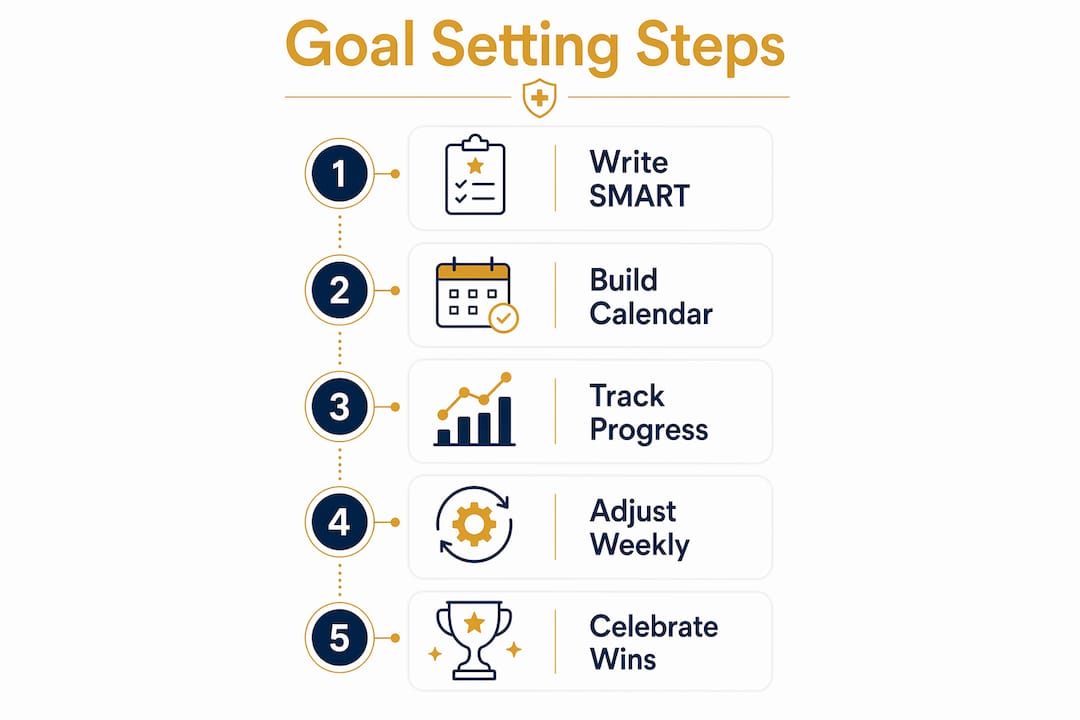
Step 1: Write your SMART statement. Be precise. "I will strength train three times per week for 45 minutes, starting Monday, for the next 12 weeks" is a SMART statement. "I want to get stronger" is not.
Step 2: Build a calendar with milestones. Map your 12-week goal backward. Identify what week 4, week 8, and week 12 should look like. Weekly milestones make a distant goal feel immediate and manageable.
Step 3: Track your key performance indicators visually. Visual progress tracking through charts, photos, and notes helps you celebrate achievements and sustain motivation. A simple spreadsheet with weekly weight, reps, or distance creates a visual record that makes progress undeniable.
Step 4: Stack your new habits onto existing ones. Identify two or three anchor behaviors you already do every day. Attach new health behaviors to them. Habit stacking and environment design create a path of least resistance for new habits, and consistency matters far more than intensity.
- Place your gym bag by the front door the night before.
- Set your water bottle on your desk before you open your laptop.
- Put your vitamins next to your coffee maker.
Step 5: Review and adjust weekly. Set a 10-minute weekly check-in with yourself. Ask: What worked? What did not? What needs to change? Flexibility is not failure. It is smart planning.
Pro Tip: Celebrate every win, no matter how small. Finished your workout on a day you did not want to? That counts. Acknowledging progress reinforces the identity of someone who follows through.
How do you troubleshoot motivation dips and stay on track?
Motivation is not a constant. It fluctuates with sleep, stress, seasons, and life events. Treating motivation as a prerequisite for action is the most common reason people quit.
The more reliable strategy is to reduce the size of the required action until motivation is irrelevant. Brief, achievable actions like 10 squats or a 5-minute walk build successful habits more effectively than rigid, intense goals that require peak motivation every day. The goal is to keep the streak alive, not to perform perfectly.
When you miss a day, treat it as data rather than a verdict on your character. Treating missed workout days as data points rather than failures helps maintain motivation and long-term consistency. Ask: Was I under-slept? Overscheduled? Was the goal too aggressive for this season of life? Adjust accordingly.
"The goal is not perfection. The goal is a pattern."
A few strategies that work when motivation drops:
- Change the environment. A new walking route, a different gym, or an outdoor workout can reset your energy.
- Find an accountability partner. Telling one person your goal doubles the social pressure to follow through.
- Return to your "why." Re-read the motivation you identified in your baseline audit. Reconnecting with your reason often reignites the drive.
- Lower the bar temporarily. A 10-minute workout is infinitely better than no workout. Protect the habit even when you cannot protect the intensity.
Pro Tip: Schedule your next workout before you finish the current one. Decision fatigue is real. Removing the "when will I work out?" question eliminates one more barrier between you and action.
Key takeaways
Setting health goals works when you combine a structured framework with honest self-assessment, consistent tracking, and the flexibility to adjust without quitting.
| Point | Details |
|---|---|
| Start with a baseline audit | Measure current metrics under consistent conditions before setting any target. |
| Use the SMART framework | Goals must be Specific, Measurable, Achievable, Relevant, and Time-bound to drive real results. |
| Stack habits onto existing ones | Anchor new behaviors to daily routines to reduce friction and build consistency. |
| Track progress visually | Charts, photos, and notes make improvement visible and reinforce continued effort. |
| Treat setbacks as data | Missed days are information, not failure. Adjust the plan and keep moving. |
What I have learned from watching people set health goals
I have spent years reading research on behavior change and watching real people succeed and fail at health goals. The pattern is consistent. The people who succeed are not more disciplined. They are more flexible.
The biggest mistake I see is treating a health goal like a contract with no renegotiation clause. Life changes. A goal set in January may not fit your life in March. That is not weakness. That is reality. The people who adjust their goals without abandoning them entirely are the ones who still have results by December.
Small, consistent habits beat intense, unsustainable efforts every time. A 20-minute walk six days a week produces more long-term cardiovascular benefit than two brutal 90-minute sessions followed by a week of soreness and avoidance. The science on this is not ambiguous.
The other thing I would tell anyone starting this process: your motivation will not always come from excitement. Sometimes it comes from identity. Decide who you are, not just what you want to do. "I am someone who moves every day" is a more durable foundation than "I want to lose 15 pounds." Goals rooted in internal motivation and personal values outlast goals rooted in external pressure, every single time.
Be patient with yourself. Progress is rarely linear. But if you keep showing up, even imperfectly, you will look back in six months and not recognize the person you used to be.
— Roosevelt
How Grownupmeds supports your health optimization goals
Setting goals is the foundation. Having the right clinical support accelerates everything built on top of it.

Grownupmeds is a physician-supervised telehealth platform designed for adults who want science-backed support for weight management, metabolic health, and longevity. If your goals include body composition, energy, or recovery, Grownupmeds connects you with licensed physicians who build personalized protocols around your specific baseline. Services include peptide therapy for recovery and body composition, NAD therapy for cellular energy and vitality, and a personalized health assessment that maps your starting point to the right treatment plan. Every protocol is delivered through US-based pharmacies with full physician oversight. Your goals deserve more than a generic plan.
FAQ
What does "setting achievable health goals" actually mean?
Setting achievable health goals means defining targets that are challenging but realistic given your current fitness level, schedule, and health status. The SMART framework is the most reliable structure for testing whether a goal meets that standard.
How do I track health progress effectively?
Track one to three key metrics consistently, such as weight, steps, or workout frequency, using a tool like MyFitnessPal, Apple Health, or a paper journal. Visual records like weekly charts make progress concrete and motivating.
What are realistic health targets for weight loss?
Clinical guidelines recommend a gradual 1 to 2 pounds per week as a safe and sustainable weight loss rate. Faster rates typically lead to muscle loss and rebound weight gain.
How long should a short-term fitness goal take?
Short-term fitness goals are defined as those completed within six months or less. Goals beyond that timeframe are considered long-term and should be broken into shorter milestones to maintain focus and momentum.
What should I do when I lose motivation?
Reduce the size of the required action to something so small it requires almost no motivation, such as a 5-minute walk or 10 bodyweight squats. Keeping the habit alive at a lower intensity is more effective than stopping entirely and restarting later.